A well-made timber front should still look good in Lowestoft long after the first coat of paint has gone. That comes from choosing a durable timber, sealing the end grain and keeping water away from the bottom of every member.
It helps if you can be there when we visit Lowestoft, since five minutes walking the frontage together answers more than a long email.
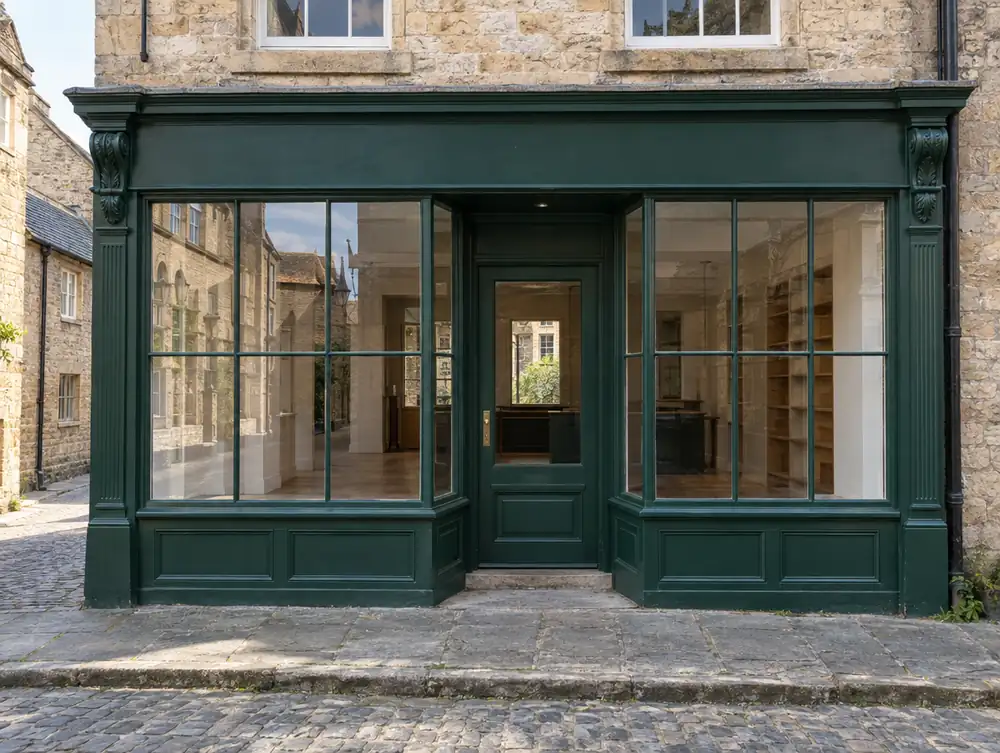
What should you think about before commissioning timber shopfronts in Lowestoft?
Narrow units suit timber well, because mouldings add interest where there's little width to work with. On a slim Lowestoft frontage we'd keep one strong pane, a panelled door and a fascia that doesn't crowd them.
Timber fits a night programme better than you'd think, since most of the joinery is made elsewhere. For a unit in Lowestoft that can't close by day, we'd fit the frame in stages at night and leave painting until the end, once the dust has gone.
Where the footway outside your Lowestoft premises is narrow, a recessed entrance earns its keep. It gives people a dry place to pause out of the walkway, and it adds a longer run of display glass either side of the door.
What is a realistic budget for timber shopfronts in Lowestoft?
We would budget £3,995 to £13,995 plus VAT for a typical frontage. Scope sets most of the figure, so a clear brief at the start does more for the budget than any later change of detail.
Who approves timber shopfronts in Lowestoft?
For timber shopfronts at premises in the Lowestoft area, the deciding question in England is whether the building work materially affects the external appearance. If it does, planning permission is needed, while a true like-for-like replacement usually needs none. The council confirms the position for each site.
Expect planning and advert applications here to go to East Suffolk Council in the normal way. We check what that means for your building when we survey it in Lowestoft.
| Town | Lowestoft |
|---|---|
| Area | Suffolk |
| Postcode districts | NR32, NR33 |
| Planning authority | East Suffolk Council |
| Building approval | Building Regulations (Approved Documents) |
| Distance from Great Barr | About 154 miles |
| Survey | Free for new work |
Questions about timber shopfronts in Lowestoft
Will timber suffer on my Lowestoft frontage if it gets a lot of rain?
Not if the details are right. Sloped cills, sealed end grain and plinth blocks keep water moving, and the paint system then only has to deal with the weather, not trapped damp.
How much disruption will a timber front cause in my Lowestoft shop?
Expect more time on site than an aluminium front, typically 3 to 7 days with the painting. Closed-day or out-of-hours fitting can be arranged, and the opening stays boarded and secure between stages.
Is timber a sensible choice for my Lowestoft frontage?
Usually, if you're happy with a repaint every 5 to 7 years. A survey shows how exposed the front is and whether the structure behind it is sound, and we'll tell you if aluminium would serve you better.
What rules apply to a fire exit door through a shopfront in the Lowestoft area?
It must open in the direction of escape and can't be locked against immediate use, and a dedicated fire exit can't be a sliding or revolving door. In England that comes from article 14(2) of the Regulatory Reform (Fire Safety) Order 2005, and the duty sits with the responsible person, normally the employer or whoever controls the premises for a business, otherwise the owner. An outward door can clash with section 153 of the Highways Act 1980 where it opens onto the footway, so raise it early.
Does a new shopfront in the Lowestoft area need Building Regulations approval?
Assume yes until building control says otherwise. England has no like-for-like exemption, though registered installers can self-certify replacement windows and doors in non-dwellings. That route doesn't cover structural glass, curtain walling or revolving doors.