Opening premises in Southend-on-Sea usually means a new fascia with a date attached. Manufacture typically takes 2 to 4 weeks from approved artwork, and fitting can be arranged around your opening plans.
Nothing gets ordered off the back of a survey in Southend-on-Sea, because its job is to give us the numbers to draw and price from.
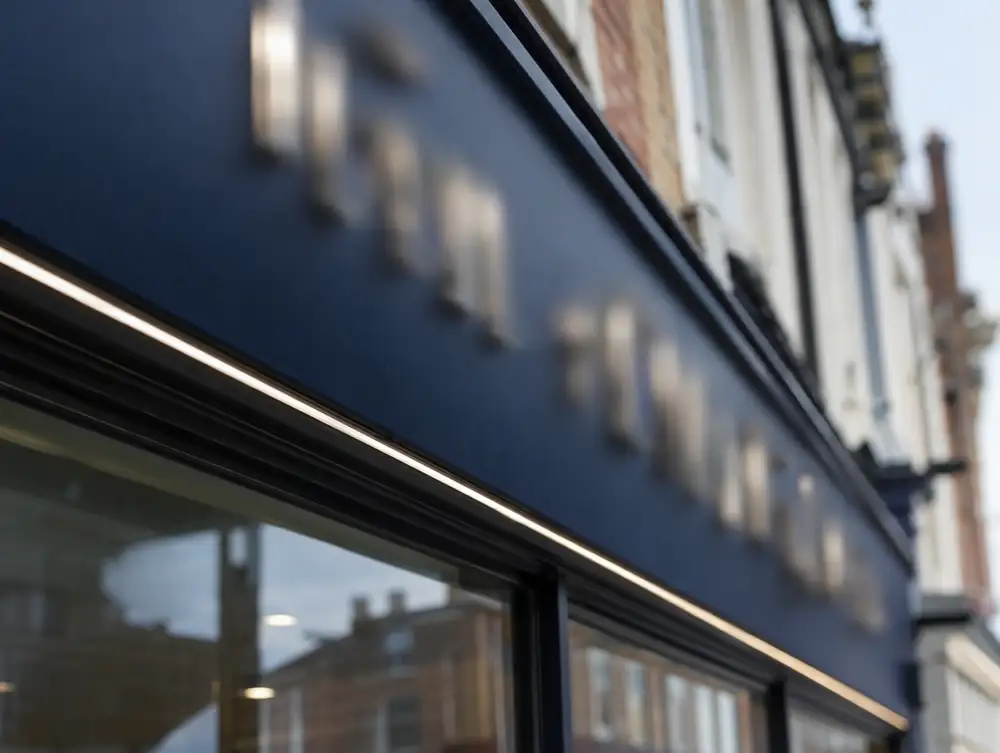
What goes into getting fascia signage right in Southend-on-Sea?
On a corner plot, the sign has to turn the corner cleanly. We set letter size and panel joints so the name reads from both streets, with the return falling at a natural break.
For brands with strict guidelines, we turn logo artwork into cut files and check the smallest details at full size. If a thin stroke will not survive in metal, we suggest a small change before anything is made.
If the pavement falls across your frontage, let the stallriser take up the slope and keep the glass line dead level. The eye reads the long horizontal, so Southend-on-Sea premises on a slope look settled once that line is true.
How much could fascia signage in Southend-on-Sea cost you?
Guide price: £395 to £1,995 plus VAT per sign. Materials, finish and the amount of drawing and coordination involved all move it, and your itemised quotation shows where the money goes on fascia signage.
Which applications might fascia signage in Southend-on-Sea involve?
A true like-for-like replacement usually needs no planning permission in England, because the external appearance isn't materially affected. New materials, a different glass line or altered proportions usually do count as material, so for fascia signage at premises in the Southend-on-Sea area, an application is then likely. The council confirms which side of that line a job falls on.
Lighting moves a sign out of Class 5 in England, because that class allows illumination only for medical-type notices. Class 4B then applies at premises in the Southend-on-Sea area: halo or character-only lighting, static, with the lowest part at least 2.5m up. Brightness is capped at 600 cd/m² on signs up to 10m² and 300 cd/m² above that, and anything outside these limits needs advertisement consent.
At survey we check how things stand for your building, although applications for planning permission or advertisement consent here normally go to Southend-on-Sea Borough Council.
| Town | Southend-on-Sea |
|---|---|
| Area | Essex |
| Postcode districts | SS0, SS1, SS2, SS9 |
| Planning authority | Southend-on-Sea Borough Council |
| Building approval | Building Regulations (Approved Documents) |
| Distance from Great Barr | About 132 miles |
| Survey | Free for new work |
Questions about fascia signage in Southend-on-Sea
Can a sign match my other sites in Essex?
Yes. Send a photograph and the drawings or brand file from an existing site, and we match the letter style, finish and colour reference. Fascia depth may differ, so the size is adjusted to keep the proportions right.
Can a fascia sign in Southend-on-Sea be lit later on?
Yes, if the sign is planned for it. Built-up letters can take halo lighting when the panel and cable route are prepared at the start, which costs far less than adapting them afterwards.
What artwork do you need for a sign in Southend-on-Sea?
Vector files such as AI, EPS or PDF are ideal, along with any brand guidelines. If you only have a low-resolution logo, it can be redrawn, and that time is shown on the quotation.
Does a new shopfront in the Southend-on-Sea area need Building Regulations approval?
Assume yes until building control says otherwise. England has no like-for-like exemption, though registered installers can self-certify replacement windows and doors in non-dwellings. That route doesn't cover structural glass, curtain walling or revolving doors.
What rules apply to a fire exit door through a shopfront in the Southend-on-Sea area?
It must open in the direction of escape and can't be locked against immediate use, and a dedicated fire exit can't be a sliding or revolving door. In England that comes from article 14(2) of the Regulatory Reform (Fire Safety) Order 2005, and the duty sits with the responsible person, normally the employer or whoever controls the premises for a business, otherwise the owner. An outward door can clash with section 153 of the Highways Act 1980 where it opens onto the footway, so raise it early.