We design, make and fit fascia signage in Viewpark and across Lanarkshire, as one job under one contract. Removal of the old sign, repairs behind it and the new sign all sit on one itemised quotation.
It helps if you can be there when we visit Viewpark, since five minutes walking the frontage together answers more than a long email.
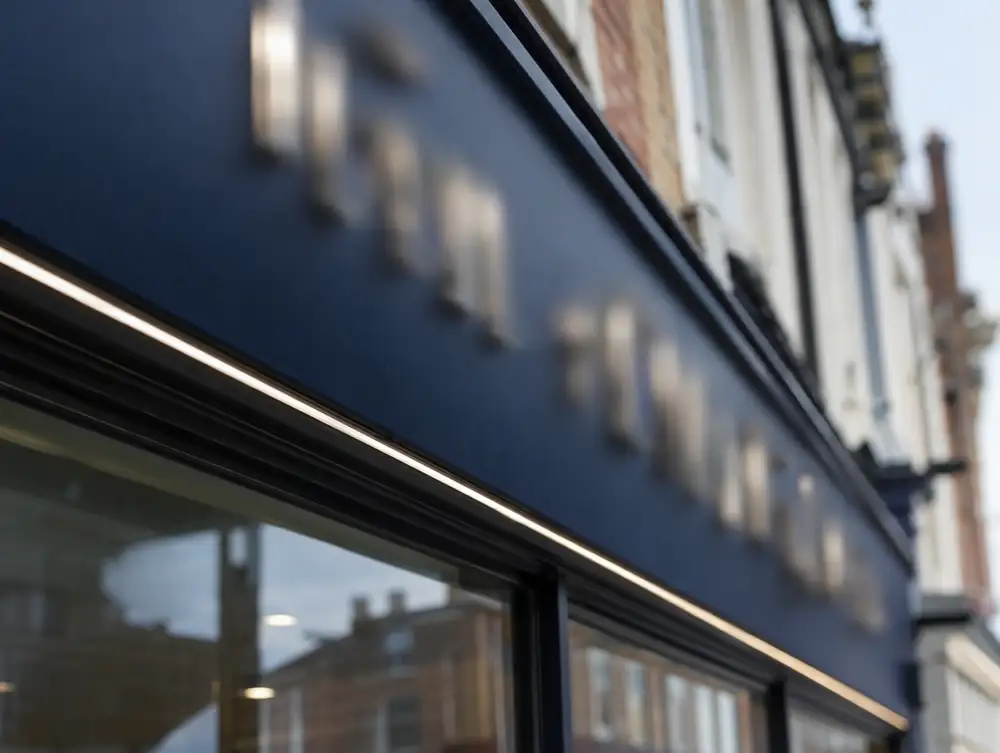
What makes fascia signage work well on Viewpark premises?
A deep fascia above a low shopfront can often be reduced on the drawing board. If your Viewpark premises have one, we would show you a slimmer panel option, with the ceiling line behind it adjusted to suit.
Where a shutter box sits above the window, the sign has to be designed around it. We either house the box behind the fascia or adjust the panel, so nothing sits awkwardly proud of the frontage.
Where units share one long run of fascia, breaking the height makes you stand out for the wrong reason. If that describes your Viewpark parade, keep the line and win attention with lettering, lighting and what's in the window.
How much should you set aside for fascia signage in Viewpark?
As a working budget, use £395 to £1,995 plus VAT per sign. Your place inside that range for fascia signage depends mostly on how much of the existing frontage can stay and how much has to be put right first.
Could fascia signage in Viewpark need planning permission?
Shutters aren't named in Class 9A, so in Scotland they usually fall to the appearance test. The same goes for fascia signage at premises in the Viewpark area: building work that materially affects the external appearance needs planning permission, and a true like-for-like usually doesn't. Ask the council to confirm the position for your site.
The 0.25m projection limit in Class VI means most lit projecting signs in Scotland fall outside it. One at premises in the Viewpark area will usually need advertisement consent, so allow for an application in the programme.
For Viewpark, the usual route for planning and advert applications is through North Lanarkshire Council, and we confirm that when we visit.
| Town | Viewpark |
|---|---|
| Area | Lanarkshire |
| Postcode districts | G71, G72, ML4, ML5 |
| Planning authority | North Lanarkshire Council |
| Building approval | Building warrant (Technical Handbook) |
| Distance from Great Barr | About 243 miles |
| Survey | Free for new work |
Does North Lanarkshire Council publish shopfront guidance?
Yes, Shopfronts & Security (2011). It tells applicants what the council expects from new and altered shopfronts. A few of the things it asks for:
- Original stallrisers should be retained or reinstated, and new ones should be 450mm to 700mm high.
- Fascias should be horizontally proportioned and roughly 300mm to 450mm high.
- Demountable grilles are preferred, and externally stored roller shutters carry a high risk of refusal.
Questions about fascia signage in Viewpark
What if the fascia behind my old sign in Viewpark is rotten?
We show you photographs and price the repair before going further. A short section of timber can often be spliced in, while a badly decayed fascia is better replaced with a new subframe.
Can a new fascia sign in Viewpark be fitted on a closed day?
Yes, we can arrange that, or fit out of hours if that suits you better. Most fascia signs take about a day, so the work can often go into your quietest trading hours.
How quickly can I see a drawing for my Viewpark sign?
Drawings typically follow within one to two weeks of the survey, depending on the artwork and how many options you want to see. Your named contact will give you a date once the survey is booked.
Do I need a building warrant for a shopfront in the Viewpark area?
Usually yes in Scotland, if the work alters a wall or structure. Schedule 3 of the Building (Scotland) Regulations 2004 lists some work that needs no warrant, such as replacing a door or window with its frame, but the standards still apply. Shopfronts aren't named there, so ask the council before relying on it.
Does the Equality Act cover a shop entrance in the Viewpark area?
Yes. The Equality Act 2010 applies in Scotland as part of Great Britain, and its anticipatory duty expects reasonable steps to remove, alter or avoid physical features that disadvantage disabled people generally. BS 8300-2:2018 is the current British Standard for accessible buildings.