Opening premises in Westhoughton usually means a new fascia with a date attached. Manufacture typically takes 2 to 4 weeks from approved artwork, and fitting can be arranged around your opening plans.
A survey in Westhoughton usually starts outside, looking at the whole elevation before any tape comes out, because the frontage has to answer the building above it.
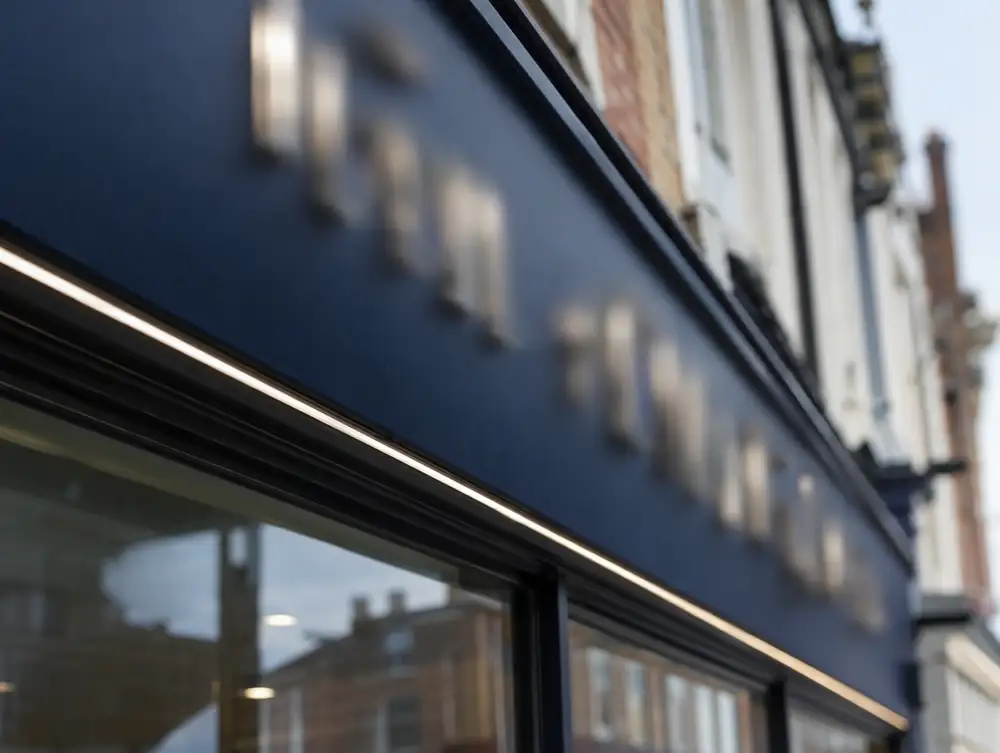
How would we approach fascia signage for your Westhoughton premises?
If your Westhoughton unit sits in a parade of similar shops, we would look at the fascia line on either side before setting your sign height. Holding that line usually looks more confident than trying to outgrow it.
A deep fascia above a low shopfront can often be reduced on the drawing board. If your Westhoughton premises have one, we would show you a slimmer panel option, with the ceiling line behind it adjusted to suit.
A corner unit has two fronts to think about, and the return elevation often does as much selling as the main one. If that is your layout in Westhoughton, carry the fascia and glass line round the corner and treat both faces as one composition.
What should you budget for fascia signage in Westhoughton?
Allow £395 to £1,995 plus VAT per sign. Size and specification set most of that figure for fascia signage, and the rest depends on what the survey finds on site.
What consents could affect fascia signage in Westhoughton?
A true like-for-like replacement usually needs no planning permission in England, because the external appearance isn't materially affected. New materials, a different glass line or altered proportions usually do count as material, so for fascia signage at premises in the Westhoughton area, an application is then likely. The council confirms which side of that line a job falls on.
In England, signs at premises in the Westhoughton area come under the 2007 Advertisement Regulations. An unlit fascia sign generally needs no application under Class 5 of Schedule 3 if it sits on a wall containing a shop window, tops out at 4.6m or the first-floor sill if that is lower, and keeps letters to 0.75m high. Displaying a sign without the consent it needs is a criminal offence, so check before it goes up.
Expect planning and advert applications here to go to Bolton Metropolitan Borough Council in the normal way. We check what that means for your building when we survey it in Westhoughton.
| Town | Westhoughton |
|---|---|
| Area | Greater Manchester |
| Postcode districts | BL5 |
| Planning authority | Bolton Metropolitan Borough Council |
| Building approval | Building Regulations (Approved Documents) |
| Distance from Great Barr | About 74 miles |
| Survey | Free for new work |
Questions about fascia signage in Westhoughton
What artwork do you need for a sign in Westhoughton?
Vector files such as AI, EPS or PDF are ideal, along with any brand guidelines. If you only have a low-resolution logo, it can be redrawn, and that time is shown on the quotation.
Can a sign match my other sites in Greater Manchester?
Yes. Send a photograph and the drawings or brand file from an existing site, and we match the letter style, finish and colour reference. Fascia depth may differ, so the size is adjusted to keep the proportions right.
What if the fascia behind my old sign in Westhoughton is rotten?
We show you photographs and price the repair before going further. A short section of timber can often be spliced in, while a badly decayed fascia is better replaced with a new subframe.
Does a shop sign in the Westhoughton area need advertisement consent?
Not always. In England, an unlit sign within Class 5 of the 2007 Advertisement Regulations generally needs no application, and neither does a lit sign within Class 4B. Anything outside those classes needs consent, and Class 4B isn't available in conservation areas, so check before ordering.
Does the Equality Act apply to a shop entrance in the Westhoughton area?
Yes. The Equality Act 2010 applies in England, as across Great Britain, and it requires reasonable steps to remove, alter or avoid physical features that disadvantage disabled people. The duty is anticipatory, so it looks at disabled people generally, and a new Services Code replaced the 2011 Code on 5 August 2026.