Built-up letters, flat-cut metal or hand-painted timber can each work on fascias in Atherton, depending on the frontage and the brand. A scale drawing of the sign on your elevation makes the choice easy to judge.
Measuring the opening is the easy part of a survey in Atherton. We also look at the beam above, the pavement fall and any meters or drains nearby.
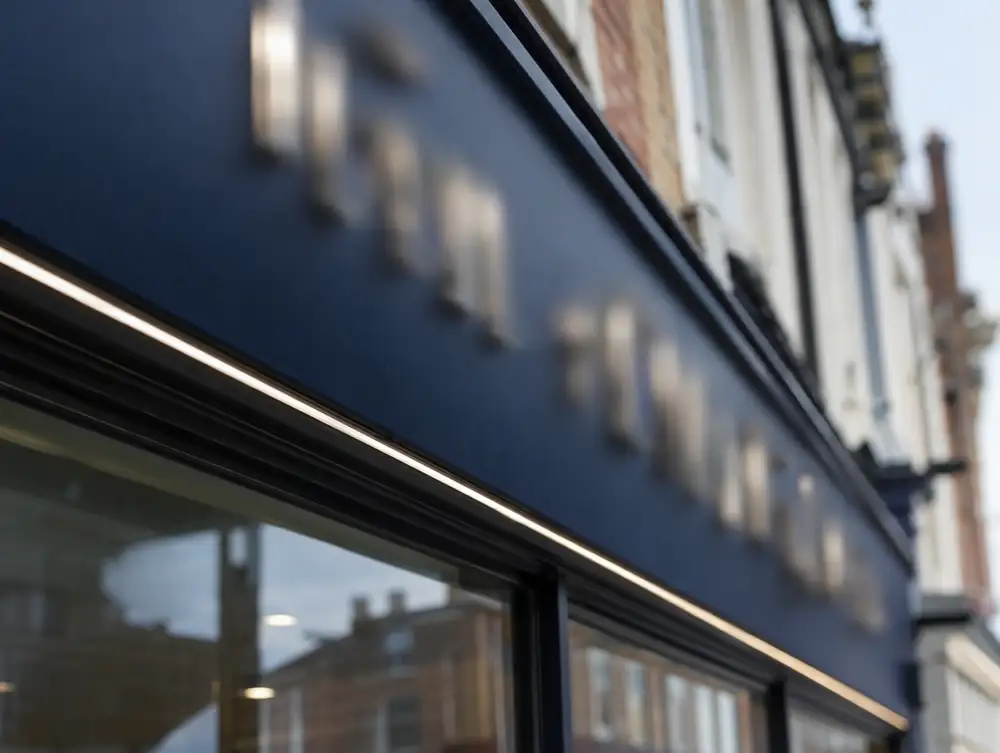
What should you think about before commissioning fascia signage in Atherton?
Where the fascia on your Atherton premises has been overclad, we lift a sample at survey to see what is underneath. Original timber, cornice mouldings or tile may be worth keeping, and they change what the new sign should be.
If your Atherton unit sits in a parade of similar shops, we would look at the fascia line on either side before setting your sign height. Holding that line usually looks more confident than trying to outgrow it.
Where the building has good brick or stone around the opening, set the frame back in the reveal so the masonry can be seen. On Atherton premises with a flat elevation, that deep reveal throws a shadow line that adds real depth in low sun.
Who approves fascia signage in Atherton?
A true like-for-like replacement usually needs no planning permission in England, because the external appearance isn't materially affected. New materials, a different glass line or altered proportions usually do count as material, so for fascia signage at premises in the Atherton area, an application is then likely. The council confirms which side of that line a job falls on.
Class 4B, England's class for lit signs, isn't available in conservation areas, Areas of Outstanding Natural Beauty, National Parks or the Broads, so a lit sign there normally needs advertisement consent. In an area of special control it is unavailable too, and Class 5 drops to a 3.6m top height, 0.3m letters and one-tenth of the building face up to 3.6m. Ask the council which designations cover premises in the Atherton area.
We confirm the position at survey, because a boundary or a special designation can change who handles the file, but applications from Atherton premises normally go to Wigan Metropolitan Borough Council.
What is a realistic budget for fascia signage in Atherton?
Until the survey is done, plan on £395 to £1,995 plus VAT per sign. Unusual sizes, fine detail and phased working push the figure up, while a simple brief and clear access keep it toward the lower end.
| Town | Atherton |
|---|---|
| Area | Greater Manchester |
| Postcode districts | BL5, M29, M46, WN7 |
| Planning authority | Wigan Metropolitan Borough Council |
| Building approval | Building Regulations (Approved Documents) |
| Distance from Great Barr | About 72 miles |
| Survey | Free for new work |
Questions about fascia signage in Atherton
Can a sign match my other sites in Greater Manchester?
Yes. Send a photograph and the drawings or brand file from an existing site, and we match the letter style, finish and colour reference. Fascia depth may differ, so the size is adjusted to keep the proportions right.
Will a new sign suit the rest of my Atherton frontage?
That is what the scale drawing is for. We draw the sign on your actual elevation with door, windows and stallriser in place, so you can judge colour and proportion together.
Can a fascia sign in Atherton be lit later on?
Yes, if the sign is planned for it. Built-up letters can take halo lighting when the panel and cable route are prepared at the start, which costs far less than adapting them afterwards.
Do I need planning permission to change a shopfront in the Atherton area?
Usually yes, if the work materially affects the building's external appearance. England's shop permitted development rights exclude creating, altering or replacing a shopfront, so there is no shortcut. A true like-for-like replacement usually needs no application, and the council confirms the position.
Does a new shopfront in the Atherton area need Building Regulations approval?
Assume yes until building control says otherwise. England has no like-for-like exemption, though registered installers can self-certify replacement windows and doors in non-dwellings. That route doesn't cover structural glass, curtain walling or revolving doors.