Good fascia signs are mostly a matter of spacing. For Woolwich premises we set letter height, margins and alignment from the door and window lines below.
Bring whatever you have to the survey in Woolwich: brand guidelines, lease plans, old drawings or a photo of a frontage you admire.
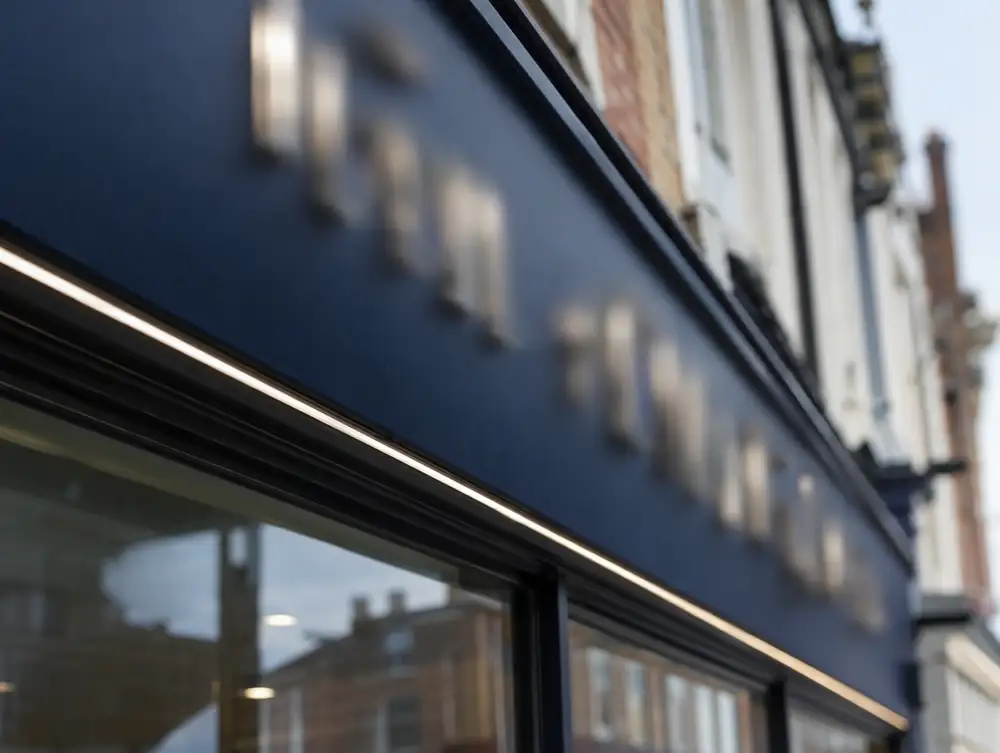
What makes fascia signage work well on Woolwich premises?
Where a shutter box sits above the window, the sign has to be designed around it. We either house the box behind the fascia or adjust the panel, so nothing sits awkwardly proud of the frontage.
If your Woolwich unit sits in a parade of similar shops, we would look at the fascia line on either side before setting your sign height. Holding that line usually looks more confident than trying to outgrow it.
Where the building has good brick or stone around the opening, set the frame back in the reveal so the masonry can be seen. On Woolwich premises with a flat elevation, that deep reveal throws a shadow line that adds real depth in low sun.
Could fascia signage in Woolwich need planning permission?
England has no permitted development route for changing a shopfront. Part 7 Class A of the General Permitted Development Order 2015 excludes creating, altering or replacing one, and it allows no alterations at all on article 2(3) land. That leaves two outcomes for fascia signage at premises in the Woolwich area: a planning application, or work that doesn't materially affect the external appearance.
Class 4B, England's class for lit signs, isn't available in conservation areas, Areas of Outstanding Natural Beauty, National Parks or the Broads, so a lit sign there normally needs advertisement consent. In an area of special control it is unavailable too, and Class 5 drops to a 3.6m top height, 0.3m letters and one-tenth of the building face up to 3.6m. Ask the council which designations cover premises in the Woolwich area.
We confirm the position at survey, because a boundary or a special designation can change who handles the file, but applications from Woolwich premises normally go to Royal Borough of Greenwich.
How much should you set aside for fascia signage in Woolwich?
Until the survey is done, plan on £395 to £1,995 plus VAT per sign. Unusual sizes, fine detail and phased working push the figure up, while a simple brief and clear access keep it toward the lower end.
| Town | Woolwich |
|---|---|
| Area | Greater London |
| Postcode districts | SE18 |
| Planning authority | Royal Borough of Greenwich |
| Building approval | Building Regulations (Approved Documents) |
| Distance from Great Barr | About 111 miles |
| Survey | Free for new work |
Questions about fascia signage in Woolwich
What if the fascia behind my old sign in Woolwich is rotten?
We show you photographs and price the repair before going further. A short section of timber can often be spliced in, while a badly decayed fascia is better replaced with a new subframe.
Will you remove the old sign from my Woolwich premises?
Yes. Taking down the old sign, clearing old fixings and making good are included in the itemised quotation. We tell you what we find behind it before going further.
What artwork do you need for a sign in Woolwich?
Vector files such as AI, EPS or PDF are ideal, along with any brand guidelines. If you only have a low-resolution logo, it can be redrawn, and that time is shown on the quotation.
Does a shop sign in the Woolwich area need advertisement consent?
Not always. In England, an unlit sign within Class 5 of the 2007 Advertisement Regulations generally needs no application, and neither does a lit sign within Class 4B. Anything outside those classes needs consent, and Class 4B isn't available in conservation areas, so check before ordering.
What rules apply to a fire exit door through a shopfront in the Woolwich area?
It must open in the direction of escape and can't be locked against immediate use, and a dedicated fire exit can't be a sliding or revolving door. In England that comes from article 14(2) of the Regulatory Reform (Fire Safety) Order 2005, and the duty sits with the responsible person, normally the employer or whoever controls the premises for a business, otherwise the owner. An outward door can clash with section 153 of the Highways Act 1980 where it opens onto the footway, so raise it early.