Built-up letters, flat-cut metal or hand-painted timber can each work on fascias in Wrexham, depending on the frontage and the brand. A scale drawing of the sign on your elevation makes the choice easy to judge.
Measuring the opening is the easy part of a survey in Wrexham. We also look at the beam above, the pavement fall and any meters or drains nearby.
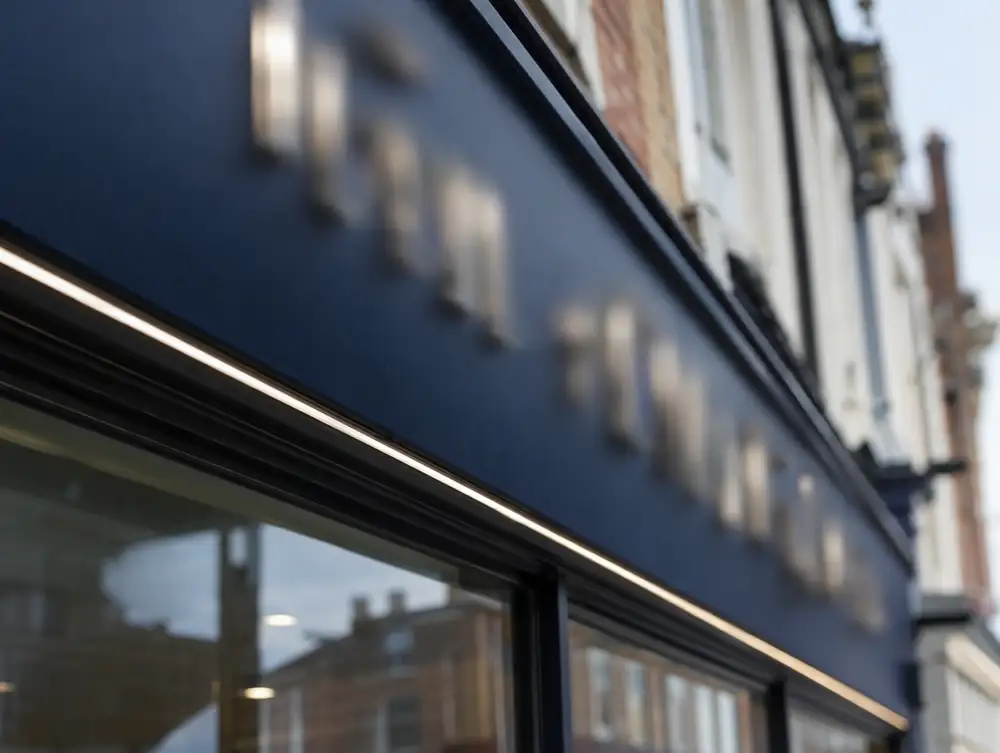
How would we approach fascia signage for your Wrexham premises?
On a corner plot, the sign has to turn the corner cleanly. We set letter size and panel joints so the name reads from both streets, with the return falling at a natural break.
If your Wrexham unit sits in a parade of similar shops, we would look at the fascia line on either side before setting your sign height. Holding that line usually looks more confident than trying to outgrow it.
If your premises were once two shops, decide early whether the front should read as one or as two. One continuous fascia with a repeated bay width usually settles the elevation better than two mismatched halves, which is worth testing on any Wrexham unit of that kind.
What should you budget for fascia signage in Wrexham?
Our guide band is £395 to £1,995 plus VAT per sign. Scope is the biggest lever, so a tighter brief for fascia signage brings the figure down faster than any change of detail.
What consents could affect fascia signage in Wrexham?
Going by Part 42 of the 1995 Order as inserted in 2014, Wales has no permitted development route for changing a shopfront. The right covers A1 and A2 premises, but it excludes creating, altering or replacing a shopfront, or fitting or replacing a security grill or shutter on one, and it doesn't apply on Article 1(5) land. For fascia signage at premises in the Wrexham area, that leaves a planning application, or work that leaves the appearance materially unchanged.
Class 4B isn't available in Welsh conservation areas, so a lit sign there normally needs advertisement consent. In an area of special control, Class 5 tightens to a 3.6m top height and a one-tenth area limit. Ask the council whether either applies to premises in the Wrexham area.
Wrexham applications for planning permission or advertisement consent are normally handled by Wrexham County Borough Council. Our survey includes a check of the position for your address.
| Town | Wrexham |
|---|---|
| Area | Clwyd |
| Postcode districts | LL11, LL12, LL13 |
| Planning authority | Wrexham County Borough Council |
| Building approval | Building Regulations (Approved Documents for Wales) |
| Distance from Great Barr | About 57 miles |
| Survey | Free for new work |
Questions about fascia signage in Wrexham
Will a new sign suit the rest of my Wrexham frontage?
That is what the scale drawing is for. We draw the sign on your actual elevation with door, windows and stallriser in place, so you can judge colour and proportion together.
Can a fascia sign in Wrexham be lit later on?
Yes, if the sign is planned for it. Built-up letters can take halo lighting when the panel and cable route are prepared at the start, which costs far less than adapting them afterwards.
Can a new fascia sign in Wrexham be fitted on a closed day?
Yes, we can arrange that, or fit out of hours if that suits you better. Most fascia signs take about a day, so the work can often go into your quietest trading hours.
Does a replacement shopfront in the Wrexham area need Building Regulations approval?
Assume yes until building control says otherwise, because Wales has no like-for-like exemption. Glazing is judged against Approved Document N, as Wales keeps Part N. A registered installer can self-certify replacement windows and doors in non-dwellings, but not structural glass, curtain walling or revolving doors.
Can a shop fire exit in the Wrexham area use a sliding door?
No, a dedicated fire exit can't be a sliding or revolving door. In Wales, article 14(2) of the Regulatory Reform (Fire Safety) Order 2005 also says fire exit doors must open in the direction of escape and can't be locked against immediate use. The responsible person holds that duty, normally the employer or whoever controls the premises for a business, otherwise the owner.