Restoring an old front in Sandy means keeping the character and solving the modern problems. Door gear, lighting, security and cleaning all have to work without showing from the street.
Expect us to measure the opening, photograph the existing front and check how materials will reach it on the day, at a time you have agreed.
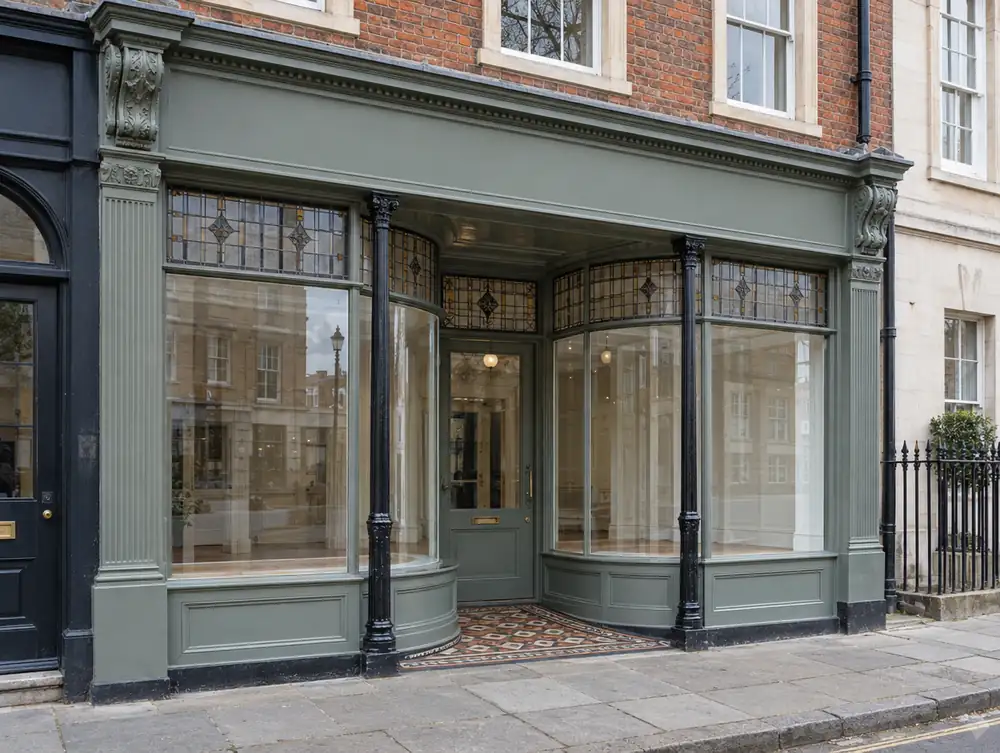
What should you think about before commissioning heritage shopfronts in Sandy?
In a parade of matching period fronts in Sandy, your neighbours are the pattern book. If their pilasters or cornices survive, we'd copy those sizes so your unit rejoins the row.
A narrow period front relies on fine detail. For a slim Sandy unit we'd keep the bars thin and the mouldings small, because anything oversized on a small front looks like a later addition.
If you trade after dark in Sandy, the view in matters more than the sign. A warm, evenly lit interior with light on the back wall will usually do more than a brighter fascia, because it gives the eye somewhere to go.
What is a realistic budget for heritage shopfronts in Sandy?
We would budget £8,495 to £24,995 plus VAT for a typical frontage. Scope sets most of the figure, so a clear brief at the start does more for the budget than any later change of detail.
Who approves heritage shopfronts in Sandy?
For heritage shopfronts at premises in the Sandy area, the deciding question in England is whether the building work materially affects the external appearance. If it does, planning permission is needed, while a true like-for-like replacement usually needs none. The council confirms the position for each site.
Planning and advert applications for Sandy premises normally go to Central Bedfordshire Council. We check the position for your address at survey.
| Town | Sandy |
|---|---|
| Area | Bedfordshire |
| Postcode districts | SG18, SG19 |
| Planning authority | Central Bedfordshire Council |
| Building approval | Building Regulations (Approved Documents) |
| Distance from Great Barr | About 74 miles |
| Survey | Free for new work |
Questions about heritage shopfronts in Sandy
Which old features would you always try to save in Bedfordshire?
Tiled stallrisers, mosaic thresholds, console brackets, ironwork and leaded top lights, wherever they survive. These are the details that are hardest to recreate convincingly.
What does a period survey of my Sandy shop involve?
We measure the front, photograph every detail and check the condition of timber, paint and glass. With your agreement, we may lift a small piece of later boarding to see what survives behind it.
Can a new sign go on my old Sandy shopfront?
Yes, and traditional sign writing often looks right on a painted fascia. We'd draw the lettering to suit the fascia, then fix anything raised so it does no harm to the original timber.
Does a shop sign in the Sandy area need advertisement consent?
Not always. In England, an unlit sign within Class 5 of the 2007 Advertisement Regulations generally needs no application, and neither does a lit sign within Class 4B. Anything outside those classes needs consent, and Class 4B isn't available in conservation areas, so check before ordering.
Do I need planning permission to change a shopfront in the Sandy area?
Usually yes, if the work materially affects the building's external appearance. England's shop permitted development rights exclude creating, altering or replacing a shopfront, so there is no shortcut. A true like-for-like replacement usually needs no application, and the council confirms the position.