Design, manufacture, wiring and fitting all sit under one contract for lit signs across Birchington-on-Sea and Kent. Your named contact handles the job from measured survey to first switch-on.
Measuring the opening is the easy part of a survey in Birchington-on-Sea. We also look at the beam above, the pavement fall and any meters or drains nearby.
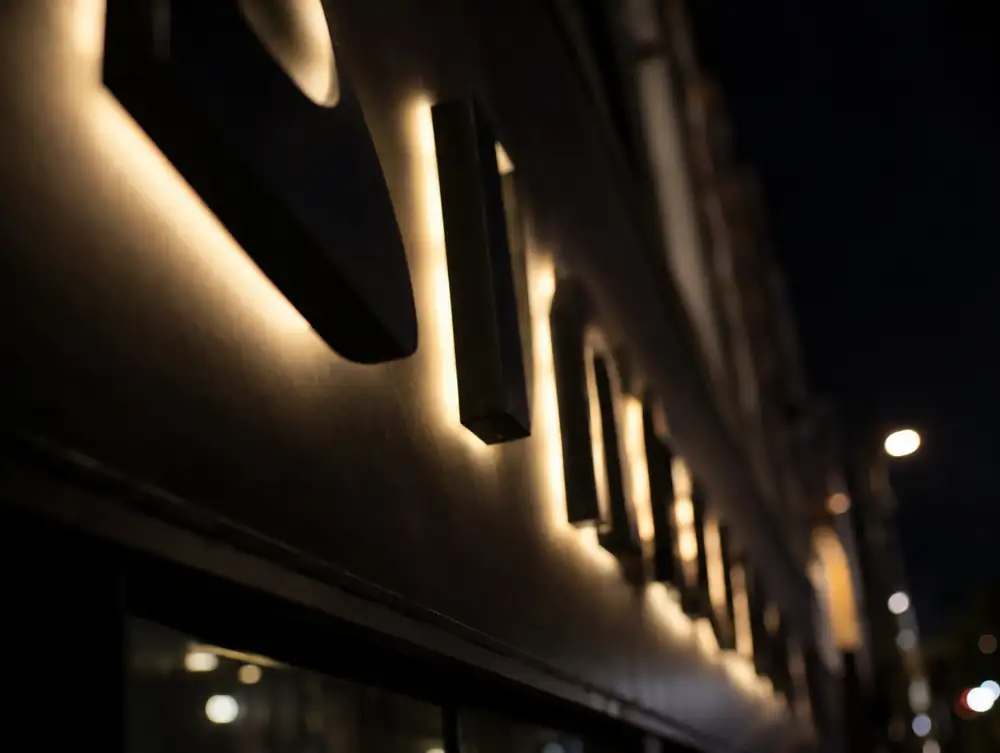
How do you design around the building when planning illuminated signage in Birchington-on-Sea?
Should your Birchington-on-Sea premises close early, a photocell and timer can keep the sign on through the evening footfall and off for the rest of the night. It costs very little and helps the frontage look looked-after.
Where the interior is lit in warm tones, a cold white sign will look wrong from the street. We match the sign to the shop lighting behind the glass, so the two read as one scheme.
A corner unit has two fronts to think about, and the return elevation often does as much selling as the main one. If that is your layout in Birchington-on-Sea, carry the fascia and glass line round the corner and treat both faces as one composition.
What might illuminated signage cost in Birchington-on-Sea?
The guide for illuminated signage is £895 to £3,995 plus VAT per sign. Expect the lower end for simple work with clear access, and the upper end where detail, finish or awkward conditions add hours.
What permissions should you check for illuminated signage in Birchington-on-Sea?
Security grilles and shutters are named in England's rules: installing or replacing one on a shopfront sits outside the shop permitted development rights. The frontage itself is treated the same way, so for illuminated signage at premises in the Birchington-on-Sea area, building work that materially affects the appearance needs planning permission. Confirm the position with the council before anything is ordered.
Lighting moves a sign out of Class 5 in England, because that class allows illumination only for medical-type notices. Class 4B then applies at premises in the Birchington-on-Sea area: halo or character-only lighting, static, with the lowest part at least 2.5m up. Brightness is capped at 600 cd/m² on signs up to 10m² and 300 cd/m² above that, and anything outside these limits needs advertisement consent.
At survey we check how things stand for your building, although applications for planning permission or advertisement consent here normally go to Thanet District Council.
| Town | Birchington-on-Sea |
|---|---|
| Area | Kent |
| Postcode districts | CT12, CT7, CT8, CT9 |
| Planning authority | Thanet District Council |
| Building approval | Building Regulations (Approved Documents) |
| Distance from Great Barr | About 159 miles |
| Survey | Free for new work |
Questions about illuminated signage in Birchington-on-Sea
Can the sign in Birchington-on-Sea be switched off at night?
Yes. A timer, photocell or simple switch can be built in, and many premises set the sign to go off shortly after closing or late in the evening.
Which illuminated sign suits a restaurant in Birchington-on-Sea?
Halo-lit letters in a warm white usually suit restaurants, as they feel calm and considered. A trough light over a painted sign is a good alternative for a more traditional room.
Will a lit sign in Birchington-on-Sea cost much to run?
Very little. A typical LED sign uses about the same power as a few domestic lamps, and a timer trims that further. Occasional driver changes are the larger long-term cost.
Does a shop sign in the Birchington-on-Sea area need advertisement consent?
Not always. In England, an unlit sign within Class 5 of the 2007 Advertisement Regulations generally needs no application, and neither does a lit sign within Class 4B. Anything outside those classes needs consent, and Class 4B isn't available in conservation areas, so check before ordering.
Does the Equality Act apply to a shop entrance in the Birchington-on-Sea area?
Yes. The Equality Act 2010 applies in England, as across Great Britain, and it requires reasonable steps to remove, alter or avoid physical features that disadvantage disabled people. The duty is anticipatory, so it looks at disabled people generally, and a new Services Code replaced the 2011 Code on 5 August 2026.