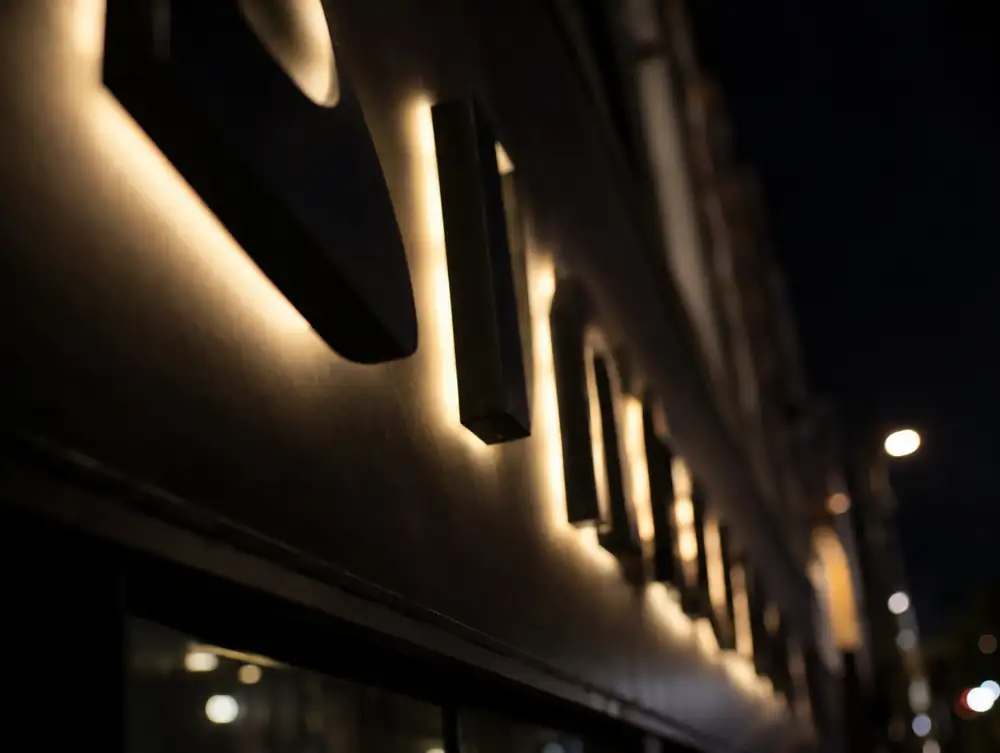
Illuminated signs for City of London premises are designed from the evening view, because that is when the choice of light shows. We draw the letters, the glow and the power route together, so the sign looks planned from the first night.
A survey in City of London usually starts outside, looking at the whole elevation before any tape comes out, because the frontage has to answer the building above it.
What should you think about before commissioning illuminated signage in City of London?
If an old lightbox is coming down, we check the cable position and the wall behind it before designing the new sign. An existing supply can often be reused, which saves work on the inside.
Where the interior is lit in warm tones, a cold white sign will look wrong from the street. We match the sign to the shop lighting behind the glass, so the two read as one scheme.
Where the building has good brick or stone around the opening, set the frame back in the reveal so the masonry can be seen. On City of London premises with a flat elevation, that deep reveal throws a shadow line that adds real depth in low sun.
Who approves illuminated signage in City of London?
For illuminated signage at premises in the City of London area, the deciding question in England is whether the building work materially affects the external appearance. If it does, planning permission is needed, while a true like-for-like replacement usually needs none. The council confirms the position for each site.
A lit projecting sign at premises in the City of London area has firm limits under Class 4B in England: 0.75m² per surface and 1m high. It can project 1m, or two-thirds of the footway if that is less, and it can't sit over the carriageway. A larger sign needs advertisement consent, and so does a lit one in a conservation area.
For City of London, the usual route for planning and advert applications is through City of London Corporation, and we confirm that when we visit.
What is a realistic budget for illuminated signage in City of London?
A sensible starting budget is £895 to £3,995 plus VAT per sign. What shifts the figure is whatever can't be seen yet, such as the condition behind the old frontage or the services running through it.
| Town | City of London |
|---|---|
| Area | Greater London |
| Postcode districts | EC2, EC3, EC4 |
| Planning authority | City of London Corporation |
| Building approval | Building Regulations (Approved Documents) |
| Distance from Great Barr | About 105 miles |
| Survey | Free for new work |
Questions about illuminated signage in City of London
Can you replace a lightbox on my City of London premises?
Yes. We take the old box down, check the wall and supply behind it, then fit the new sign. Built-up letters will often need a new panel, because the old box leaves a mark on the fascia.
Will a lit sign in City of London cost much to run?
Very little. A typical LED sign uses about the same power as a few domestic lamps, and a timer trims that further. Occasional driver changes are the larger long-term cost.
Which illuminated sign suits a restaurant in City of London?
Halo-lit letters in a warm white usually suit restaurants, as they feel calm and considered. A trough light over a painted sign is a good alternative for a more traditional room.
Does a new shopfront in the City of London area need Building Regulations approval?
Assume yes until building control says otherwise. England has no like-for-like exemption, though registered installers can self-certify replacement windows and doors in non-dwellings. That route doesn't cover structural glass, curtain walling or revolving doors.
Do I need listed building consent for a shopfront in the City of London area?
Usually yes, if the building is listed. In England the local planning authority decides, and Historic England is notified of Grade I and II* works and specified Grade II works. Like-for-like repair may not need consent, so ask the council before work starts.