Replacing an old lightbox on Clydach premises is a good moment to rethink how the name is lit. Slimmer letters and hidden LEDs can give a far more refined result from the same fascia.
Nothing gets ordered off the back of a survey in Clydach, because its job is to give us the numbers to draw and price from.
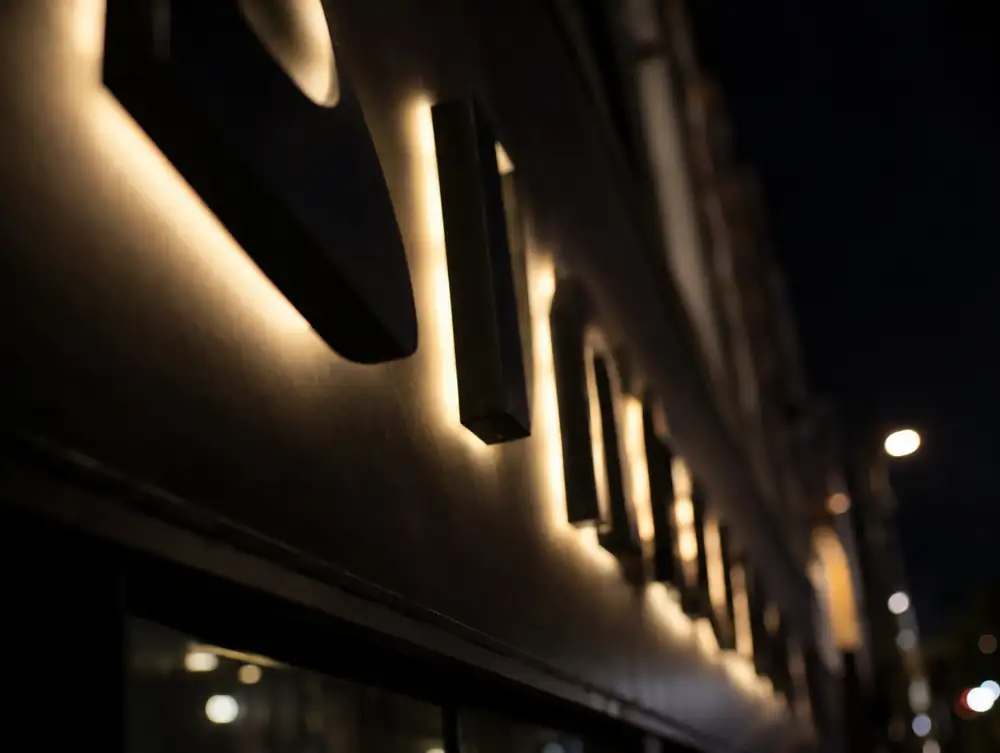
What should you think about before commissioning illuminated signage in Clydach?
Where the frontage faces a wide road, face-lit letters can carry further than halo lighting. On a narrower street the softer option usually reads well enough and looks more refined.
Should your Clydach premises close early, a photocell and timer can keep the sign on through the evening footfall and off for the rest of the night. It costs very little and helps the frontage look looked-after.
On a north-facing frontage the glass stays free of glare, but the interior can look dim from the street, so lighting needs to sit closer to the window. If your Clydach premises face south, the problem flips to reflections by day and fading stock.
What is a realistic budget for illuminated signage in Clydach?
The guide for illuminated signage is £895 to £3,995 plus VAT per sign. Expect the lower end for simple work with clear access, and the upper end where detail, finish or awkward conditions add hours.
Who approves illuminated signage in Clydach?
Going by Part 42 of the 1995 Order as inserted in 2014, Wales has no permitted development route for changing a shopfront. The right covers A1 and A2 premises, but it excludes creating, altering or replacing a shopfront, or fitting or replacing a security grill or shutter on one, and it doesn't apply on Article 1(5) land. For illuminated signage at premises in the Clydach area, that leaves a planning application, or work that leaves the appearance materially unchanged.
In Wales, adding light takes a sign out of Class 5, which allows illumination only for medical-type notices, and into Class 4B. For premises in the Clydach area, that generally means halo or character-only lighting, static, with the lowest part at least 2.5m up. Any other lighting needs advertisement consent.
We confirm the position at survey, because a boundary or a special designation can change who handles the file, but applications from Clydach premises normally go to City and County of Swansea Council.
| Town | Clydach |
|---|---|
| Area | West Glamorgan |
| Postcode districts | SA5, SA6, SA7, SA8 |
| Planning authority | City and County of Swansea Council |
| Building approval | Building Regulations (Approved Documents for Wales) |
| Distance from Great Barr | About 103 miles |
| Survey | Free for new work |
Questions about illuminated signage in Clydach
What happens if a lit letter fails on my Clydach sign?
Usually a single LED driver or a damaged connection is to blame, and it can be traced from the access point. That is why drivers are placed where they can be reached without taking the sign down.
Do you supply lit signs for premises across West Glamorgan?
Yes. We travel from Great Barr, with vetted teams working under S&K Glazing and one named contact for the job. The same scale drawing and sign-off process applies wherever your premises are.
How will I know what my Clydach sign looks like at night?
We draw it on your elevation and describe the lighting effect in the specification, and a sample letter can be tested on your fascia where that helps. Colour temperature and output are agreed before manufacture.
What access duty applies to a shop in the Clydach area?
The Equality Act 2010 applies, in Wales as across Great Britain, and it requires reasonable steps to remove, alter or avoid physical features that disadvantage disabled people. The duty is anticipatory, so it covers disabled people generally. A feature that meets a design standard is generally protected for 10 years.
Does a replacement shopfront in the Clydach area need Building Regulations approval?
Assume yes until building control says otherwise, because Wales has no like-for-like exemption. Glazing is judged against Approved Document N, as Wales keeps Part N. A registered installer can self-certify replacement windows and doors in non-dwellings, but not structural glass, curtain walling or revolving doors.