Halo-lit letters give Dumbarton premises a soft glow on the panel behind, with the name itself in crisp silhouette. Face-lit and trough options suit other brands and buildings, and we show you the difference on a scale drawing.
Measuring the opening is the easy part of a survey in Dumbarton. We also look at the beam above, the pavement fall and any meters or drains nearby.
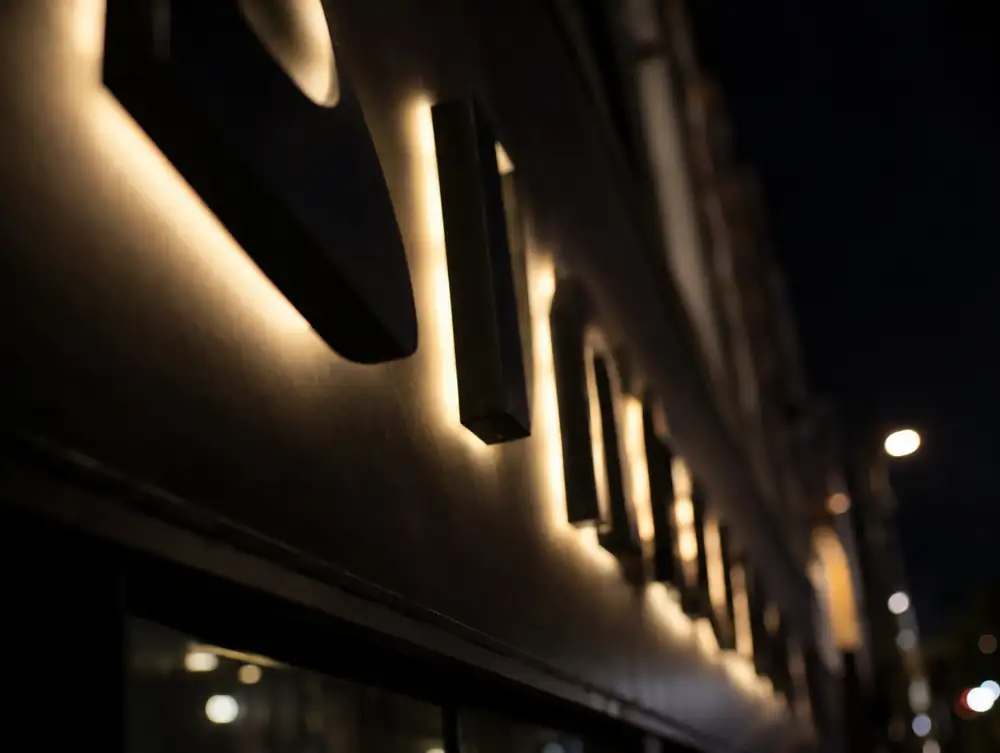
How would we approach illuminated signage for your Dumbarton premises?
Where the frontage faces a wide road, face-lit letters can carry further than halo lighting. On a narrower street the softer option usually reads well enough and looks more refined.
If your Dumbarton fascia is dark and glossy, halo light may disappear into it. We would test a sample or suggest a matt panel behind the letters, so the glow has something to land on.
A corner unit has two fronts to think about, and the return elevation often does as much selling as the main one. If that is your layout in Dumbarton, carry the fascia and glass line round the corner and treat both faces as one composition.
What consents could affect illuminated signage in Dumbarton?
Scottish guidance says like-for-like windows need no permission, and a true like-for-like frontage replacement usually follows the same logic. Class 7A covers altering or replacing an existing window, but it doesn't mention shopfronts, so ask before relying on it for a display window. For illuminated signage at premises in the Dumbarton area, a material effect on the external appearance means planning permission, and the council confirms the position.
Class VI is the class for lit signs in Scotland, and it is tightly drawn: each character lit from within, the sign at least 2.5m up, no more than 0.25m of projection, and static lighting. One Scottish council says illuminated signs always need express consent, which doesn't match Class VI, so ask the council for the Dumbarton area before ordering.
We confirm the position at survey, because a boundary or a special designation can change who handles the file, but applications from Dumbarton premises normally go to West Dunbartonshire Council.
What should you budget for illuminated signage in Dumbarton?
The guide for illuminated signage is £895 to £3,995 plus VAT per sign. Expect the lower end for simple work with clear access, and the upper end where detail, finish or awkward conditions add hours.
| Town | Dumbarton |
|---|---|
| Area | Glasgow and Clyde |
| Postcode districts | G82 |
| Planning authority | West Dunbartonshire Council |
| Building approval | Building warrant (Technical Handbook) |
| Distance from Great Barr | About 258 miles |
| Survey | Free for new work |
Questions about illuminated signage in Dumbarton
Can you replace a lightbox on my Dumbarton premises?
Yes. We take the old box down, check the wall and supply behind it, then fit the new sign. Built-up letters will often need a new panel, because the old box leaves a mark on the fascia.
How will I know what my Dumbarton sign looks like at night?
We draw it on your elevation and describe the lighting effect in the specification, and a sample letter can be tested on your fascia where that helps. Colour temperature and output are agreed before manufacture.
Which illuminated sign suits a restaurant in Dumbarton?
Halo-lit letters in a warm white usually suit restaurants, as they feel calm and considered. A trough light over a painted sign is a good alternative for a more traditional room.
Does a shop sign in the Dumbarton area need advertisement consent?
Not always. Scotland's 1984 Regulations let an unlit sign within Class IV(1) go up without an application, and Class VI does the same for a lit sign with each character lit from within. Class VI isn't available in conservation areas, and one council says lit signs always need express consent, so ask first.
Do I need a building warrant for a shopfront in the Dumbarton area?
Usually yes in Scotland, if the work alters a wall or structure. Schedule 3 of the Building (Scotland) Regulations 2004 lists some work that needs no warrant, such as replacing a door or window with its frame, but the standards still apply. Shopfronts aren't named there, so ask the council before relying on it.