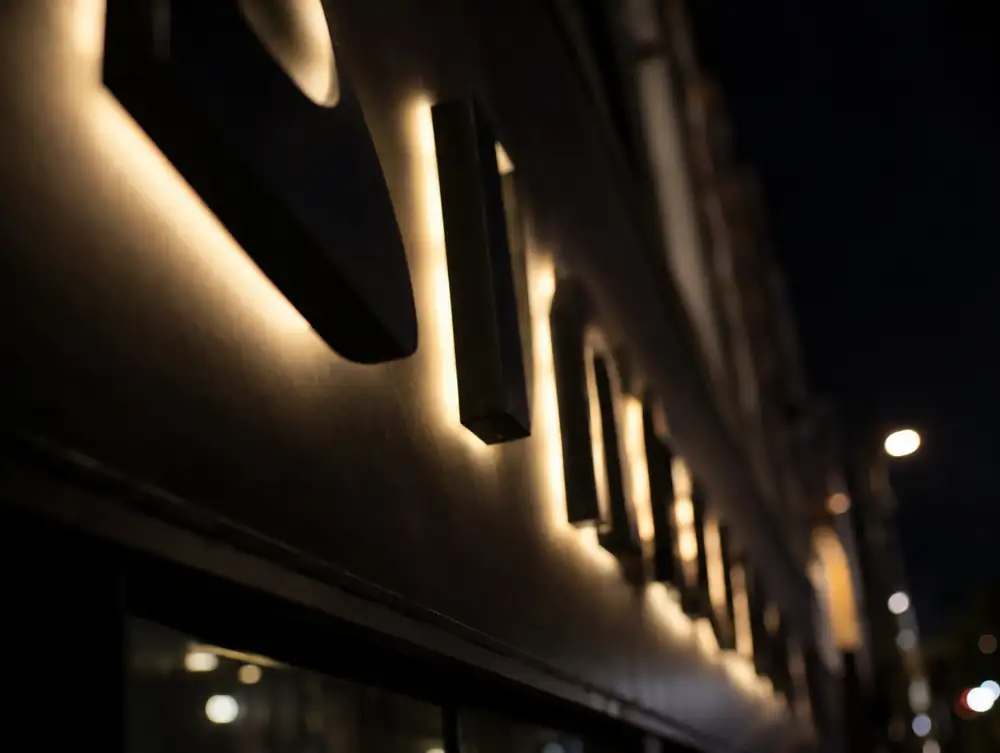
Halo-lit letters give Haydock premises a soft glow on the panel behind, with the name itself in crisp silhouette. Face-lit and trough options suit other brands and buildings, and we show you the difference on a scale drawing.
Expect us to measure the opening, photograph the existing front and check how materials will reach it on the day, at a time you have agreed.
What goes into getting illuminated signage right in Haydock?
If an old lightbox is coming down, we check the cable position and the wall behind it before designing the new sign. An existing supply can often be reused, which saves work on the inside.
Should your Haydock premises close early, a photocell and timer can keep the sign on through the evening footfall and off for the rest of the night. It costs very little and helps the frontage look looked-after.
If your Haydock unit is narrow, a central door can split a small window into two weak ones. Moving the door to one side gives you a single confident pane, provided the layout inside still works.
How much could illuminated signage in Haydock cost you?
A sensible starting budget is £895 to £3,995 plus VAT per sign. What shifts the figure is whatever can't be seen yet, such as the condition behind the old frontage or the services running through it.
Which applications might illuminated signage in Haydock involve?
A true like-for-like replacement usually needs no planning permission in England, because the external appearance isn't materially affected. New materials, a different glass line or altered proportions usually do count as material, so for illuminated signage at premises in the Haydock area, an application is then likely. The council confirms which side of that line a job falls on.
A lit projecting sign at premises in the Haydock area has firm limits under Class 4B in England: 0.75m² per surface and 1m high. It can project 1m, or two-thirds of the footway if that is less, and it can't sit over the carriageway. A larger sign needs advertisement consent, and so does a lit one in a conservation area.
Planning and advert applications for Haydock premises normally go to St Helens Council. We check the position for your address at survey.
| Town | Haydock |
|---|---|
| Area | Merseyside |
| Postcode districts | WA11, WA12, WA9, WN4 |
| Planning authority | St Helens Council |
| Building approval | Building Regulations (Approved Documents) |
| Distance from Great Barr | About 71 miles |
| Survey | Free for new work |
Questions about illuminated signage in Haydock
Can the sign in Haydock be switched off at night?
Yes. A timer, photocell or simple switch can be built in, and many premises set the sign to go off shortly after closing or late in the evening.
Will a lit sign in Haydock cost much to run?
Very little. A typical LED sign uses about the same power as a few domestic lamps, and a timer trims that further. Occasional driver changes are the larger long-term cost.
Can an illuminated sign be fitted around trading in Haydock?
Yes. External fitting is usually done from a tower or platform with little effect on the shop, and internal cable work can be arranged out of hours.
Does a shop sign in the Haydock area need advertisement consent?
Not always. In England, an unlit sign within Class 5 of the 2007 Advertisement Regulations generally needs no application, and neither does a lit sign within Class 4B. Anything outside those classes needs consent, and Class 4B isn't available in conservation areas, so check before ordering.
What rules apply to a fire exit door through a shopfront in the Haydock area?
It must open in the direction of escape and can't be locked against immediate use, and a dedicated fire exit can't be a sliding or revolving door. In England that comes from article 14(2) of the Regulatory Reform (Fire Safety) Order 2005, and the duty sits with the responsible person, normally the employer or whoever controls the premises for a business, otherwise the owner. An outward door can clash with section 153 of the Highways Act 1980 where it opens onto the footway, so raise it early.