Evening trade in Holywood depends on being found. A well-lit name helps people pick out your door at a distance, and good lighting design does that without glare.
Nothing gets ordered off the back of a survey in Holywood, because its job is to give us the numbers to draw and price from.
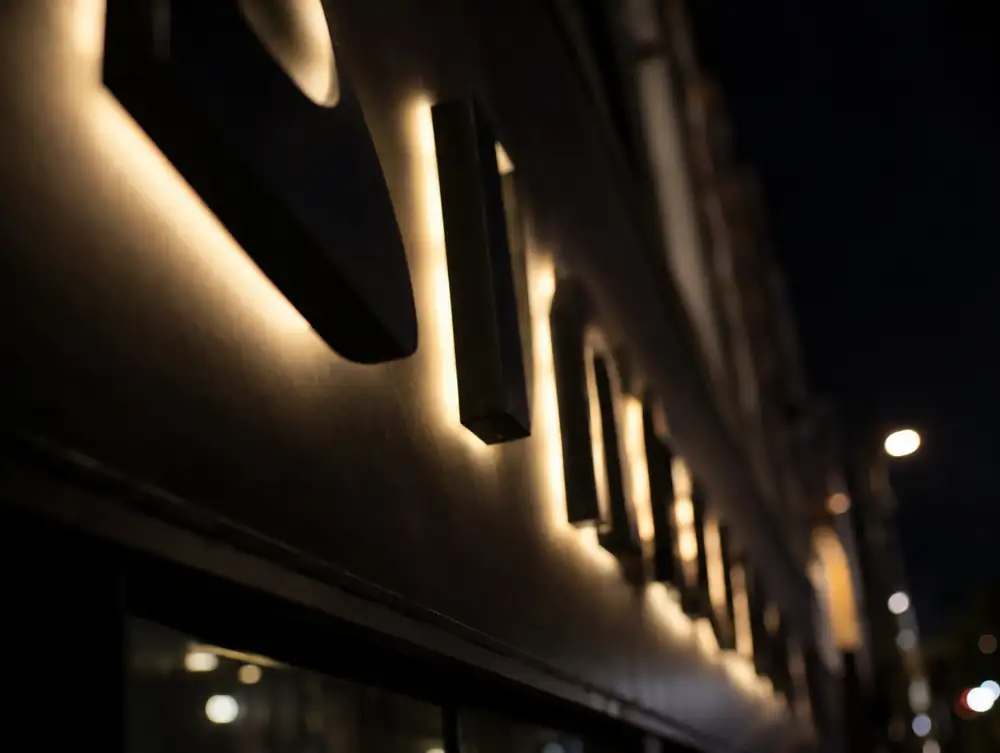
What makes illuminated signage work well on Holywood premises?
Where the frontage faces a wide road, face-lit letters can carry further than halo lighting. On a narrower street the softer option usually reads well enough and looks more refined.
Where the interior is lit in warm tones, a cold white sign will look wrong from the street. We match the sign to the shop lighting behind the glass, so the two read as one scheme.
If your Holywood unit sits in a Victorian parade, the old pilasters usually set the rhythm, so a new front should land on them and not run past them. Keep that line and even a modern frame looks as though it belongs.
How much should you set aside for illuminated signage in Holywood?
The guide for illuminated signage is £895 to £3,995 plus VAT per sign. Expect the lower end for simple work with clear access, and the upper end where detail, finish or awkward conditions add hours.
Could illuminated signage in Holywood need planning permission?
Shutters in Northern Ireland are treated like the rest of the frontage: as no permitted development route appears to exist, they usually fall to the appearance test. Building work that materially affects the external appearance needs planning permission, for illuminated signage at premises in the Holywood area as for anything else on the frontage, while a true like-for-like usually doesn't. Ask the council where a particular job stands.
Class 4(2) is the class for lit signs in Northern Ireland, because Class 5 can't be lit. For premises in the Holywood area, it generally means halo or character-only lighting, static, with the lowest part at least 2.5m up. Brightness limits of 1,000, 800, 600 and 400 candela apply by area, and the council can confirm whether the Regulations have changed since they were made in 2015.
At survey we check how things stand for your building, although applications for planning permission or advertisement consent here normally go to Ards and North Down Borough Council.
| Town | Holywood |
|---|---|
| Area | County Down |
| Postcode districts | BT18 |
| Planning authority | Ards and North Down Borough Council |
| Building approval | Building Control (Technical Booklets) |
| Survey | Free for new work |
Questions about illuminated signage in Holywood
Can the sign in Holywood be switched off at night?
Yes. A timer, photocell or simple switch can be built in, and many premises set the sign to go off shortly after closing or late in the evening.
How will I know what my Holywood sign looks like at night?
We draw it on your elevation and describe the lighting effect in the specification, and a sample letter can be tested on your fascia where that helps. Colour temperature and output are agreed before manufacture.
Can you replace a lightbox on my Holywood premises?
Yes. We take the old box down, check the wall and supply behind it, then fit the new sign. Built-up letters will often need a new panel, because the old box leaves a mark on the fascia.
Does the Disability Discrimination Act apply to a shop entrance in the Holywood area?
Yes. The Disability Discrimination Act 1995 applies in Northern Ireland, and section 21 deals with physical features that make a service hard for disabled people to use. Regulations made in 2007 (SR 2007/473) add detail on features, third-party consent and design standards.
What rules apply to a fire exit door through a shopfront in the Holywood area?
It must open in the direction of escape, it can't be locked against immediate use, and a dedicated fire exit can't be sliding or revolving. In Northern Ireland that comes from regulation 13(2) of the Fire Safety Regulations (Northern Ireland) 2010, and duties sit with dutyholders, meaning the employer and any person with control of the premises, whom the Fire and Rescue Service calls the appropriate person. An outward door may also need Department consent under Article 56 of the Roads (Northern Ireland) Order 1993.