After dark, your sign is the frontage. In Kensington we would usually start with halo-lit letters, then look at face-lit or trough lighting if distance or the building calls for them.
A survey in Kensington usually starts outside, looking at the whole elevation before any tape comes out, because the frontage has to answer the building above it.
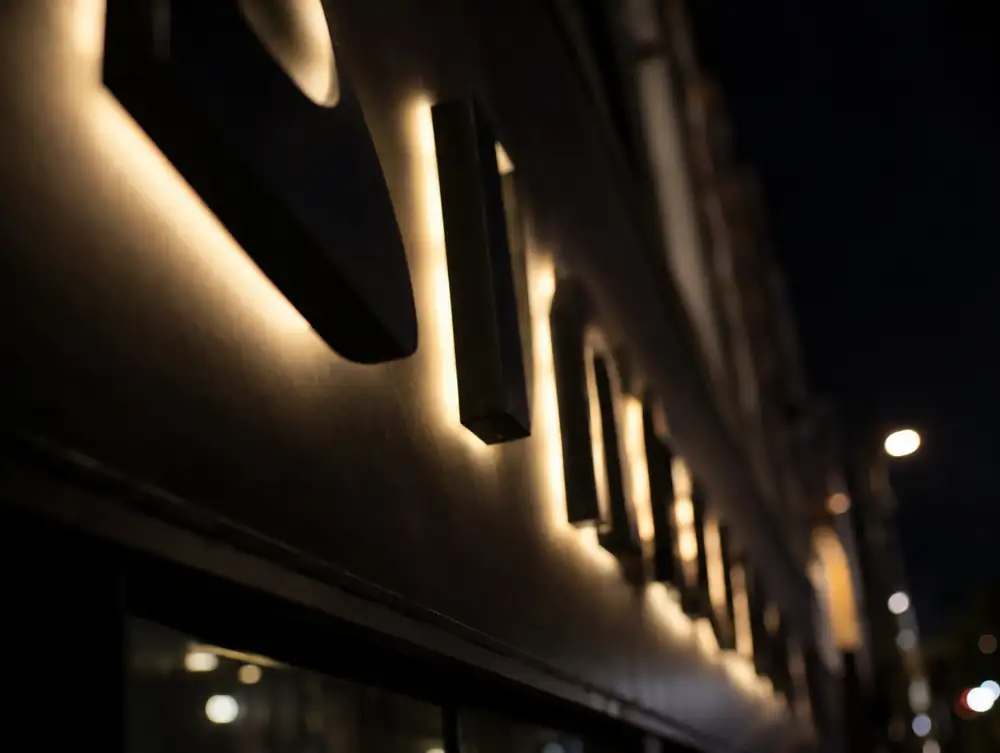
How do you design around the building when planning illuminated signage in Kensington?
If an old lightbox is coming down, we check the cable position and the wall behind it before designing the new sign. An existing supply can often be reused, which saves work on the inside.
On a timber frontage, a slim trough light usually keeps more of the daytime character than lit letters. We colour-match the bar to the fascia, so it almost disappears by day.
A corner unit has two fronts to think about, and the return elevation often does as much selling as the main one. If that is your layout in Kensington, carry the fascia and glass line round the corner and treat both faces as one composition.
What permissions should you check for illuminated signage in Kensington?
England has no permitted development route for changing a shopfront. Part 7 Class A of the General Permitted Development Order 2015 excludes creating, altering or replacing one, and it allows no alterations at all on article 2(3) land. That leaves two outcomes for illuminated signage at premises in the Kensington area: a planning application, or work that doesn't materially affect the external appearance.
In England, signs at premises in the Kensington area come under the 2007 Advertisement Regulations. An unlit fascia sign generally needs no application under Class 5 of Schedule 3 if it sits on a wall containing a shop window, tops out at 4.6m or the first-floor sill if that is lower, and keeps letters to 0.75m high. Displaying a sign without the consent it needs is a criminal offence, so check before it goes up.
For Kensington, the usual route for planning and advert applications is through Liverpool City Council, and we confirm that when we visit.
What might illuminated signage cost in Kensington?
Allow £895 to £3,995 plus VAT per sign. Size and specification set most of that figure for illuminated signage, and the rest depends on what the survey finds on site.
| Town | Kensington |
|---|---|
| Area | Merseyside |
| Postcode districts | L6, L69, L7, L70 |
| Planning authority | Liverpool City Council |
| Building approval | Building Regulations (Approved Documents) |
| Distance from Great Barr | About 74 miles |
| Survey | Free for new work |
Questions about illuminated signage in Kensington
Which illuminated sign suits a restaurant in Kensington?
Halo-lit letters in a warm white usually suit restaurants, as they feel calm and considered. A trough light over a painted sign is a good alternative for a more traditional room.
What happens if a lit letter fails on my Kensington sign?
Usually a single LED driver or a damaged connection is to blame, and it can be traced from the access point. That is why drivers are placed where they can be reached without taking the sign down.
How will I know what my Kensington sign looks like at night?
We draw it on your elevation and describe the lighting effect in the specification, and a sample letter can be tested on your fascia where that helps. Colour temperature and output are agreed before manufacture.
Does a shop sign in the Kensington area need advertisement consent?
Not always. In England, an unlit sign within Class 5 of the 2007 Advertisement Regulations generally needs no application, and neither does a lit sign within Class 4B. Anything outside those classes needs consent, and Class 4B isn't available in conservation areas, so check before ordering.
Does the Equality Act apply to a shop entrance in the Kensington area?
Yes. The Equality Act 2010 applies in England, as across Great Britain, and it requires reasonable steps to remove, alter or avoid physical features that disadvantage disabled people. The duty is anticipatory, so it looks at disabled people generally, and a new Services Code replaced the 2011 Code on 5 August 2026.