Design, manufacture, wiring and fitting all sit under one contract for lit signs across Limavady and County Londonderry. Your named contact handles the job from measured survey to first switch-on.
We measure your Limavady opening in person, at a time agreed with you first, so the visit fits around your trading.
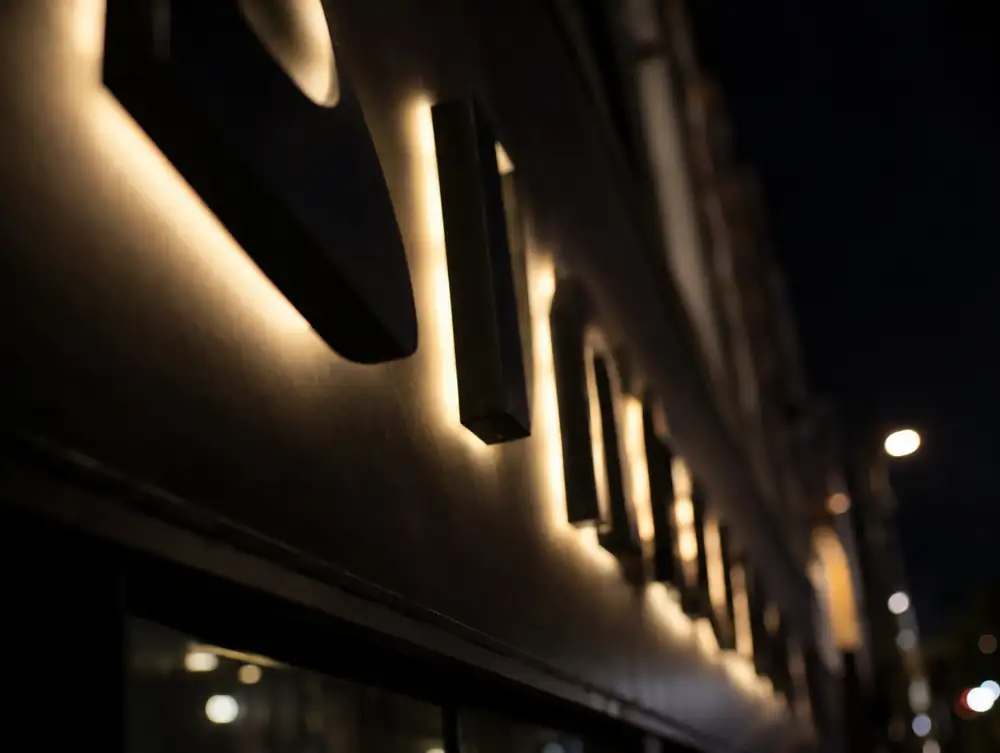
How do you design around the building when planning illuminated signage in Limavady?
If letters will sit close to a window head or canopy, we check how the light falls across it. A small change in stand-off or letter position can prevent a hard shadow line.
Where the frontage faces a wide road, face-lit letters can carry further than halo lighting. On a narrower street the softer option usually reads well enough and looks more refined.
On a north-facing frontage the glass stays free of glare, but the interior can look dim from the street, so lighting needs to sit closer to the window. If your Limavady premises face south, the problem flips to reflections by day and fading stock.
What permissions should you check for illuminated signage in Limavady?
Shutters in Northern Ireland are treated like the rest of the frontage: as no permitted development route appears to exist, they usually fall to the appearance test. Building work that materially affects the external appearance needs planning permission, for illuminated signage at premises in the Limavady area as for anything else on the frontage, while a true like-for-like usually doesn't. Ask the council where a particular job stands.
A lit projecting sign in Northern Ireland can generally reach 1m² per surface and 1m high under Class 4(2). Projection is limited to 1m or two-thirds of the footway, so work to the smaller figure. At premises in the Limavady area, anything bigger needs advertisement consent, and so does a lit sign in a conservation area.
Planning and advert applications for Limavady premises normally go to Causeway Coast and Glens Borough Council. We check the position for your address at survey.
What might illuminated signage cost in Limavady?
As a working budget, use £895 to £3,995 plus VAT per sign. Your place inside that range for illuminated signage depends mostly on how much of the existing frontage can stay and how much has to be put right first.
| Town | Limavady |
|---|---|
| Area | County Londonderry |
| Postcode districts | BT49 |
| Planning authority | Causeway Coast and Glens Borough Council |
| Building approval | Building Control (Technical Booklets) |
| Survey | Free for new work |
Questions about illuminated signage in Limavady
Can an illuminated sign be fitted around trading in Limavady?
Yes. External fitting is usually done from a tower or platform with little effect on the shop, and internal cable work can be arranged out of hours.
How will I know what my Limavady sign looks like at night?
We draw it on your elevation and describe the lighting effect in the specification, and a sample letter can be tested on your fascia where that helps. Colour temperature and output are agreed before manufacture.
Which illuminated sign suits a restaurant in Limavady?
Halo-lit letters in a warm white usually suit restaurants, as they feel calm and considered. A trough light over a painted sign is a good alternative for a more traditional room.
Does a shop sign in the Limavady area need advertisement consent?
Not always. Under Northern Ireland's 2015 Regulations, an unlit sign within Class 5 generally needs no application, with a 5m top height and 0.3m letters, and neither does a lit sign within Class 4(2). That lit class isn't available in conservation areas, Areas of Outstanding Natural Beauty or National Parks, so ask first.
What rules apply to a fire exit door through a shopfront in the Limavady area?
It must open in the direction of escape, it can't be locked against immediate use, and a dedicated fire exit can't be sliding or revolving. In Northern Ireland that comes from regulation 13(2) of the Fire Safety Regulations (Northern Ireland) 2010, and duties sit with dutyholders, meaning the employer and any person with control of the premises, whom the Fire and Rescue Service calls the appropriate person. An outward door may also need Department consent under Article 56 of the Roads (Northern Ireland) Order 1993.