Halo-lit letters give Little Hulton premises a soft glow on the panel behind, with the name itself in crisp silhouette. Face-lit and trough options suit other brands and buildings, and we show you the difference on a scale drawing.
It helps if you can be there when we visit Little Hulton, since five minutes walking the frontage together answers more than a long email.
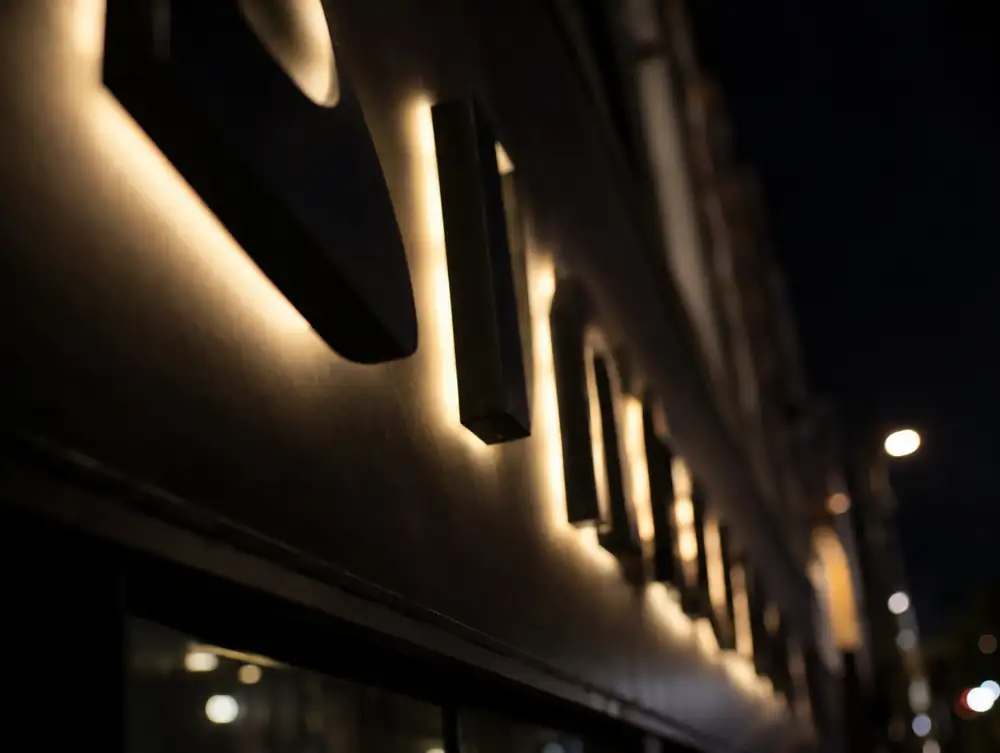
How would we approach illuminated signage for your Little Hulton premises?
On a timber frontage, a slim trough light usually keeps more of the daytime character than lit letters. We colour-match the bar to the fascia, so it almost disappears by day.
If your Little Hulton fascia is dark and glossy, halo light may disappear into it. We would test a sample or suggest a matt panel behind the letters, so the glow has something to land on.
Where the footway outside your Little Hulton premises is narrow, a recessed entrance earns its keep. It gives people a dry place to pause out of the walkway, and it adds a longer run of display glass either side of the door.
What consents could affect illuminated signage in Little Hulton?
A true like-for-like replacement usually needs no planning permission in England, because the external appearance isn't materially affected. New materials, a different glass line or altered proportions usually do count as material, so for illuminated signage at premises in the Little Hulton area, an application is then likely. The council confirms which side of that line a job falls on.
A lit projecting sign at premises in the Little Hulton area has firm limits under Class 4B in England: 0.75m² per surface and 1m high. It can project 1m, or two-thirds of the footway if that is less, and it can't sit over the carriageway. A larger sign needs advertisement consent, and so does a lit one in a conservation area.
For Little Hulton, the usual route for planning and advert applications is through Salford City Council, and we confirm that when we visit.
What should you budget for illuminated signage in Little Hulton?
As a working budget, use £895 to £3,995 plus VAT per sign. Your place inside that range for illuminated signage depends mostly on how much of the existing frontage can stay and how much has to be put right first.
| Town | Little Hulton |
|---|---|
| Area | Greater Manchester |
| Postcode districts | BL3, BL4, M28, M38 |
| Planning authority | Salford City Council |
| Building approval | Building Regulations (Approved Documents) |
| Distance from Great Barr | About 71 miles |
| Survey | Free for new work |
Questions about illuminated signage in Little Hulton
Do you supply lit signs for premises across Greater Manchester?
Yes. We travel from Great Barr, with vetted teams working under S&K Glazing and one named contact for the job. The same scale drawing and sign-off process applies wherever your premises are.
Can you replace a lightbox on my Little Hulton premises?
Yes. We take the old box down, check the wall and supply behind it, then fit the new sign. Built-up letters will often need a new panel, because the old box leaves a mark on the fascia.
Which illuminated sign suits a restaurant in Little Hulton?
Halo-lit letters in a warm white usually suit restaurants, as they feel calm and considered. A trough light over a painted sign is a good alternative for a more traditional room.
What rules apply to a fire exit door through a shopfront in the Little Hulton area?
It must open in the direction of escape and can't be locked against immediate use, and a dedicated fire exit can't be a sliding or revolving door. In England that comes from article 14(2) of the Regulatory Reform (Fire Safety) Order 2005, and the duty sits with the responsible person, normally the employer or whoever controls the premises for a business, otherwise the owner. An outward door can clash with section 153 of the Highways Act 1980 where it opens onto the footway, so raise it early.
Does a new shopfront in the Little Hulton area need Building Regulations approval?
Assume yes until building control says otherwise. England has no like-for-like exemption, though registered installers can self-certify replacement windows and doors in non-dwellings. That route doesn't cover structural glass, curtain walling or revolving doors.