Design, manufacture, wiring and fitting all sit under one contract for lit signs across Lower Earley and Berkshire. Your named contact handles the job from measured survey to first switch-on.
Bring whatever you have to the survey in Lower Earley: brand guidelines, lease plans, old drawings or a photo of a frontage you admire.
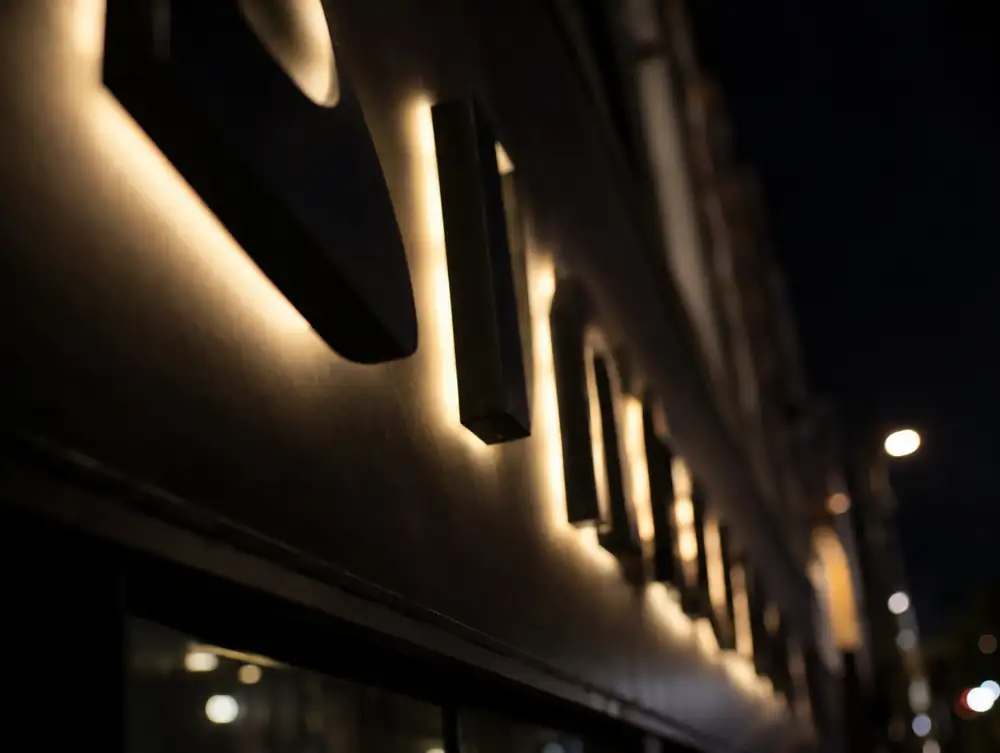
What makes illuminated signage work well on Lower Earley premises?
If there are flats above your Lower Earley premises, we would keep the output modest and put the sign on a timer. A warm white at lower brightness is kinder to neighbours and still does its job.
If letters will sit close to a window head or canopy, we check how the light falls across it. A small change in stand-off or letter position can prevent a hard shadow line.
Where the building has good brick or stone around the opening, set the frame back in the reveal so the masonry can be seen. On Lower Earley premises with a flat elevation, that deep reveal throws a shadow line that adds real depth in low sun.
How much should you set aside for illuminated signage in Lower Earley?
Guide price: £895 to £3,995 plus VAT per sign. Materials, finish and the amount of drawing and coordination involved all move it, and your itemised quotation shows where the money goes on illuminated signage.
Could illuminated signage in Lower Earley need planning permission?
Security grilles and shutters are named in England's rules: installing or replacing one on a shopfront sits outside the shop permitted development rights. The frontage itself is treated the same way, so for illuminated signage at premises in the Lower Earley area, building work that materially affects the appearance needs planning permission. Confirm the position with the council before anything is ordered.
Lighting moves a sign out of Class 5 in England, because that class allows illumination only for medical-type notices. Class 4B then applies at premises in the Lower Earley area: halo or character-only lighting, static, with the lowest part at least 2.5m up. Brightness is capped at 600 cd/m² on signs up to 10m² and 300 cd/m² above that, and anything outside these limits needs advertisement consent.
Lower Earley applications for planning permission or advertisement consent are normally handled by Wokingham Borough Council. Our survey includes a check of the position for your address.
| Town | Lower Earley |
|---|---|
| Area | Berkshire |
| Postcode districts | RG1, RG2, RG5, RG6 |
| Planning authority | Wokingham Borough Council |
| Building approval | Building Regulations (Approved Documents) |
| Distance from Great Barr | About 88 miles |
| Survey | Free for new work |
Questions about illuminated signage in Lower Earley
Can an illuminated sign be fitted around trading in Lower Earley?
Yes. External fitting is usually done from a tower or platform with little effect on the shop, and internal cable work can be arranged out of hours.
How will I know what my Lower Earley sign looks like at night?
We draw it on your elevation and describe the lighting effect in the specification, and a sample letter can be tested on your fascia where that helps. Colour temperature and output are agreed before manufacture.
Can the sign in Lower Earley be switched off at night?
Yes. A timer, photocell or simple switch can be built in, and many premises set the sign to go off shortly after closing or late in the evening.
What rules apply to a fire exit door through a shopfront in the Lower Earley area?
It must open in the direction of escape and can't be locked against immediate use, and a dedicated fire exit can't be a sliding or revolving door. In England that comes from article 14(2) of the Regulatory Reform (Fire Safety) Order 2005, and the duty sits with the responsible person, normally the employer or whoever controls the premises for a business, otherwise the owner. An outward door can clash with section 153 of the Highways Act 1980 where it opens onto the footway, so raise it early.
Do I need planning permission to change a shopfront in the Lower Earley area?
Usually yes, if the work materially affects the building's external appearance. England's shop permitted development rights exclude creating, altering or replacing a shopfront, so there is no shortcut. A true like-for-like replacement usually needs no application, and the council confirms the position.