Few businesses can shut for a week, so any time on site for illuminated signage in Nottinghamshire is planned around the hours you trade. Closed-day or out-of-hours installation can be arranged.
Your frontage is read alongside its neighbours, so we note the fascia line, stallriser height and pilasters on either side before drawing illuminated signage for Nottinghamshire premises. Matching those lines or breaking them on purpose can both work, whereas doing it by accident never does.
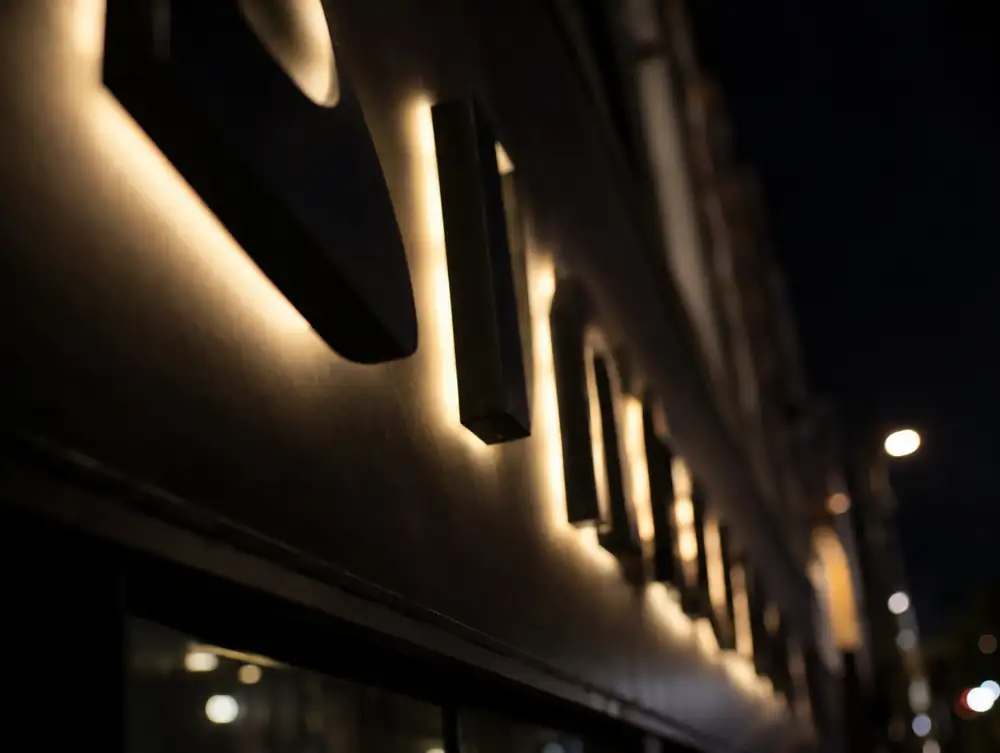
What should you look for from illuminated signage in Nottinghamshire?
Background decides whether halo lighting works. On premises around Nottingham we test the glow against your actual fascia finish, because brick, painted timber and dark composite each throw the light differently.
Power often sets the layout. On a frontage near Nottingham we trace where a supply can reach the sign without surface trunking, and we leave the drivers where they can be changed.
What consents apply to illuminated signage in Nottinghamshire?
For illuminated signage at premises in the Nottinghamshire area, the deciding question in England is whether the building work materially affects the external appearance. If it does, planning permission is needed, while a true like-for-like replacement usually needs none. The council confirms the position for each site.
A lit projecting sign at premises in the Nottinghamshire area has firm limits under Class 4B in England: 0.75m² per surface and 1m high. It can project 1m, or two-thirds of the footway if that is less, and it can't sit over the carriageway. A larger sign needs advertisement consent, and so does a lit one in a conservation area.
How much does illuminated signage cost in Nottinghamshire?
We would budget £895 to £3,995 plus VAT per sign. Scope sets most of the figure, so a clear brief at the start does more for the budget than any later change of detail.
| Area | Nottinghamshire |
|---|---|
| Nation | England |
| Towns covered | 17 |
| Main town | Nottingham |
| Planning regime | England: TCPA 1990 and the 2007 Advertisement Regulations |
| Building approval | Building Regulations (Approved Documents) |
| Survey | Free for new work, from our Great Barr base |
Does Nottingham City Council publish shopfront guidance?
Yes, Shopfront Design - Design Quality Framework. It tells applicants what the council expects from new and altered shopfronts. A few of the things it asks for:
- Fascias and signs should be sized to suit the shopfront and the building above, and oversized fascias are named as a common detractor.
- Historic glass should be kept, and toughened or laminated glass over 10mm is often enough for shop security.
- Internally fitted grilles and security gates are considered case by case, with extra care on listed buildings and in conservation areas.
Questions about illuminated signage in Nottinghamshire
Can you test a lit letter on my premises in Nottinghamshire before ordering?
Yes, where the job warrants it. A sample letter held against your fascia at dusk tells you more than a visual, particularly for halo lighting on a dark finish.
Can a lit sign in Nottinghamshire be set on a timer?
Yes, and we would recommend it. A timer or photocell switches the sign to suit your trading hours, and it can dim or switch off late in the evening.
How disruptive is fitting a lit sign in Nottinghamshire?
Very little, as a rule. Fitting usually takes one to two days from a tower or platform, and any cable work inside the shop can be done outside trading hours.
Does a new shopfront in the Nottinghamshire area need Building Regulations approval?
Assume yes until building control says otherwise. England has no like-for-like exemption, though registered installers can self-certify replacement windows and doors in non-dwellings. That route doesn't cover structural glass, curtain walling or revolving doors.
Do roller shutters need planning permission in the Nottinghamshire area?
Usually yes. Installing or replacing a security grill or shutter on a shopfront is expressly outside England's shop permitted development rights, so the only way to avoid an application is work that doesn't materially affect the appearance. Ask the council before ordering.