LED signs use very little power, so running cost is rarely the deciding factor. For premises in Portsmouth the real questions are how the light looks and whether the drivers can be reached years from now.
Your survey is where the price gets real, because widths, heights, levels and access are all taken on site in Portsmouth.
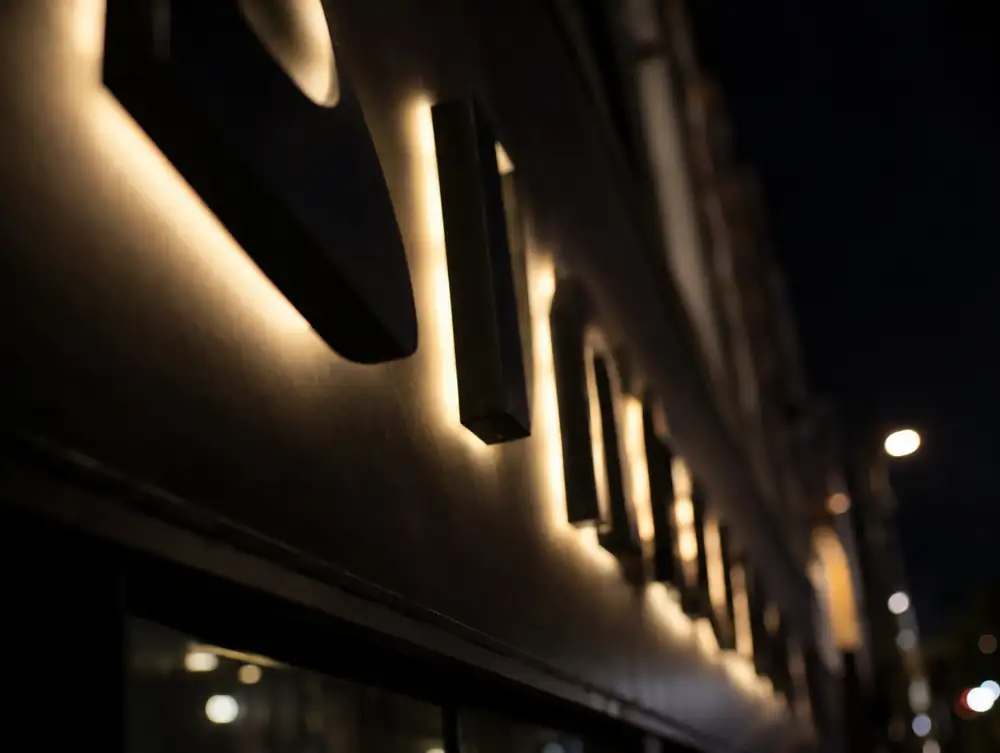
What makes illuminated signage work well on Portsmouth premises?
If an old lightbox is coming down, we check the cable position and the wall behind it before designing the new sign. An existing supply can often be reused, which saves work on the inside.
If there are flats above your Portsmouth premises, we would keep the output modest and put the sign on a timer. A warm white at lower brightness is kinder to neighbours and still does its job.
If your Portsmouth unit sits in a Victorian parade, the old pilasters usually set the rhythm, so a new front should land on them and not run past them. Keep that line and even a modern frame looks as though it belongs.
Could illuminated signage in Portsmouth need planning permission?
England has no permitted development route for changing a shopfront. Part 7 Class A of the General Permitted Development Order 2015 excludes creating, altering or replacing one, and it allows no alterations at all on article 2(3) land. That leaves two outcomes for illuminated signage at premises in the Portsmouth area: a planning application, or work that doesn't materially affect the external appearance.
Lighting moves a sign out of Class 5 in England, because that class allows illumination only for medical-type notices. Class 4B then applies at premises in the Portsmouth area: halo or character-only lighting, static, with the lowest part at least 2.5m up. Brightness is capped at 600 cd/m² on signs up to 10m² and 300 cd/m² above that, and anything outside these limits needs advertisement consent.
Portsmouth applications for planning permission or advertisement consent are normally handled by Portsmouth City Council. Our survey includes a check of the position for your address.
How much should you set aside for illuminated signage in Portsmouth?
The guide for illuminated signage is £895 to £3,995 plus VAT per sign. Expect the lower end for simple work with clear access, and the upper end where detail, finish or awkward conditions add hours.
| Town | Portsmouth |
|---|---|
| Area | Hampshire |
| Postcode districts | PO1, PO2, PO4, PO5 |
| Planning authority | Portsmouth City Council |
| Building approval | Building Regulations (Approved Documents) |
| Distance from Great Barr | About 126 miles |
| Survey | Free for new work |
Questions about illuminated signage in Portsmouth
Will a lit sign in Portsmouth cost much to run?
Very little. A typical LED sign uses about the same power as a few domestic lamps, and a timer trims that further. Occasional driver changes are the larger long-term cost.
Can the sign in Portsmouth be switched off at night?
Yes. A timer, photocell or simple switch can be built in, and many premises set the sign to go off shortly after closing or late in the evening.
Can you replace a lightbox on my Portsmouth premises?
Yes. We take the old box down, check the wall and supply behind it, then fit the new sign. Built-up letters will often need a new panel, because the old box leaves a mark on the fascia.
What rules apply to a fire exit door through a shopfront in the Portsmouth area?
It must open in the direction of escape and can't be locked against immediate use, and a dedicated fire exit can't be a sliding or revolving door. In England that comes from article 14(2) of the Regulatory Reform (Fire Safety) Order 2005, and the duty sits with the responsible person, normally the employer or whoever controls the premises for a business, otherwise the owner. An outward door can clash with section 153 of the Highways Act 1980 where it opens onto the footway, so raise it early.
Do I need listed building consent for a shopfront in the Portsmouth area?
Usually yes, if the building is listed. In England the local planning authority decides, and Historic England is notified of Grade I and II* works and specified Grade II works. Like-for-like repair may not need consent, so ask the council before work starts.