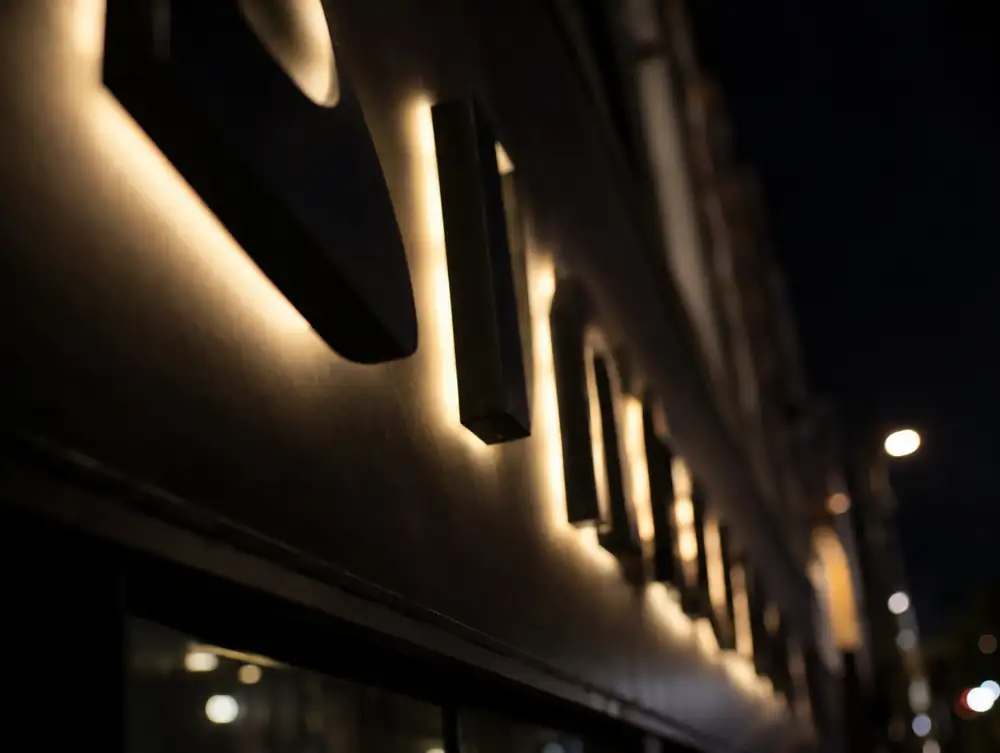
After dark, your sign is the frontage. In Salisbury we would usually start with halo-lit letters, then look at face-lit or trough lighting if distance or the building calls for them.
Nothing gets ordered off the back of a survey in Salisbury, because its job is to give us the numbers to draw and price from.
How do you design around the building when planning illuminated signage in Salisbury?
Where the interior is lit in warm tones, a cold white sign will look wrong from the street. We match the sign to the shop lighting behind the glass, so the two read as one scheme.
If your Salisbury fascia is dark and glossy, halo light may disappear into it. We would test a sample or suggest a matt panel behind the letters, so the glow has something to land on.
Where the footway outside your Salisbury premises is narrow, a recessed entrance earns its keep. It gives people a dry place to pause out of the walkway, and it adds a longer run of display glass either side of the door.
What might illuminated signage cost in Salisbury?
Guide price: £895 to £3,995 plus VAT per sign. Materials, finish and the amount of drawing and coordination involved all move it, and your itemised quotation shows where the money goes on illuminated signage.
What permissions should you check for illuminated signage in Salisbury?
England has no permitted development route for changing a shopfront. Part 7 Class A of the General Permitted Development Order 2015 excludes creating, altering or replacing one, and it allows no alterations at all on article 2(3) land. That leaves two outcomes for illuminated signage at premises in the Salisbury area: a planning application, or work that doesn't materially affect the external appearance.
Lighting moves a sign out of Class 5 in England, because that class allows illumination only for medical-type notices. Class 4B then applies at premises in the Salisbury area: halo or character-only lighting, static, with the lowest part at least 2.5m up. Brightness is capped at 600 cd/m² on signs up to 10m² and 300 cd/m² above that, and anything outside these limits needs advertisement consent.
At survey we check how things stand for your building, although applications for planning permission or advertisement consent here normally go to Wiltshire Council.
| Town | Salisbury |
|---|---|
| Area | Wiltshire |
| Postcode districts | SP1, SP2 |
| Planning authority | Wiltshire Council |
| Building approval | Building Regulations (Approved Documents) |
| Distance from Great Barr | About 102 miles |
| Survey | Free for new work |
Questions about illuminated signage in Salisbury
Can you replace a lightbox on my Salisbury premises?
Yes. We take the old box down, check the wall and supply behind it, then fit the new sign. Built-up letters will often need a new panel, because the old box leaves a mark on the fascia.
What happens if a lit letter fails on my Salisbury sign?
Usually a single LED driver or a damaged connection is to blame, and it can be traced from the access point. That is why drivers are placed where they can be reached without taking the sign down.
Can the sign in Salisbury be switched off at night?
Yes. A timer, photocell or simple switch can be built in, and many premises set the sign to go off shortly after closing or late in the evening.
What rules apply to a fire exit door through a shopfront in the Salisbury area?
It must open in the direction of escape and can't be locked against immediate use, and a dedicated fire exit can't be a sliding or revolving door. In England that comes from article 14(2) of the Regulatory Reform (Fire Safety) Order 2005, and the duty sits with the responsible person, normally the employer or whoever controls the premises for a business, otherwise the owner. An outward door can clash with section 153 of the Highways Act 1980 where it opens onto the footway, so raise it early.
Does a new shopfront in the Salisbury area need Building Regulations approval?
Assume yes until building control says otherwise. England has no like-for-like exemption, though registered installers can self-certify replacement windows and doors in non-dwellings. That route doesn't cover structural glass, curtain walling or revolving doors.