Evening trade in Selsey depends on being found. A well-lit name helps people pick out your door at a distance, and good lighting design does that without glare.
Nothing gets ordered off the back of a survey in Selsey, because its job is to give us the numbers to draw and price from.
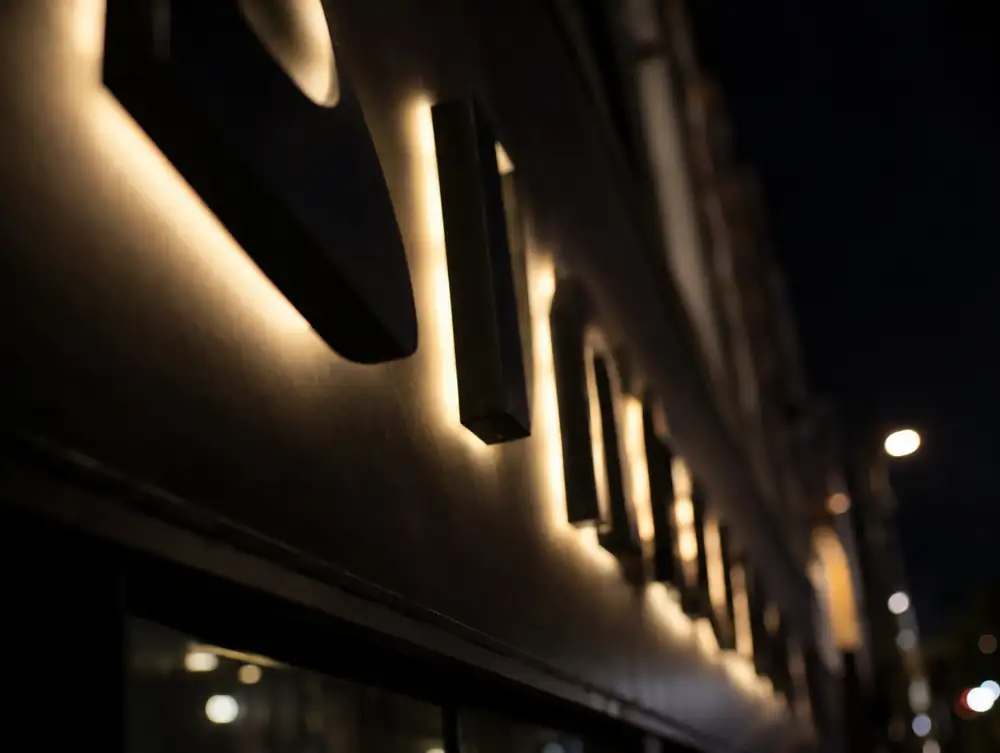
What makes illuminated signage work well on Selsey premises?
Where the frontage faces a wide road, face-lit letters can carry further than halo lighting. On a narrower street the softer option usually reads well enough and looks more refined.
Should your Selsey premises close early, a photocell and timer can keep the sign on through the evening footfall and off for the rest of the night. It costs very little and helps the frontage look looked-after.
On a north-facing frontage the glass stays free of glare, but the interior can look dim from the street, so lighting needs to sit closer to the window. If your Selsey premises face south, the problem flips to reflections by day and fading stock.
Could illuminated signage in Selsey need planning permission?
Security grilles and shutters are named in England's rules: installing or replacing one on a shopfront sits outside the shop permitted development rights. The frontage itself is treated the same way, so for illuminated signage at premises in the Selsey area, building work that materially affects the appearance needs planning permission. Confirm the position with the council before anything is ordered.
Lighting moves a sign out of Class 5 in England, because that class allows illumination only for medical-type notices. Class 4B then applies at premises in the Selsey area: halo or character-only lighting, static, with the lowest part at least 2.5m up. Brightness is capped at 600 cd/m² on signs up to 10m² and 300 cd/m² above that, and anything outside these limits needs advertisement consent.
We confirm the position at survey, because a boundary or a special designation can change who handles the file, but applications from Selsey premises normally go to Chichester District Council.
How much should you set aside for illuminated signage in Selsey?
The guide for illuminated signage is £895 to £3,995 plus VAT per sign. Expect the lower end for simple work with clear access, and the upper end where detail, finish or awkward conditions add hours.
| Town | Selsey |
|---|---|
| Area | West Sussex |
| Postcode districts | PO20 |
| Planning authority | Chichester District Council |
| Building approval | Building Regulations (Approved Documents) |
| Distance from Great Barr | About 134 miles |
| Survey | Free for new work |
Questions about illuminated signage in Selsey
Do you supply lit signs for premises across West Sussex?
Yes. We travel from Great Barr, with vetted teams working under S&K Glazing and one named contact for the job. The same scale drawing and sign-off process applies wherever your premises are.
Can you replace a lightbox on my Selsey premises?
Yes. We take the old box down, check the wall and supply behind it, then fit the new sign. Built-up letters will often need a new panel, because the old box leaves a mark on the fascia.
Which illuminated sign suits a restaurant in Selsey?
Halo-lit letters in a warm white usually suit restaurants, as they feel calm and considered. A trough light over a painted sign is a good alternative for a more traditional room.
What rules apply to a fire exit door through a shopfront in the Selsey area?
It must open in the direction of escape and can't be locked against immediate use, and a dedicated fire exit can't be a sliding or revolving door. In England that comes from article 14(2) of the Regulatory Reform (Fire Safety) Order 2005, and the duty sits with the responsible person, normally the employer or whoever controls the premises for a business, otherwise the owner. An outward door can clash with section 153 of the Highways Act 1980 where it opens onto the footway, so raise it early.
Do roller shutters need planning permission in the Selsey area?
Usually yes. Installing or replacing a security grill or shutter on a shopfront is expressly outside England's shop permitted development rights, so the only way to avoid an application is work that doesn't materially affect the appearance. Ask the council before ordering.