After dark, your sign is the frontage. In Staines-upon-Thames we would usually start with halo-lit letters, then look at face-lit or trough lighting if distance or the building calls for them.
Measuring the opening is the easy part of a survey in Staines-upon-Thames. We also look at the beam above, the pavement fall and any meters or drains nearby.
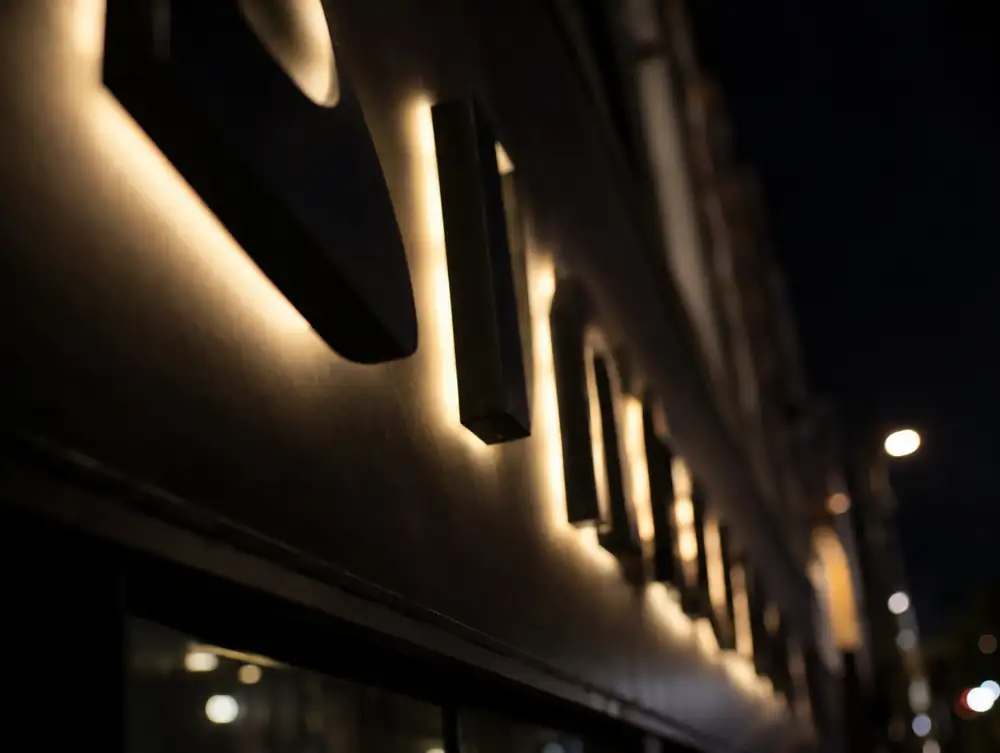
What makes illuminated signage work well on Staines-upon-Thames premises?
Where the interior is lit in warm tones, a cold white sign will look wrong from the street. We match the sign to the shop lighting behind the glass, so the two read as one scheme.
Where the frontage faces a wide road, face-lit letters can carry further than halo lighting. On a narrower street the softer option usually reads well enough and looks more refined.
If the pavement falls across your frontage, let the stallriser take up the slope and keep the glass line dead level. The eye reads the long horizontal, so Staines-upon-Thames premises on a slope look settled once that line is true.
How much should you set aside for illuminated signage in Staines-upon-Thames?
Until the survey is done, plan on £895 to £3,995 plus VAT per sign. Unusual sizes, fine detail and phased working push the figure up, while a simple brief and clear access keep it toward the lower end.
Could illuminated signage in Staines-upon-Thames need planning permission?
England has no permitted development route for changing a shopfront. Part 7 Class A of the General Permitted Development Order 2015 excludes creating, altering or replacing one, and it allows no alterations at all on article 2(3) land. That leaves two outcomes for illuminated signage at premises in the Staines-upon-Thames area: a planning application, or work that doesn't materially affect the external appearance.
Class 4B, England's class for lit signs, isn't available in conservation areas, Areas of Outstanding Natural Beauty, National Parks or the Broads, so a lit sign there normally needs advertisement consent. In an area of special control it is unavailable too, and Class 5 drops to a 3.6m top height, 0.3m letters and one-tenth of the building face up to 3.6m. Ask the council which designations cover premises in the Staines-upon-Thames area.
At survey we check how things stand for your building, although applications for planning permission or advertisement consent here normally go to Spelthorne Borough Council.
| Town | Staines-upon-Thames |
|---|---|
| Area | Surrey |
| Postcode districts | TW15, TW16, TW17, TW18 |
| Planning authority | Spelthorne Borough Council |
| Building approval | Building Regulations (Approved Documents) |
| Distance from Great Barr | About 98 miles |
| Survey | Free for new work |
Questions about illuminated signage in Staines-upon-Thames
Can an illuminated sign be fitted around trading in Staines-upon-Thames?
Yes. External fitting is usually done from a tower or platform with little effect on the shop, and internal cable work can be arranged out of hours.
Which illuminated sign suits a restaurant in Staines-upon-Thames?
Halo-lit letters in a warm white usually suit restaurants, as they feel calm and considered. A trough light over a painted sign is a good alternative for a more traditional room.
Can the sign in Staines-upon-Thames be switched off at night?
Yes. A timer, photocell or simple switch can be built in, and many premises set the sign to go off shortly after closing or late in the evening.
Does a new shopfront in the Staines-upon-Thames area need Building Regulations approval?
Assume yes until building control says otherwise. England has no like-for-like exemption, though registered installers can self-certify replacement windows and doors in non-dwellings. That route doesn't cover structural glass, curtain walling or revolving doors.
What rules apply to a fire exit door through a shopfront in the Staines-upon-Thames area?
It must open in the direction of escape and can't be locked against immediate use, and a dedicated fire exit can't be a sliding or revolving door. In England that comes from article 14(2) of the Regulatory Reform (Fire Safety) Order 2005, and the duty sits with the responsible person, normally the employer or whoever controls the premises for a business, otherwise the owner. An outward door can clash with section 153 of the Highways Act 1980 where it opens onto the footway, so raise it early.