After dark, your sign is the frontage. In Stonehaven we would usually start with halo-lit letters, then look at face-lit or trough lighting if distance or the building calls for them.
Measuring the opening is the easy part of a survey in Stonehaven. We also look at the beam above, the pavement fall and any meters or drains nearby.
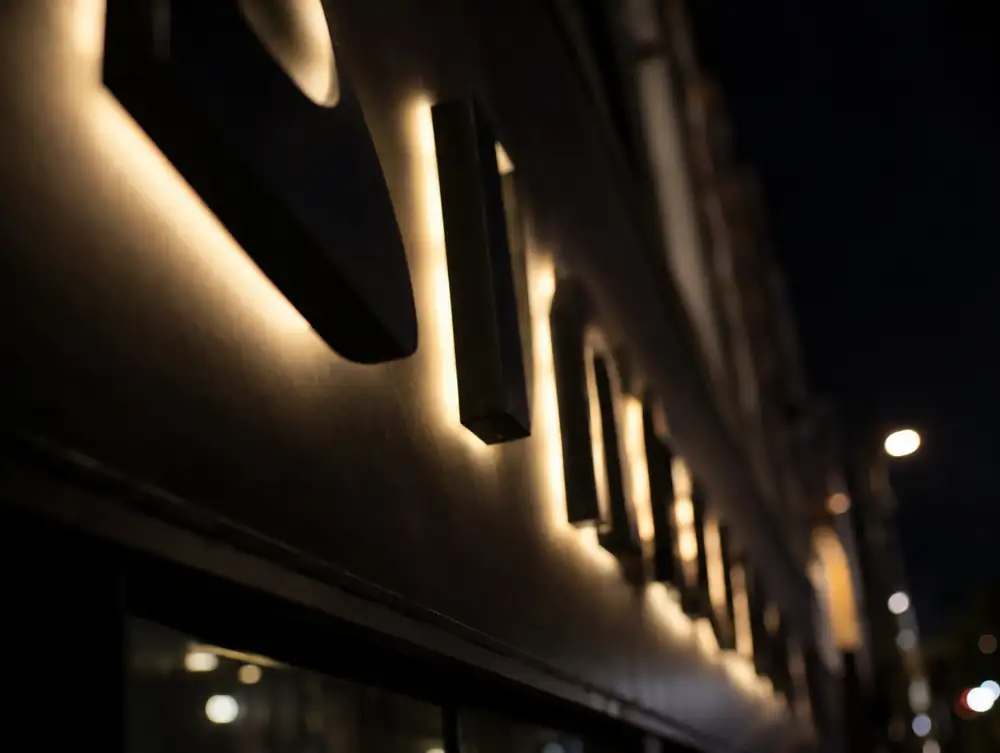
Where should you begin with illuminated signage in Stonehaven?
If your Stonehaven fascia is dark and glossy, halo light may disappear into it. We would test a sample or suggest a matt panel behind the letters, so the glow has something to land on.
If an old lightbox is coming down, we check the cable position and the wall behind it before designing the new sign. An existing supply can often be reused, which saves work on the inside.
If your premises were once two shops, decide early whether the front should read as one or as two. One continuous fascia with a repeated bay width usually settles the elevation better than two mismatched halves, which is worth testing on any Stonehaven unit of that kind.
What price should you expect for illuminated signage in Stonehaven?
The guide for illuminated signage is £895 to £3,995 plus VAT per sign. Expect the lower end for simple work with clear access, and the upper end where detail, finish or awkward conditions add hours.
What sign-off might you need for illuminated signage in Stonehaven?
Class 9A, Scotland's shop permitted development right, gives no route for a shopfront change. It covers Class 1A premises, but not work that alters or extends beyond the existing front, and it doesn't apply in conservation areas, National Parks or World Heritage Sites. For illuminated signage at premises in the Stonehaven area, that generally means a planning application unless the external appearance isn't materially affected.
Class VI is the class for lit signs in Scotland, and it is tightly drawn: each character lit from within, the sign at least 2.5m up, no more than 0.25m of projection, and static lighting. One Scottish council says illuminated signs always need express consent, which doesn't match Class VI, so ask the council for the Stonehaven area before ordering.
At survey we check how things stand for your building, although applications for planning permission or advertisement consent here normally go to Aberdeenshire Council.
| Town | Stonehaven |
|---|---|
| Area | Aberdeen and Aberdeenshire |
| Postcode districts | AB39 |
| Planning authority | Aberdeenshire Council |
| Building approval | Building warrant (Technical Handbook) |
| Distance from Great Barr | About 305 miles |
| Survey | Free for new work |
Questions about illuminated signage in Stonehaven
Can the sign in Stonehaven be switched off at night?
Yes. A timer, photocell or simple switch can be built in, and many premises set the sign to go off shortly after closing or late in the evening.
What happens if a lit letter fails on my Stonehaven sign?
Usually a single LED driver or a damaged connection is to blame, and it can be traced from the access point. That is why drivers are placed where they can be reached without taking the sign down.
How will I know what my Stonehaven sign looks like at night?
We draw it on your elevation and describe the lighting effect in the specification, and a sample letter can be tested on your fascia where that helps. Colour temperature and output are agreed before manufacture.
Does the Equality Act cover a shop entrance in the Stonehaven area?
Yes. The Equality Act 2010 applies in Scotland as part of Great Britain, and its anticipatory duty expects reasonable steps to remove, alter or avoid physical features that disadvantage disabled people generally. BS 8300-2:2018 is the current British Standard for accessible buildings.
Which way must a fire exit door open on a shop in the Stonehaven area?
In the direction of escape. Regulation 13(2) of the Fire Safety (Scotland) Regulations 2006 also rules out sliding and revolving doors on a dedicated fire exit and says fire exit doors can't be locked against immediate use. Duties sit with dutyholders under Part 3 of the Fire (Scotland) Act 2005, meaning the employer and any person with control of the premises.