Replacing an old lightbox on Tottenham Hale premises is a good moment to rethink how the name is lit. Slimmer letters and hidden LEDs can give a far more refined result from the same fascia.
Please have keys to any meter cupboards and shutter housings to hand when we survey in Tottenham Hale, because what sits behind them can change the drawing.
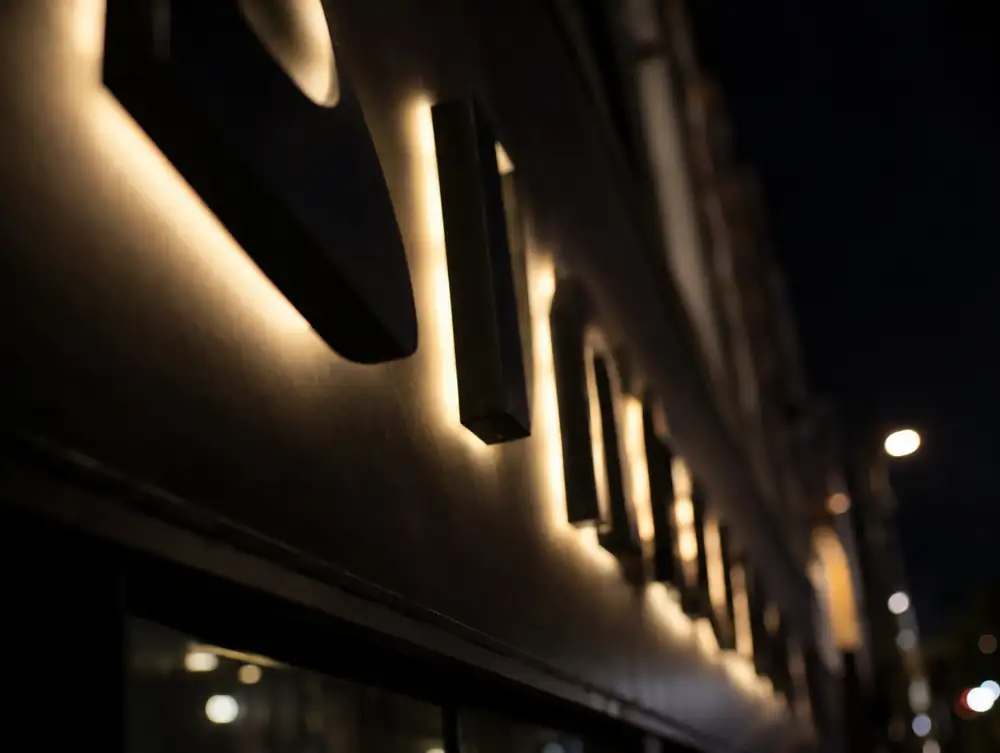
How would we approach illuminated signage for your Tottenham Hale premises?
If an old lightbox is coming down, we check the cable position and the wall behind it before designing the new sign. An existing supply can often be reused, which saves work on the inside.
Should your Tottenham Hale premises close early, a photocell and timer can keep the sign on through the evening footfall and off for the rest of the night. It costs very little and helps the frontage look looked-after.
Where a fascia has crept down over the years, lifting it back to its original line can add real height to the glass. Check what sits behind it first at Tottenham Hale premises, since a shutter box or old beam may set the limit.
What consents could affect illuminated signage in Tottenham Hale?
A true like-for-like replacement usually needs no planning permission in England, because the external appearance isn't materially affected. New materials, a different glass line or altered proportions usually do count as material, so for illuminated signage at premises in the Tottenham Hale area, an application is then likely. The council confirms which side of that line a job falls on.
A lit projecting sign at premises in the Tottenham Hale area has firm limits under Class 4B in England: 0.75m² per surface and 1m high. It can project 1m, or two-thirds of the footway if that is less, and it can't sit over the carriageway. A larger sign needs advertisement consent, and so does a lit one in a conservation area.
Expect planning and advert applications here to go to London Borough of Haringey in the normal way. We check what that means for your building when we survey it in Tottenham Hale.
What should you budget for illuminated signage in Tottenham Hale?
As a working budget, use £895 to £3,995 plus VAT per sign. Your place inside that range for illuminated signage depends mostly on how much of the existing frontage can stay and how much has to be put right first.
| Town | Tottenham Hale |
|---|---|
| Area | Greater London |
| Postcode districts | E17, N15, N17, N18 |
| Planning authority | London Borough of Haringey |
| Building approval | Building Regulations (Approved Documents) |
| Distance from Great Barr | About 103 miles |
| Survey | Free for new work |
Questions about illuminated signage in Tottenham Hale
Which illuminated sign suits a restaurant in Tottenham Hale?
Halo-lit letters in a warm white usually suit restaurants, as they feel calm and considered. A trough light over a painted sign is a good alternative for a more traditional room.
How will I know what my Tottenham Hale sign looks like at night?
We draw it on your elevation and describe the lighting effect in the specification, and a sample letter can be tested on your fascia where that helps. Colour temperature and output are agreed before manufacture.
What happens if a lit letter fails on my Tottenham Hale sign?
Usually a single LED driver or a damaged connection is to blame, and it can be traced from the access point. That is why drivers are placed where they can be reached without taking the sign down.
Do I need planning permission to change a shopfront in the Tottenham Hale area?
Usually yes, if the work materially affects the building's external appearance. England's shop permitted development rights exclude creating, altering or replacing a shopfront, so there is no shortcut. A true like-for-like replacement usually needs no application, and the council confirms the position.
Does the Equality Act apply to a shop entrance in the Tottenham Hale area?
Yes. The Equality Act 2010 applies in England, as across Great Britain, and it requires reasonable steps to remove, alter or avoid physical features that disadvantage disabled people. The duty is anticipatory, so it looks at disabled people generally, and a new Services Code replaced the 2011 Code on 5 August 2026.