Replacing an old lightbox on Tranent premises is a good moment to rethink how the name is lit. Slimmer letters and hidden LEDs can give a far more refined result from the same fascia.
Surveys for Tranent are booked with you directly. Tell us your quieter days and we'll work around them.
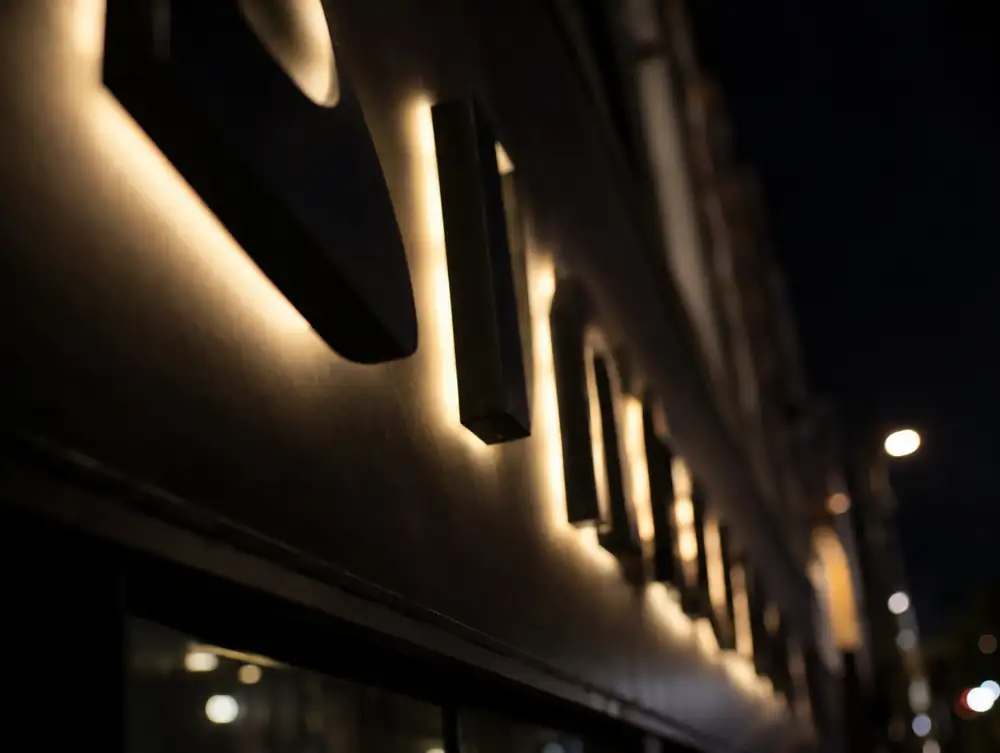
How would we approach illuminated signage for your Tranent premises?
On a timber frontage, a slim trough light usually keeps more of the daytime character than lit letters. We colour-match the bar to the fascia, so it almost disappears by day.
Should your Tranent premises close early, a photocell and timer can keep the sign on through the evening footfall and off for the rest of the night. It costs very little and helps the frontage look looked-after.
If the pavement falls across your frontage, let the stallriser take up the slope and keep the glass line dead level. The eye reads the long horizontal, so Tranent premises on a slope look settled once that line is true.
What should you budget for illuminated signage in Tranent?
The guide for illuminated signage is £895 to £3,995 plus VAT per sign. Expect the lower end for simple work with clear access, and the upper end where detail, finish or awkward conditions add hours.
What consents could affect illuminated signage in Tranent?
Scottish guidance says like-for-like windows need no permission, and a true like-for-like frontage replacement usually follows the same logic. Class 7A covers altering or replacing an existing window, but it doesn't mention shopfronts, so ask before relying on it for a display window. For illuminated signage at premises in the Tranent area, a material effect on the external appearance means planning permission, and the council confirms the position.
Class VI is the class for lit signs in Scotland, and it is tightly drawn: each character lit from within, the sign at least 2.5m up, no more than 0.25m of projection, and static lighting. One Scottish council says illuminated signs always need express consent, which doesn't match Class VI, so ask the council for the Tranent area before ordering.
Tranent applications for planning permission or advertisement consent are normally handled by East Lothian Council. Our survey includes a check of the position for your address.
| Town | Tranent |
|---|---|
| Area | Edinburgh and the Lothians |
| Postcode districts | EH33 |
| Planning authority | East Lothian Council |
| Building approval | Building warrant (Technical Handbook) |
| Distance from Great Barr | About 238 miles |
| Survey | Free for new work |
Questions about illuminated signage in Tranent
Will a lit sign in Tranent cost much to run?
Very little. A typical LED sign uses about the same power as a few domestic lamps, and a timer trims that further. Occasional driver changes are the larger long-term cost.
What happens if a lit letter fails on my Tranent sign?
Usually a single LED driver or a damaged connection is to blame, and it can be traced from the access point. That is why drivers are placed where they can be reached without taking the sign down.
How will I know what my Tranent sign looks like at night?
We draw it on your elevation and describe the lighting effect in the specification, and a sample letter can be tested on your fascia where that helps. Colour temperature and output are agreed before manufacture.
Do I need planning permission to alter a shopfront in the Tranent area?
Usually yes, if the work materially affects the external appearance. Class 9A, Scotland's shop permitted development right, doesn't cover work that alters or extends beyond the existing front. A true like-for-like replacement usually needs no permission, and the council confirms the position.
Does a shop sign in the Tranent area need advertisement consent?
Not always. Scotland's 1984 Regulations let an unlit sign within Class IV(1) go up without an application, and Class VI does the same for a lit sign with each character lit from within. Class VI isn't available in conservation areas, and one council says lit signs always need express consent, so ask first.