LED signs use very little power, so running cost is rarely the deciding factor. For premises in Whitefield the real questions are how the light looks and whether the drivers can be reached years from now.
It helps if you can be there when we visit Whitefield, since five minutes walking the frontage together answers more than a long email.
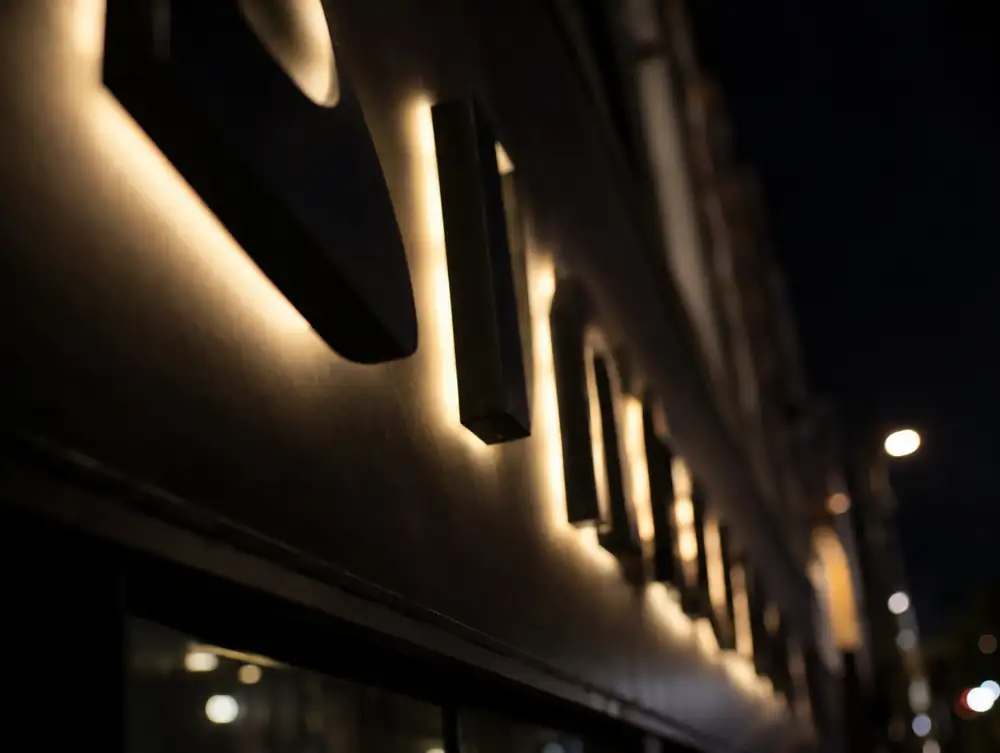
How do you design around the building when planning illuminated signage in Whitefield?
If there are flats above your Whitefield premises, we would keep the output modest and put the sign on a timer. A warm white at lower brightness is kinder to neighbours and still does its job.
If an old lightbox is coming down, we check the cable position and the wall behind it before designing the new sign. An existing supply can often be reused, which saves work on the inside.
If you trade after dark in Whitefield, the view in matters more than the sign. A warm, evenly lit interior with light on the back wall will usually do more than a brighter fascia, because it gives the eye somewhere to go.
What permissions should you check for illuminated signage in Whitefield?
England has no permitted development route for changing a shopfront. Part 7 Class A of the General Permitted Development Order 2015 excludes creating, altering or replacing one, and it allows no alterations at all on article 2(3) land. That leaves two outcomes for illuminated signage at premises in the Whitefield area: a planning application, or work that doesn't materially affect the external appearance.
In England, signs at premises in the Whitefield area come under the 2007 Advertisement Regulations. An unlit fascia sign generally needs no application under Class 5 of Schedule 3 if it sits on a wall containing a shop window, tops out at 4.6m or the first-floor sill if that is lower, and keeps letters to 0.75m high. Displaying a sign without the consent it needs is a criminal offence, so check before it goes up.
For Whitefield, the usual route for planning and advert applications is through Bury Metropolitan Borough Council, and we confirm that when we visit.
What might illuminated signage cost in Whitefield?
Allow £895 to £3,995 plus VAT per sign. Size and specification set most of that figure for illuminated signage, and the rest depends on what the survey finds on site.
| Town | Whitefield |
|---|---|
| Area | Greater Manchester |
| Postcode districts | BL9, M25, M26, M45 |
| Planning authority | Bury Metropolitan Borough Council |
| Building approval | Building Regulations (Approved Documents) |
| Distance from Great Barr | About 71 miles |
| Survey | Free for new work |
Questions about illuminated signage in Whitefield
Can an illuminated sign be fitted around trading in Whitefield?
Yes. External fitting is usually done from a tower or platform with little effect on the shop, and internal cable work can be arranged out of hours.
Will a lit sign in Whitefield cost much to run?
Very little. A typical LED sign uses about the same power as a few domestic lamps, and a timer trims that further. Occasional driver changes are the larger long-term cost.
Which illuminated sign suits a restaurant in Whitefield?
Halo-lit letters in a warm white usually suit restaurants, as they feel calm and considered. A trough light over a painted sign is a good alternative for a more traditional room.
What rules apply to a fire exit door through a shopfront in the Whitefield area?
It must open in the direction of escape and can't be locked against immediate use, and a dedicated fire exit can't be a sliding or revolving door. In England that comes from article 14(2) of the Regulatory Reform (Fire Safety) Order 2005, and the duty sits with the responsible person, normally the employer or whoever controls the premises for a business, otherwise the owner. An outward door can clash with section 153 of the Highways Act 1980 where it opens onto the footway, so raise it early.
Does the Equality Act apply to a shop entrance in the Whitefield area?
Yes. The Equality Act 2010 applies in England, as across Great Britain, and it requires reasonable steps to remove, alter or avoid physical features that disadvantage disabled people. The duty is anticipatory, so it looks at disabled people generally, and a new Services Code replaced the 2011 Code on 5 August 2026.