LED signs use very little power, so running cost is rarely the deciding factor. For premises in Whittlesey the real questions are how the light looks and whether the drivers can be reached years from now.
Expect us to measure the opening, photograph the existing front and check how materials will reach it on the day, at a time you have agreed.
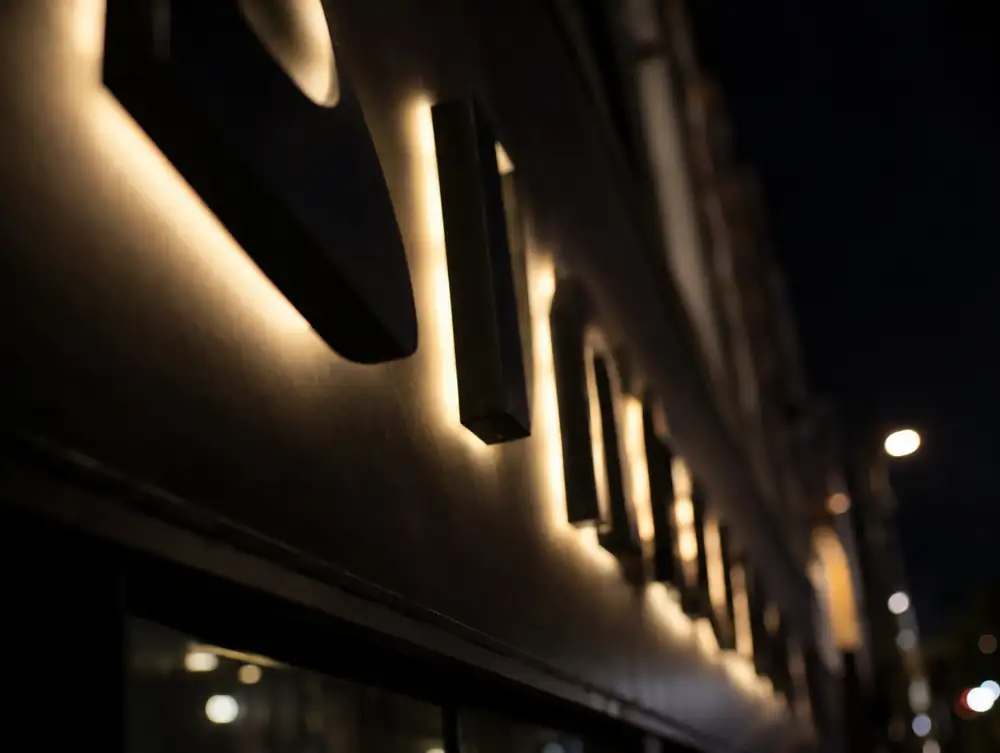
What makes illuminated signage work well on Whittlesey premises?
Where the interior is lit in warm tones, a cold white sign will look wrong from the street. We match the sign to the shop lighting behind the glass, so the two read as one scheme.
If letters will sit close to a window head or canopy, we check how the light falls across it. A small change in stand-off or letter position can prevent a hard shadow line.
If your premises were once two shops, decide early whether the front should read as one or as two. One continuous fascia with a repeated bay width usually settles the elevation better than two mismatched halves, which is worth testing on any Whittlesey unit of that kind.
Could illuminated signage in Whittlesey need planning permission?
England has no permitted development route for changing a shopfront. Part 7 Class A of the General Permitted Development Order 2015 excludes creating, altering or replacing one, and it allows no alterations at all on article 2(3) land. That leaves two outcomes for illuminated signage at premises in the Whittlesey area: a planning application, or work that doesn't materially affect the external appearance.
In England, signs at premises in the Whittlesey area come under the 2007 Advertisement Regulations. An unlit fascia sign generally needs no application under Class 5 of Schedule 3 if it sits on a wall containing a shop window, tops out at 4.6m or the first-floor sill if that is lower, and keeps letters to 0.75m high. Displaying a sign without the consent it needs is a criminal offence, so check before it goes up.
For Whittlesey, the usual route for planning and advert applications is through Fenland District Council, and we confirm that when we visit.
How much should you set aside for illuminated signage in Whittlesey?
Allow £895 to £3,995 plus VAT per sign. Size and specification set most of that figure for illuminated signage, and the rest depends on what the survey finds on site.
| Town | Whittlesey |
|---|---|
| Area | Cambridgeshire |
| Postcode districts | PE7 |
| Planning authority | Fenland District Council |
| Building approval | Building Regulations (Approved Documents) |
| Distance from Great Barr | About 75 miles |
| Survey | Free for new work |
Questions about illuminated signage in Whittlesey
Can an illuminated sign be fitted around trading in Whittlesey?
Yes. External fitting is usually done from a tower or platform with little effect on the shop, and internal cable work can be arranged out of hours.
Do you supply lit signs for premises across Cambridgeshire?
Yes. We travel from Great Barr, with vetted teams working under S&K Glazing and one named contact for the job. The same scale drawing and sign-off process applies wherever your premises are.
Can the sign in Whittlesey be switched off at night?
Yes. A timer, photocell or simple switch can be built in, and many premises set the sign to go off shortly after closing or late in the evening.
Do roller shutters need planning permission in the Whittlesey area?
Usually yes. Installing or replacing a security grill or shutter on a shopfront is expressly outside England's shop permitted development rights, so the only way to avoid an application is work that doesn't materially affect the appearance. Ask the council before ordering.
Do I need planning permission to change a shopfront in the Whittlesey area?
Usually yes, if the work materially affects the building's external appearance. England's shop permitted development rights exclude creating, altering or replacing a shopfront, so there is no shortcut. A true like-for-like replacement usually needs no application, and the council confirms the position.