Landlords, shopfitters and architects working in Bradford can use the service as a full package or for one difficult detail. Either way the drawings start from a measured survey.
A survey in Bradford usually starts outside, looking at the whole elevation before any tape comes out, because the frontage has to answer the building above it.
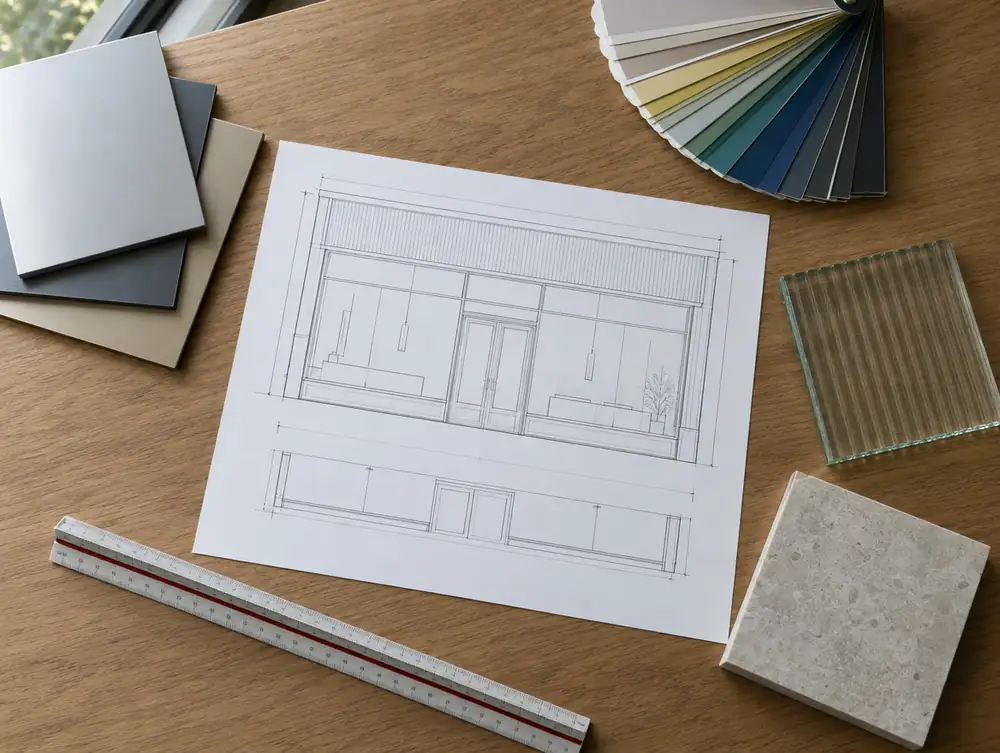
What makes shopfront design work well on Bradford premises?
For a corner unit in Bradford, we design both elevations as one. The return, the door position and the sign all depend on which street brings your customers.
If your brand is new to Bradford, we look at how far the guidelines need adapting to this building. A logo may need a different size or layout on a shallow fascia, and that is worth settling early.
If there are storeys above the shop, the frontage should feel like the base of the building and not a sign stuck on it. Lining up mullions with the windows overhead is a small move that settles the whole elevation at Bradford premises.
Could shopfront design in Bradford need planning permission?
England has no permitted development route for changing a shopfront. Part 7 Class A of the General Permitted Development Order 2015 excludes creating, altering or replacing one, and it allows no alterations at all on article 2(3) land. That leaves two outcomes for shopfront work at premises in the Bradford area: a planning application, or work that doesn't materially affect the external appearance.
Expect planning and advert applications here to go to City of Bradford Metropolitan District Council in the normal way. We check what that means for your building when we survey it in Bradford.
How much should you set aside for shopfront design in Bradford?
A sensible starting budget is £495 to £2,495 plus VAT per frontage. What shifts the figure is whatever can't be seen yet, such as the condition behind the old frontage or the services running through it.
| Town | Bradford |
|---|---|
| Area | West Yorkshire |
| Postcode districts | BD1, BD3, BD5, BD8 |
| Planning authority | City of Bradford Metropolitan District Council |
| Building approval | Building Regulations (Approved Documents) |
| Distance from Great Barr | About 86 miles |
| Survey | Free for new work |
Does City of Bradford Metropolitan District Council publish shopfront guidance?
Yes, Bradford Shopfront Design Guide Supplementary Planning Document (2026). It tells applicants what the council expects from new and altered shopfronts. A few of the things it asks for:
- Stallrisers should ideally be no more than 20% of total shopfront height, and plastic is never acceptable for them.
- Cornice, fascia and architrave together should be no more than 20% of total height, with lettering no more than two-thirds of the fascia height.
- Solid and perforated roller shutters are strongly discouraged, and internal grilles, ideally set back at least 1m from the window, are the council's preferred approach.
Questions about shopfront design in Bradford
Can the work on my Bradford frontage be designed in phases?
Yes. We can draw the complete frontage first, then split it into stages, so a new sign and paint now will still suit a new shopfront later.
What do you need from me before designing for my Bradford premises?
The address, brand files and a few frontages you admire are a good start. Tell us your rough budget too, because it helps us focus on what can be built.
Will you work with my shopfitter or architect in Bradford?
Yes. We share drawings and coordinate the frontage with their ceiling, lighting and display plans. Your named contact stays the route for questions on the frontage.
Do roller shutters need planning permission in the Bradford area?
Usually yes. Installing or replacing a security grill or shutter on a shopfront is expressly outside England's shop permitted development rights, so the only way to avoid an application is work that doesn't materially affect the appearance. Ask the council before ordering.
Does a new shopfront in the Bradford area need Building Regulations approval?
Assume yes until building control says otherwise. England has no like-for-like exemption, though registered installers can self-certify replacement windows and doors in non-dwellings. That route doesn't cover structural glass, curtain walling or revolving doors.