Refurbishment is a design job as much as a repair job. Small changes to colour, fascia depth and lighting can lift frontages in St Andrews far more than their cost suggests.
It helps if you can be there when we visit St Andrews, since five minutes walking the frontage together answers more than a long email.
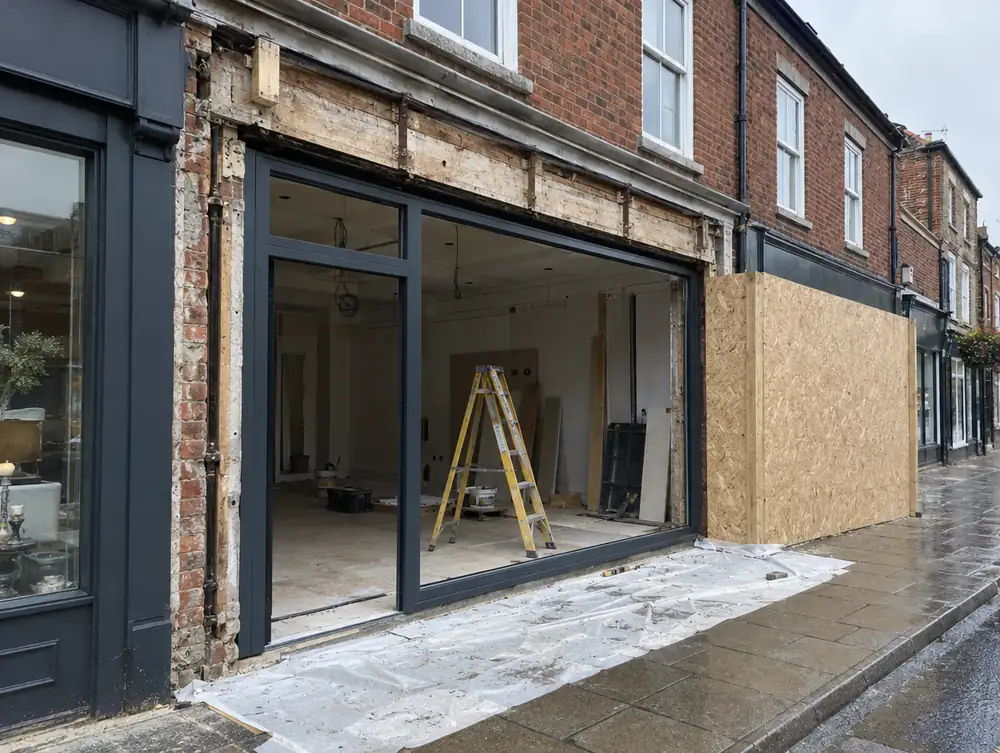
How do you design around the building when planning shopfront refurbishment in St Andrews?
Where the frontage is timber, we probe the sills, bottom rails and door jambs before quoting. Rot usually starts low, and a spliced repair in hardwood can save more of the joinery than you might expect.
Should your St Andrews premises have an older door, we look at the closer, the hinges and the threshold along with the finish. A door that opens easily and closes quietly does more for the frontage than a fresh coat of paint.
Where a fascia has crept down over the years, lifting it back to its original line can add real height to the glass. Check what sits behind it first at St Andrews premises, since a shutter box or old beam may set the limit.
What permissions should you check for shopfront refurbishment in St Andrews?
Class 9A, Scotland's shop permitted development right, gives no route for a shopfront change. It covers Class 1A premises, but not work that alters or extends beyond the existing front, and it doesn't apply in conservation areas, National Parks or World Heritage Sites. For shopfront refurbishment at premises in the St Andrews area, that generally means a planning application unless the external appearance isn't materially affected.
Expect planning and advert applications here to go to Fife Council in the normal way. We check what that means for your building when we survey it in St Andrews.
What might shopfront refurbishment cost in St Andrews?
A sensible starting budget is £1,995 to £8,995 plus VAT depending on what is kept. What shifts the figure is whatever can't be seen yet, such as the condition behind the old frontage or the services running through it.
| Town | St Andrews |
|---|---|
| Area | Fife |
| Postcode districts | KY16 |
| Planning authority | Fife Council |
| Building approval | Building warrant (Technical Handbook) |
| Distance from Great Barr | About 264 miles |
| Survey | Free for new work |
Does Fife Council publish shopfront guidance?
Yes, Shop Front Design Guidelines (2016). It tells applicants what the council expects from new and altered shopfronts. A few of the things it asks for:
- Solid security shutters are discouraged, and shutter boxes may not project in front of the shop front.
- Internal lattice shutters and reinforced laminated glass are encouraged in town centres, with demountable mesh grilles preferred on traditional shop fronts.
- Each shop normally gets one fascia sign and one projecting sign, and only one of them may be lit.
Questions about shopfront refurbishment in St Andrews
Can a refurbishment make my St Andrews premises easier to enter?
Often, yes. Lighter door closers, better handles and a lower threshold can all be added without replacing the frontage. We check the door width and the step at survey.
How do I know if my St Andrews shopfront needs replacing?
A measured survey will show you. We check the frame, joints, door and glass, then tell you plainly whether refurbishment will last or whether a new shopfront would be better value.
Can you repair a timber shopfront in St Andrews?
Yes. Decayed sections are cut out and spliced with new hardwood, then primed and painted. That keeps the joinery you have, and it usually costs far less than making a new frontage.
Do roller shutters need planning permission in the St Andrews area?
Usually yes, if they materially affect the external appearance. Class 9A doesn't name shutters, so in Scotland treat them as falling to the appearance test rather than assuming a permitted development route. Ask the council before ordering, as this is a reading of the rules and not an official statement.
Does the Equality Act cover a shop entrance in the St Andrews area?
Yes. The Equality Act 2010 applies in Scotland as part of Great Britain, and its anticipatory duty expects reasonable steps to remove, alter or avoid physical features that disadvantage disabled people generally. BS 8300-2:2018 is the current British Standard for accessible buildings.