Seen a frontage you admire? Bring the picture to our first talk about stallrisers and cladding in County Durham, and we will work out what makes it succeed, from fascia depth to glass line, and what that means for your building.
Finishes behave differently at full size. Any sample we show you for stallrisers and cladding is better judged at the premises in daylight, since a colour that looks quiet on a desk can read much louder across a whole elevation.
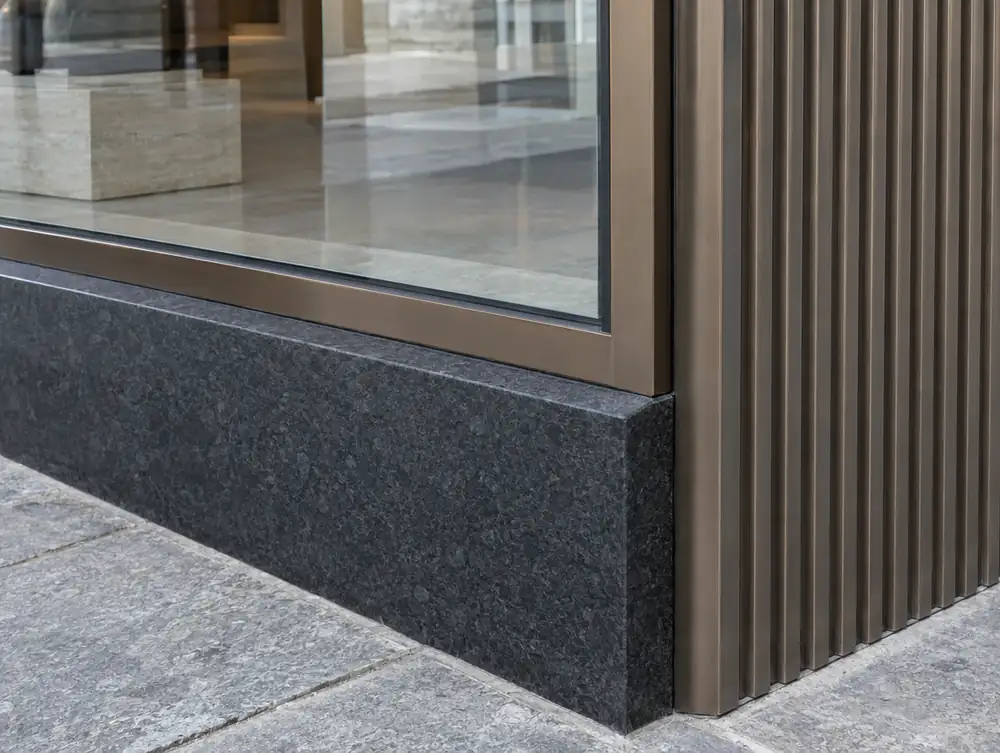
What makes stallrisers and cladding work well for premises in County Durham?
Stone and tile need a clean, dry surface and time to set. If your unit around Durham opens straight onto the pavement, we cut off site and keep the working area small so the entrance stays usable.
Road grit does the most damage at this level. On premises across County Durham that take winter salt or regular pavement washing, we fit a replaceable plinth so the lowest edge can be changed without disturbing the facing.
What consents apply to stallrisers and cladding in County Durham?
Security grilles and shutters are named in England's rules: installing or replacing one on a shopfront sits outside the shop permitted development rights. The frontage itself is treated the same way, so for stallrisers and cladding at premises in the County Durham area, building work that materially affects the appearance needs planning permission. Confirm the position with the council before anything is ordered.
How much do stallrisers and cladding cost in County Durham?
Until the survey is done, plan on £195 to £495 plus VAT per m². Unusual sizes, fine detail and phased working push the figure up, while a simple brief and clear access keep it toward the lower end.
| Area | County Durham |
|---|---|
| Nation | England |
| Towns covered | 18 |
| Main town | Durham |
| Planning regime | England: TCPA 1990 and the 2007 Advertisement Regulations |
| Building approval | Building Regulations (Approved Documents) |
| Survey | Free for new work, from our Great Barr base |
Questions about stallrisers and cladding in County Durham
How do I pick a stallriser finish for a unit in County Durham?
Start with the brick, stone or render above the shop, then bring in the brand colour. Samples held against the building in daylight will tell you more than a screen, so try them in the morning and the evening.
Do you fit natural stone stallrisers across County Durham?
Yes. Stone is templated from the measured survey, then fixed with mechanical restraints and a ventilated cavity. Heavier stone may need a check of the wall behind before we confirm the thickness.
Can you match an existing tiled stallriser on premises in County Durham?
Often, yes, though an exact glaze match can be difficult. We take a sample tile, compare it with what is available, and suggest a specialist tile or a change at a natural break if the colour cannot be found.
Do I need planning permission to change a shopfront in the County Durham area?
Usually yes, if the work materially affects the building's external appearance. England's shop permitted development rights exclude creating, altering or replacing a shopfront, so there is no shortcut. A true like-for-like replacement usually needs no application, and the council confirms the position.
Do I need listed building consent for a shopfront in the County Durham area?
Usually yes, if the building is listed. In England the local planning authority decides, and Historic England is notified of Grade I and II* works and specified Grade II works. Like-for-like repair may not need consent, so ask the council before work starts.