Every enquiry for stallrisers and cladding in Devon begins with a measured survey at the premises, because a price taken from a photograph is only a guess. That visit gives you real dimensions before anyone draws a line or orders a thing.
Most frontages share something with someone, be that a door to the flats above, a meter cupboard or a pilaster on the boundary. We pick those up early on stallrisers and cladding in Devon, because they are far easier to design around than to discover on the day.
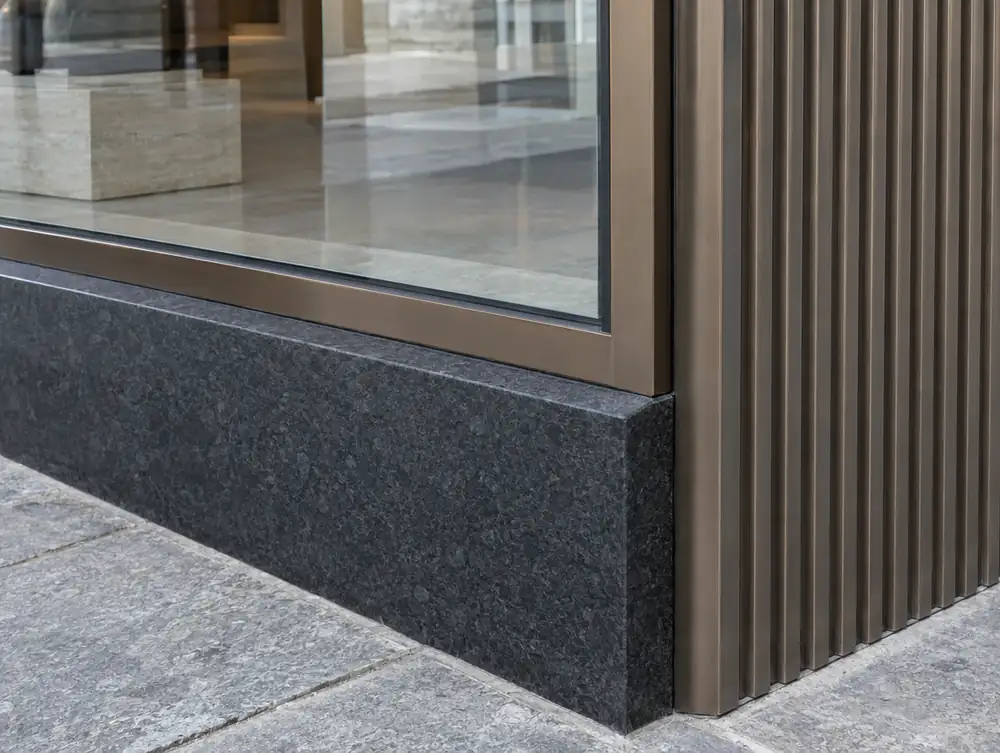
How should you approach stallrisers and cladding in Devon?
A restaurant and a jeweller want very different stallrisers, even side by side. For premises in Devon we set the height around what people do behind the glass, whether that is sitting, browsing or studying a tray.
A pavement that falls along the frontage needs careful handling. Where your premises in Devon sit on a slope, the sill stays level and the stallriser takes up the difference.
What consents apply to stallrisers and cladding in Devon?
For stallrisers and cladding at premises in the Devon area, the deciding question in England is whether the building work materially affects the external appearance. If it does, planning permission is needed, while a true like-for-like replacement usually needs none. The council confirms the position for each site.
How much do stallrisers and cladding cost in Devon?
Allow £195 to £495 plus VAT per m². Size and specification set most of that figure for stallrisers and cladding, and the rest depends on what the survey finds on site.
| Area | Devon |
|---|---|
| Nation | England |
| Towns covered | 22 |
| Main town | Exeter |
| Planning regime | England: TCPA 1990 and the 2007 Advertisement Regulations |
| Building approval | Building Regulations (Approved Documents) |
| Survey | Free for new work, from our Great Barr base |
Questions about stallrisers and cladding in Devon
Do you fit natural stone stallrisers across Devon?
Yes. Stone is templated from the measured survey, then fixed with mechanical restraints and a ventilated cavity. Heavier stone may need a check of the wall behind before we confirm the thickness.
Can you reclad only the stallriser on my premises in Devon?
Yes. It is one of the simplest ways to lift a tired frontage, provided the frame above is sound. We check the sill detail first, because a new facing must not trap water beneath it.
Can you match an existing tiled stallriser on premises in Devon?
Often, yes, though an exact glaze match can be difficult. We take a sample tile, compare it with what is available, and suggest a specialist tile or a change at a natural break if the colour cannot be found.
What rules apply to a fire exit door through a shopfront in the Devon area?
It must open in the direction of escape and can't be locked against immediate use, and a dedicated fire exit can't be a sliding or revolving door. In England that comes from article 14(2) of the Regulatory Reform (Fire Safety) Order 2005, and the duty sits with the responsible person, normally the employer or whoever controls the premises for a business, otherwise the owner. An outward door can clash with section 153 of the Highways Act 1980 where it opens onto the footway, so raise it early.
Does a new shopfront in the Devon area need Building Regulations approval?
Assume yes until building control says otherwise. England has no like-for-like exemption, though registered installers can self-certify replacement windows and doors in non-dwellings. That route doesn't cover structural glass, curtain walling or revolving doors.