Every enquiry for stallrisers and cladding in Dorset begins with a measured survey at the premises, because a price taken from a photograph is only a guess. That visit gives you real dimensions before anyone draws a line or orders a thing.
Most frontages share something with someone, be that a door to the flats above, a meter cupboard or a pilaster on the boundary. We pick those up early on stallrisers and cladding in Dorset, because they are far easier to design around than to discover on the day.
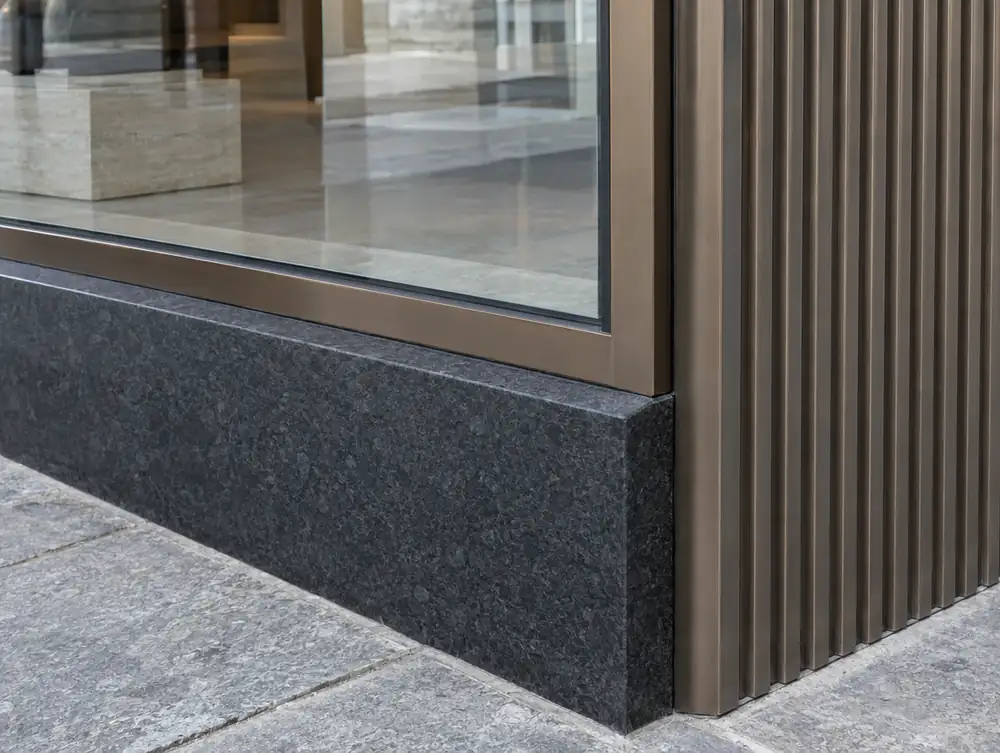
How should you approach stallrisers and cladding in Dorset?
Stone and tile need a clean, dry surface and time to set. If your unit around Bournemouth opens straight onto the pavement, we cut off site and keep the working area small so the entrance stays usable.
Stripping an old facing can reveal what the building had first. If original tile or timber turns up on your premises in Dorset, we stop and talk to you, since repairing it may cost less than cladding over it.
What consents apply to stallrisers and cladding in Dorset?
For stallrisers and cladding at premises in the Dorset area, the deciding question in England is whether the building work materially affects the external appearance. If it does, planning permission is needed, while a true like-for-like replacement usually needs none. The council confirms the position for each site.
How much do stallrisers and cladding cost in Dorset?
Allow £195 to £495 plus VAT per m². Size and specification set most of that figure for stallrisers and cladding, and the rest depends on what the survey finds on site.
| Area | Dorset |
|---|---|
| Nation | England |
| Towns covered | 16 |
| Main town | Bournemouth |
| Planning regime | England: TCPA 1990 and the 2007 Advertisement Regulations |
| Building approval | Building Regulations (Approved Documents) |
| Survey | Free for new work, from our Great Barr base |
Questions about stallrisers and cladding in Dorset
Can stallriser work on premises around Bournemouth be done in a day?
A straightforward composite or painted panel often can, and fitting can be arranged on a closed day. Stone and tile take longer because of fixing and setting time, so we would agree a short phased plan.
Will road salt damage a metal stallriser in Dorset?
It will, if cut edges are left exposed. We use folded sheet with hidden edges, keep the base clear of the pavement and fit a replaceable plinth where salt is heavy.
Can you match an existing tiled stallriser on premises in Dorset?
Often, yes, though an exact glaze match can be difficult. We take a sample tile, compare it with what is available, and suggest a specialist tile or a change at a natural break if the colour cannot be found.
Does a shop sign in the Dorset area need advertisement consent?
Not always. In England, an unlit sign within Class 5 of the 2007 Advertisement Regulations generally needs no application, and neither does a lit sign within Class 4B. Anything outside those classes needs consent, and Class 4B isn't available in conservation areas, so check before ordering.
What rules apply to a fire exit door through a shopfront in the Dorset area?
It must open in the direction of escape and can't be locked against immediate use, and a dedicated fire exit can't be a sliding or revolving door. In England that comes from article 14(2) of the Regulatory Reform (Fire Safety) Order 2005, and the duty sits with the responsible person, normally the employer or whoever controls the premises for a business, otherwise the owner. An outward door can clash with section 153 of the Highways Act 1980 where it opens onto the footway, so raise it early.