Every enquiry for stallrisers and cladding in Kent begins with a measured survey at the premises, because a price taken from a photograph is only a guess. That visit gives you real dimensions before anyone draws a line or orders a thing.
What sits behind the existing fascia often decides the job. Old beams, abandoned cable runs and earlier frames are common finds, which is why our visit to Kent premises looks past the surface before anything is drawn or priced for stallrisers and cladding.
How should you approach stallrisers and cladding in Kent?
Stone and tile need a clean, dry surface and time to set. If your unit around Maidstone opens straight onto the pavement, we cut off site and keep the working area small so the entrance stays usable.
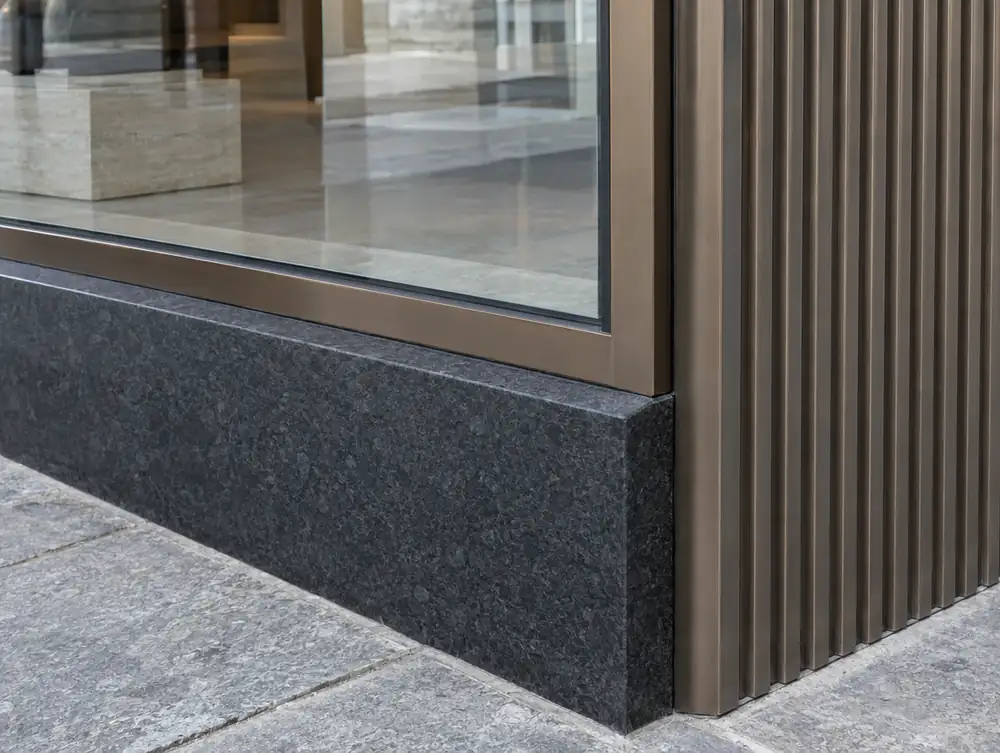
Road grit does the most damage at this level. On premises across Kent that take winter salt or regular pavement washing, we fit a replaceable plinth so the lowest edge can be changed without disturbing the facing.
What consents apply to stallrisers and cladding in Kent?
For stallrisers and cladding at premises in the Kent area, the deciding question in England is whether the building work materially affects the external appearance. If it does, planning permission is needed, while a true like-for-like replacement usually needs none. The council confirms the position for each site.
How much do stallrisers and cladding cost in Kent?
Allow £195 to £495 plus VAT per m². Size and specification set most of that figure for stallrisers and cladding, and the rest depends on what the survey finds on site.
| Area | Kent |
|---|---|
| Nation | England |
| Towns covered | 31 |
| Main town | Maidstone |
| Planning regime | England: TCPA 1990 and the 2007 Advertisement Regulations |
| Building approval | Building Regulations (Approved Documents) |
| Survey | Free for new work, from our Great Barr base |
Does Canterbury City Council publish shopfront guidance?
Yes, Shopfront design Supplementary Planning Document (2020). It tells applicants what the council expects from new and altered shopfronts. A few of the things it asks for:
- Fascia depth must not exceed the depth of the console, or one-fifth of the distance from console to pavement.
- External solid roller shutters are not normally supported in conservation areas or main shopping streets and are unacceptable on listed buildings.
- Internally lit box signs, illuminated letters and window neon are unsuitable in conservation areas, with external lighting only for premises open at night.
Questions about stallrisers and cladding in Kent
Do you fit natural stone stallrisers across Kent?
Yes. Stone is templated from the measured survey, then fixed with mechanical restraints and a ventilated cavity. Heavier stone may need a check of the wall behind before we confirm the thickness.
Can stallriser work on premises around Maidstone be done in a day?
A straightforward composite or painted panel often can, and fitting can be arranged on a closed day. Stone and tile take longer because of fixing and setting time, so we would agree a short phased plan.
Can you reclad only the stallriser on my premises in Kent?
Yes. It is one of the simplest ways to lift a tired frontage, provided the frame above is sound. We check the sill detail first, because a new facing must not trap water beneath it.
Do roller shutters need planning permission in the Kent area?
Usually yes. Installing or replacing a security grill or shutter on a shopfront is expressly outside England's shop permitted development rights, so the only way to avoid an application is work that doesn't materially affect the appearance. Ask the council before ordering.
Do I need planning permission to change a shopfront in the Kent area?
Usually yes, if the work materially affects the building's external appearance. England's shop permitted development rights exclude creating, altering or replacing a shopfront, so there is no shortcut. A true like-for-like replacement usually needs no application, and the council confirms the position.