From Bath to the furthest corner of Somerset, the sequence for stallrisers and cladding stays the same: survey, drawings, written price, then work on site. We travel from Great Barr in Birmingham and use vetted teams working under S&K Glazing.
What sits behind the existing fascia often decides the job. Old beams, abandoned cable runs and earlier frames are common finds, which is why our visit to Somerset premises looks past the surface before anything is drawn or priced for stallrisers and cladding.
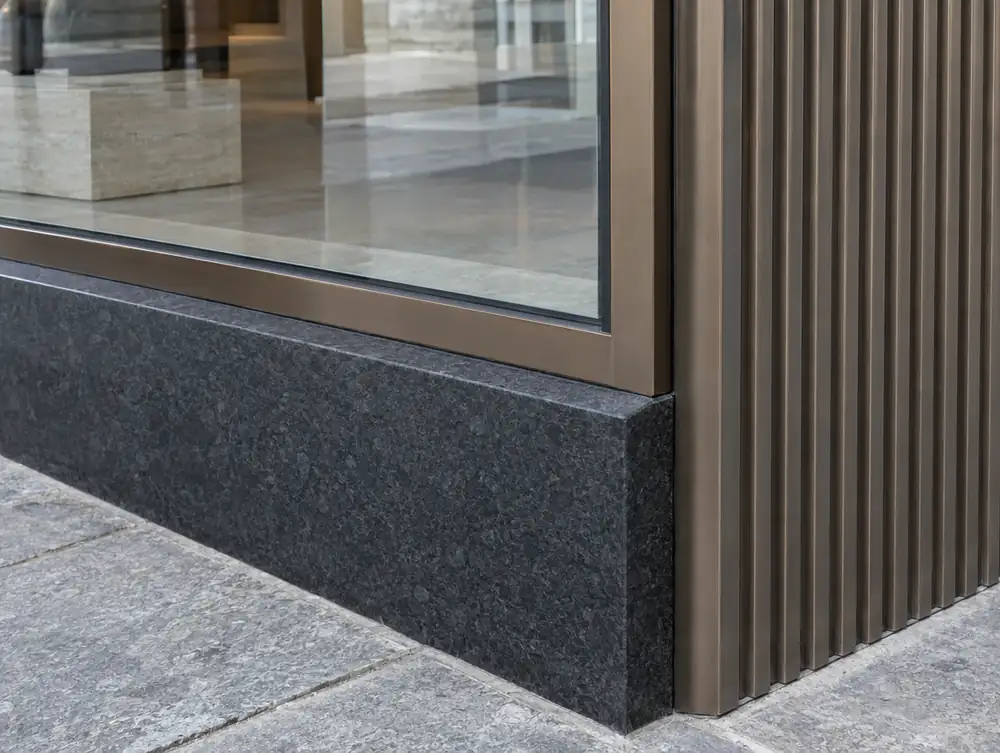
What should you settle before committing to stallrisers and cladding in Somerset?
Stripping an old facing can reveal what the building had first. If original tile or timber turns up on your premises in Somerset, we stop and talk to you, since repairing it may cost less than cladding over it.
Road grit does the most damage at this level. On premises across Somerset that take winter salt or regular pavement washing, we fit a replaceable plinth so the lowest edge can be changed without disturbing the facing.
What consents apply to stallrisers and cladding in Somerset?
A true like-for-like replacement usually needs no planning permission in England, because the external appearance isn't materially affected. New materials, a different glass line or altered proportions usually do count as material, so for stallrisers and cladding at premises in the Somerset area, an application is then likely. The council confirms which side of that line a job falls on.
How much do stallrisers and cladding cost in Somerset?
A sensible starting budget is £195 to £495 plus VAT per m². What shifts the figure is whatever can't be seen yet, such as the condition behind the old frontage or the services running through it.
| Area | Somerset |
|---|---|
| Nation | England |
| Towns covered | 18 |
| Main town | Bath |
| Planning regime | England: TCPA 1990 and the 2007 Advertisement Regulations |
| Building approval | Building Regulations (Approved Documents) |
| Survey | Free for new work, from our Great Barr base |
Questions about stallrisers and cladding in Somerset
How do I pick a stallriser finish for a unit in Somerset?
Start with the brick, stone or render above the shop, then bring in the brand colour. Samples held against the building in daylight will tell you more than a screen, so try them in the morning and the evening.
Can you match an existing tiled stallriser on premises in Somerset?
Often, yes, though an exact glaze match can be difficult. We take a sample tile, compare it with what is available, and suggest a specialist tile or a change at a natural break if the colour cannot be found.
Will road salt damage a metal stallriser in Somerset?
It will, if cut edges are left exposed. We use folded sheet with hidden edges, keep the base clear of the pavement and fit a replaceable plinth where salt is heavy.
What rules apply to a fire exit door through a shopfront in the Somerset area?
It must open in the direction of escape and can't be locked against immediate use, and a dedicated fire exit can't be a sliding or revolving door. In England that comes from article 14(2) of the Regulatory Reform (Fire Safety) Order 2005, and the duty sits with the responsible person, normally the employer or whoever controls the premises for a business, otherwise the owner. An outward door can clash with section 153 of the Highways Act 1980 where it opens onto the footway, so raise it early.
Do I need listed building consent for a shopfront in the Somerset area?
Usually yes, if the building is listed. In England the local planning authority decides, and Historic England is notified of Grade I and II* works and specified Grade II works. Like-for-like repair may not need consent, so ask the council before work starts.