Across Cumbria, timber is the material we suggest when a building has proportions worth respecting. For Barrow-in-Furness premises, we set the stallriser, pilasters and fascia from the elevation above, then detail the joinery to match.
Nothing gets ordered off the back of a survey in Barrow-in-Furness, because its job is to give us the numbers to draw and price from.
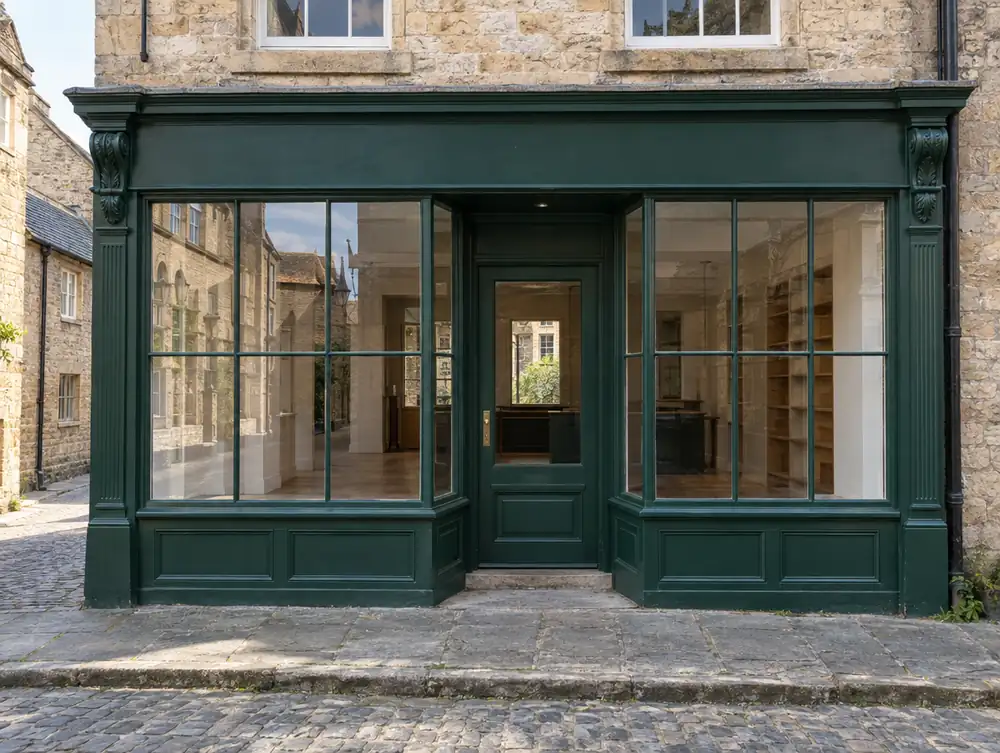
How do you design around the building when planning timber shopfronts in Barrow-in-Furness?
Narrow units suit timber well, because mouldings add interest where there's little width to work with. On a slim Barrow-in-Furness frontage we'd keep one strong pane, a panelled door and a fascia that doesn't crowd them.
In a parade of mixed fronts in Barrow-in-Furness, painted timber can lift a unit without shouting. We'd take the height of the neighbouring cills and fascias, then let the depth of the mouldings and a considered colour do the talking.
Where the footway outside your Barrow-in-Furness premises is narrow, a recessed entrance earns its keep. It gives people a dry place to pause out of the walkway, and it adds a longer run of display glass either side of the door.
What permissions should you check for timber shopfronts in Barrow-in-Furness?
England has no permitted development route for changing a shopfront. Part 7 Class A of the General Permitted Development Order 2015 excludes creating, altering or replacing one, and it allows no alterations at all on article 2(3) land. That leaves two outcomes for timber shopfronts at premises in the Barrow-in-Furness area: a planning application, or work that doesn't materially affect the external appearance.
We confirm the position at survey, because a boundary or a special designation can change who handles the file, but applications from Barrow-in-Furness premises normally go to Westmorland and Furness Council.
What might timber shopfronts cost in Barrow-in-Furness?
Until the survey is done, plan on £3,995 to £13,995 plus VAT for a typical frontage. Unusual sizes, fine detail and phased working push the figure up, while a simple brief and clear access keep it toward the lower end.
| Town | Barrow-in-Furness |
|---|---|
| Area | Cumbria |
| Postcode districts | LA13, LA14, LA15 |
| Planning authority | Westmorland and Furness Council |
| Building approval | Building Regulations (Approved Documents) |
| Distance from Great Barr | About 121 miles |
| Survey | Free for new work |
Questions about timber shopfronts in Barrow-in-Furness
Can a timber front take a modern sign in Barrow-in-Furness?
Yes. Hand-painted letters suit a timber fascia well, and raised letters or a concealed trough light work too. We draw the sign and the joinery together, so the fixings don't cut through a moulding.
Can you fit a timber front around existing tiles in Barrow-in-Furness?
Often, yes, and it's usually worth trying. If your stallriser or entrance has good original tile, we'd measure it carefully and scribe the new joinery to it.
How much disruption will a timber front cause in my Barrow-in-Furness shop?
Expect more time on site than an aluminium front, typically 3 to 7 days with the painting. Closed-day or out-of-hours fitting can be arranged, and the opening stays boarded and secure between stages.
What rules apply to a fire exit door through a shopfront in the Barrow-in-Furness area?
It must open in the direction of escape and can't be locked against immediate use, and a dedicated fire exit can't be a sliding or revolving door. In England that comes from article 14(2) of the Regulatory Reform (Fire Safety) Order 2005, and the duty sits with the responsible person, normally the employer or whoever controls the premises for a business, otherwise the owner. An outward door can clash with section 153 of the Highways Act 1980 where it opens onto the footway, so raise it early.
Does the Equality Act apply to a shop entrance in the Barrow-in-Furness area?
Yes. The Equality Act 2010 applies in England, as across Great Britain, and it requires reasonable steps to remove, alter or avoid physical features that disadvantage disabled people. The duty is anticipatory, so it looks at disabled people generally, and a new Services Code replaced the 2011 Code on 5 August 2026.