Want a front in Brynmawr that feels made rather than assembled? Timber does that well, provided the mouldings are in scale and the joinery is detailed to shed water.
We measure your Brynmawr opening in person, at a time agreed with you first, so the visit fits around your trading.
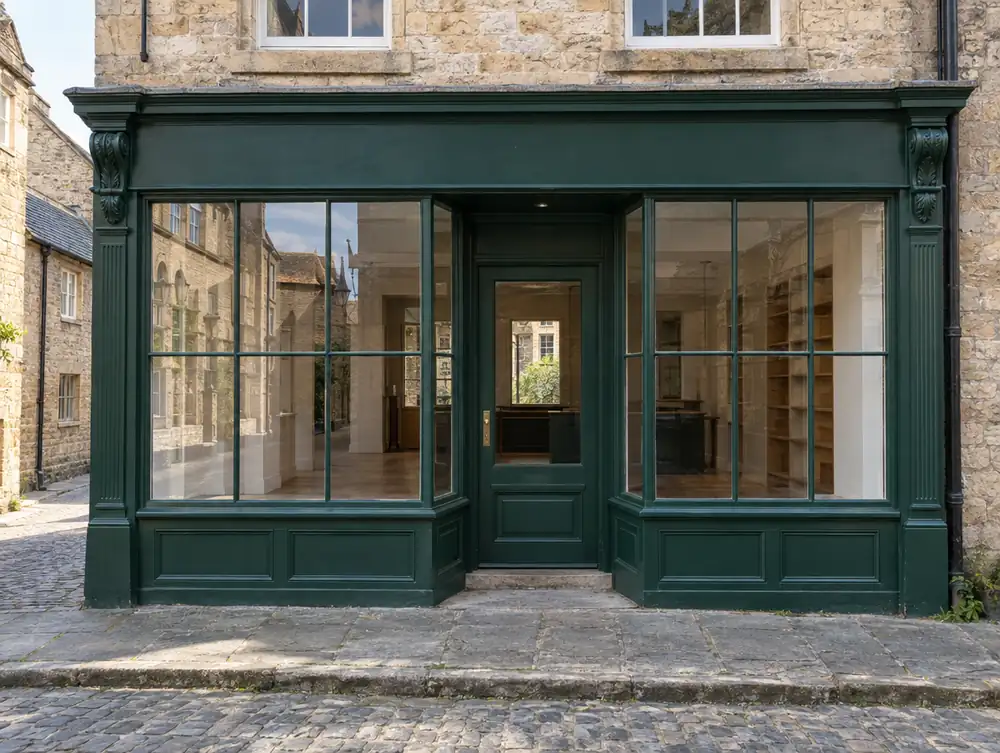
How do you design around the building when planning timber shopfronts in Brynmawr?
Narrow units suit timber well, because mouldings add interest where there's little width to work with. On a slim Brynmawr frontage we'd keep one strong pane, a panelled door and a fascia that doesn't crowd them.
A corner plot gives a timber front two faces and one chance to get the turn right. For Brynmawr premises on a corner, we'd use a pilaster or a canted bay at the angle, so the cornice wraps round without a clumsy mitre.
If your Brynmawr unit sits in a Victorian parade, the old pilasters usually set the rhythm, so a new front should land on them and not run past them. Keep that line and even a modern frame looks as though it belongs.
What permissions should you check for timber shopfronts in Brynmawr?
Like-for-like replacement usually needs no planning permission in Wales, because the external appearance isn't materially affected. Matching the existing materials, proportions and glass line is what keeps a job in that position. For timber shopfronts at premises in the Brynmawr area, changing any of those usually means an application, which the council can confirm.
Planning and advert applications for Brynmawr premises normally go to Blaenau Gwent County Borough Council. We check the position for your address at survey.
What might timber shopfronts cost in Brynmawr?
As a working budget, use £3,995 to £13,995 plus VAT for a typical frontage. Your place inside that range for timber shopfronts depends mostly on how much of the existing frontage can stay and how much has to be put right first.
| Town | Brynmawr |
|---|---|
| Area | Gwent |
| Postcode districts | NP22, NP23 |
| Planning authority | Blaenau Gwent County Borough Council |
| Building approval | Building Regulations (Approved Documents for Wales) |
| Distance from Great Barr | About 75 miles |
| Survey | Free for new work |
Does Blaenau Gwent County Borough Council publish shopfront guidance?
Yes, Shopfronts and Advertisements Supplementary Planning Guidance (2015). It tells applicants what the council expects from new and altered shopfronts. A few of the things it asks for:
- Solid metal shutters are not acceptable, while lattice or brick-bond grilles with housing hidden behind the fascia are more likely to be accepted.
- Shutter housing must be at least 2.1m above ground, and locks and guides must not encroach on the highway.
- Reinstating a stallriser is desirable where one has previously been removed.
Questions about timber shopfronts in Brynmawr
Do you make the joinery for Brynmawr shops to order?
Yes. Every length is made to the signed-off drawings for your opening, then brought to Brynmawr from Great Barr by vetted teams working under S&K Glazing.
Can you copy a timber shopfront I've seen in Gwent?
We can work from your photo and borrow what makes it succeed, including proportions, moulding sizes and colour. The front is then drawn to your own Brynmawr opening.
Is timber a sensible choice for my Brynmawr frontage?
Usually, if you're happy with a repaint every 5 to 7 years. A survey shows how exposed the front is and whether the structure behind it is sound, and we'll tell you if aluminium would serve you better.
What access duty applies to a shop in the Brynmawr area?
The Equality Act 2010 applies, in Wales as across Great Britain, and it requires reasonable steps to remove, alter or avoid physical features that disadvantage disabled people. The duty is anticipatory, so it covers disabled people generally. A feature that meets a design standard is generally protected for 10 years.
Can a shop fire exit in the Brynmawr area use a sliding door?
No, a dedicated fire exit can't be a sliding or revolving door. In Wales, article 14(2) of the Regulatory Reform (Fire Safety) Order 2005 also says fire exit doors must open in the direction of escape and can't be locked against immediate use. The responsible person holds that duty, normally the employer or whoever controls the premises for a business, otherwise the owner.