Refurbishment is a design job as much as a repair job. Small changes to colour, fascia depth and lighting can lift frontages in Brynmawr far more than their cost suggests.
It helps if you can be there when we visit Brynmawr, since five minutes walking the frontage together answers more than a long email.
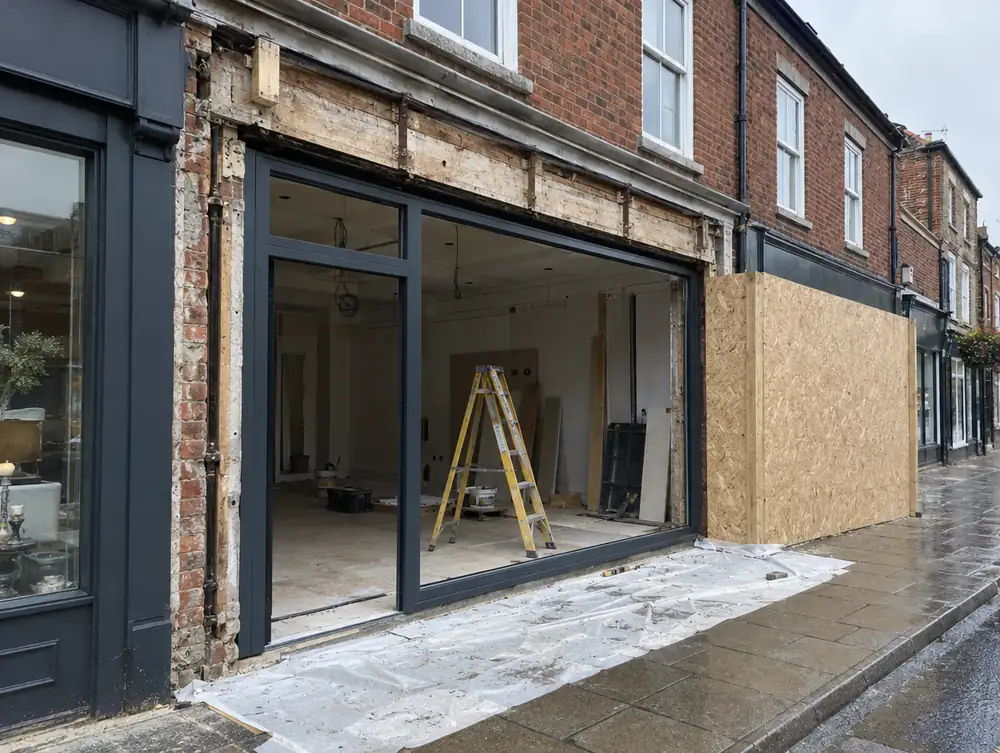
Where should you begin with shopfront refurbishment in Brynmawr?
If your Brynmawr premises need to stay open, we split the work into short stages. One bay at a time keeps the door in use, with out-of-hours work for anything noisy.
If the glass is old, we look for the etched safety mark in the corner of each pane. Panes without one, in the door or at low level, should be replaced while the frontage is being worked on.
If your premises were once two shops, decide early whether the front should read as one or as two. One continuous fascia with a repeated bay width usually settles the elevation better than two mismatched halves, which is worth testing on any Brynmawr unit of that kind.
What price should you expect for shopfront refurbishment in Brynmawr?
Allow £1,995 to £8,995 plus VAT depending on what is kept. Size and specification set most of that figure for shopfront refurbishment, and the rest depends on what the survey finds on site.
What sign-off might you need for shopfront refurbishment in Brynmawr?
Section 55 of the Town and Country Planning Act 1990 sets the test in Wales: work that doesn't materially affect the external appearance isn't development. Anything that does needs planning permission, and that goes for shopfront refurbishment at premises in the Brynmawr area as much as for a full new frontage. The council confirms how the test applies to your site.
Planning and advert applications for Brynmawr premises normally go to Blaenau Gwent County Borough Council. We check the position for your address at survey.
| Town | Brynmawr |
|---|---|
| Area | Gwent |
| Postcode districts | NP22, NP23 |
| Planning authority | Blaenau Gwent County Borough Council |
| Building approval | Building Regulations (Approved Documents for Wales) |
| Distance from Great Barr | About 75 miles |
| Survey | Free for new work |
Does Blaenau Gwent County Borough Council publish shopfront guidance?
Yes, Shopfronts and Advertisements Supplementary Planning Guidance (2015). It tells applicants what the council expects from new and altered shopfronts. A few of the things it asks for:
- Solid metal shutters are not acceptable, while lattice or brick-bond grilles with housing hidden behind the fascia are more likely to be accepted.
- Shutter housing must be at least 2.1m above ground, and locks and guides must not encroach on the highway.
- Reinstating a stallriser is desirable where one has previously been removed.
Questions about shopfront refurbishment in Brynmawr
How do I know if my Brynmawr shopfront needs replacing?
A measured survey will show you. We check the frame, joints, door and glass, then tell you plainly whether refurbishment will last or whether a new shopfront would be better value.
Can you repair a timber shopfront in Brynmawr?
Yes. Decayed sections are cut out and spliced with new hardwood, then primed and painted. That keeps the joinery you have, and it usually costs far less than making a new frontage.
Is it worth refurbishing an old aluminium shopfront in Brynmawr?
Often, yes, if the frame is straight and the corners are tight. Recoating, new gaskets and better glass can add years of life. If the frame is corroded or the door has worn out its fixings, replacement may make more sense.
Does a replacement shopfront in the Brynmawr area need Building Regulations approval?
Assume yes until building control says otherwise, because Wales has no like-for-like exemption. Glazing is judged against Approved Document N, as Wales keeps Part N. A registered installer can self-certify replacement windows and doors in non-dwellings, but not structural glass, curtain walling or revolving doors.
What access duty applies to a shop in the Brynmawr area?
The Equality Act 2010 applies, in Wales as across Great Britain, and it requires reasonable steps to remove, alter or avoid physical features that disadvantage disabled people. The duty is anticipatory, so it covers disabled people generally. A feature that meets a design standard is generally protected for 10 years.