Across Bedfordshire, timber is the material we suggest when a building has proportions worth respecting. For Dunstable premises, we set the stallriser, pilasters and fascia from the elevation above, then detail the joinery to match.
Nothing gets ordered off the back of a survey in Dunstable, because its job is to give us the numbers to draw and price from.
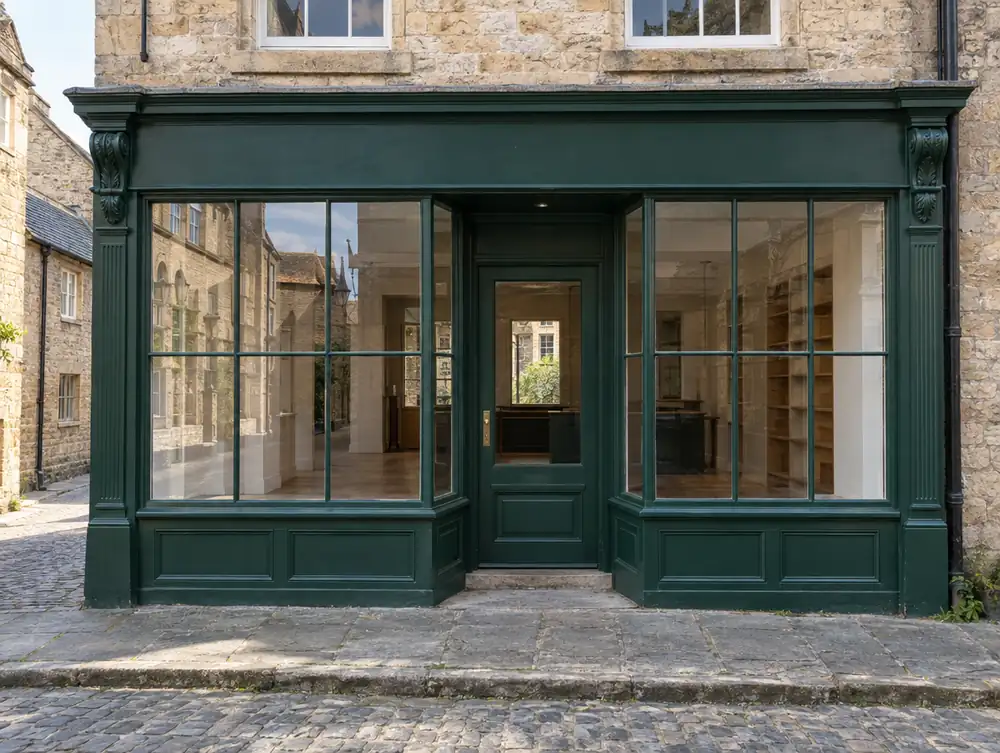
Where should you begin with timber shopfronts in Dunstable?
A corner plot gives a timber front two faces and one chance to get the turn right. For Dunstable premises on a corner, we'd use a pilaster or a canted bay at the angle, so the cornice wraps round without a clumsy mitre.
Where a landlord in Dunstable has set rules for materials or colour, timber is usually an easy conversation. We'd prepare a drawing and paint reference for approval, and adjust the mouldings if the terms ask for something plainer.
If your premises were once two shops, decide early whether the front should read as one or as two. One continuous fascia with a repeated bay width usually settles the elevation better than two mismatched halves, which is worth testing on any Dunstable unit of that kind.
What sign-off might you need for timber shopfronts in Dunstable?
England has no permitted development route for changing a shopfront. Part 7 Class A of the General Permitted Development Order 2015 excludes creating, altering or replacing one, and it allows no alterations at all on article 2(3) land. That leaves two outcomes for timber shopfronts at premises in the Dunstable area: a planning application, or work that doesn't materially affect the external appearance.
We confirm the position at survey, because a boundary or a special designation can change who handles the file, but applications from Dunstable premises normally go to Central Bedfordshire Council.
What price should you expect for timber shopfronts in Dunstable?
Until the survey is done, plan on £3,995 to £13,995 plus VAT for a typical frontage. Unusual sizes, fine detail and phased working push the figure up, while a simple brief and clear access keep it toward the lower end.
| Town | Dunstable |
|---|---|
| Area | Bedfordshire |
| Postcode districts | LU6 |
| Planning authority | Central Bedfordshire Council |
| Building approval | Building Regulations (Approved Documents) |
| Distance from Great Barr | About 75 miles |
| Survey | Free for new work |
Questions about timber shopfronts in Dunstable
Is timber a sensible choice for my Dunstable frontage?
Usually, if you're happy with a repaint every 5 to 7 years. A survey shows how exposed the front is and whether the structure behind it is sound, and we'll tell you if aluminium would serve you better.
How much disruption will a timber front cause in my Dunstable shop?
Expect more time on site than an aluminium front, typically 3 to 7 days with the painting. Closed-day or out-of-hours fitting can be arranged, and the opening stays boarded and secure between stages.
Will timber suffer on my Dunstable frontage if it gets a lot of rain?
Not if the details are right. Sloped cills, sealed end grain and plinth blocks keep water moving, and the paint system then only has to deal with the weather, not trapped damp.
Does a shop sign in the Dunstable area need advertisement consent?
Not always. In England, an unlit sign within Class 5 of the 2007 Advertisement Regulations generally needs no application, and neither does a lit sign within Class 4B. Anything outside those classes needs consent, and Class 4B isn't available in conservation areas, so check before ordering.
Do roller shutters need planning permission in the Dunstable area?
Usually yes. Installing or replacing a security grill or shutter on a shopfront is expressly outside England's shop permitted development rights, so the only way to avoid an application is work that doesn't materially affect the appearance. Ask the council before ordering.