Want a front in Halewood that feels made rather than assembled? Timber does that well, provided the mouldings are in scale and the joinery is detailed to shed water.
It helps if you can be there when we visit Halewood, since five minutes walking the frontage together answers more than a long email.
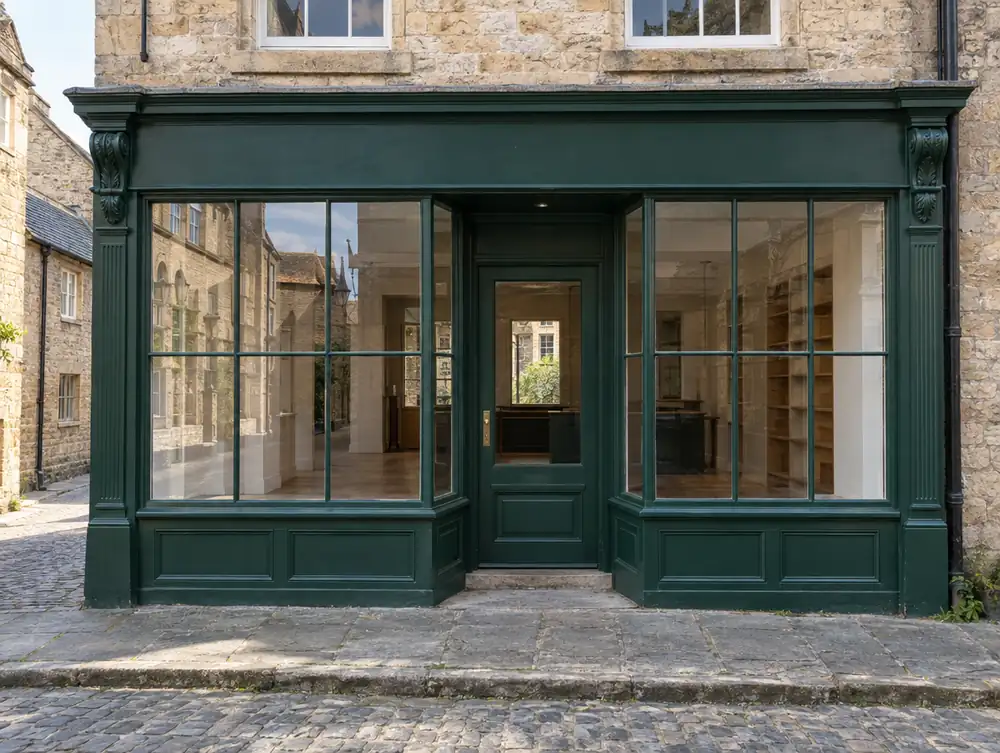
Where should you begin with timber shopfronts in Halewood?
A brand rollout can include timber, as long as the details repeat. For a branch in Halewood we'd use the same mouldings, colours and sign panel as your other sites, adjusting only the widths and heights to fit the opening.
In a parade of mixed fronts in Halewood, painted timber can lift a unit without shouting. We'd take the height of the neighbouring cills and fascias, then let the depth of the mouldings and a considered colour do the talking.
If your premises were once two shops, decide early whether the front should read as one or as two. One continuous fascia with a repeated bay width usually settles the elevation better than two mismatched halves, which is worth testing on any Halewood unit of that kind.
What price should you expect for timber shopfronts in Halewood?
A sensible starting budget is £3,995 to £13,995 plus VAT for a typical frontage. What shifts the figure is whatever can't be seen yet, such as the condition behind the old frontage or the services running through it.
What sign-off might you need for timber shopfronts in Halewood?
Security grilles and shutters are named in England's rules: installing or replacing one on a shopfront sits outside the shop permitted development rights. The frontage itself is treated the same way, so for timber shopfronts at premises in the Halewood area, building work that materially affects the appearance needs planning permission. Confirm the position with the council before anything is ordered.
Planning and advert applications for Halewood premises normally go to Knowsley Metropolitan Borough Council. We check the position for your address at survey.
| Town | Halewood |
|---|---|
| Area | Merseyside |
| Postcode districts | L26 |
| Planning authority | Knowsley Metropolitan Borough Council |
| Building approval | Building Regulations (Approved Documents) |
| Distance from Great Barr | About 68 miles |
| Survey | Free for new work |
Does Knowsley Metropolitan Borough Council publish shopfront guidance?
Yes, Shopfront and Signage Design Supplementary Planning Document (2023). It tells applicants what the council expects from new and altered shopfronts. A few of the things it asks for:
- The stallriser should generally be no more than 20% of the shopfront's overall height.
- The fascia should be no more than 20% of the shopfront's height and generally no deeper than 400mm.
- Solid external roller shutters are unacceptable, and internal grilles or shutters are preferred.
Questions about timber shopfronts in Halewood
Do you make the joinery for Halewood shops to order?
Yes. Every length is made to the signed-off drawings for your opening, then brought to Halewood from Great Barr by vetted teams working under S&K Glazing.
What should I budget for looking after a timber front in Halewood?
A repaint every 5 to 7 years, plus a yearly wash and touch-up of the cills. Door gear needs checking too, since seasonal movement can throw a door out of line.
Is timber a sensible choice for my Halewood frontage?
Usually, if you're happy with a repaint every 5 to 7 years. A survey shows how exposed the front is and whether the structure behind it is sound, and we'll tell you if aluminium would serve you better.
Does a new shopfront in the Halewood area need Building Regulations approval?
Assume yes until building control says otherwise. England has no like-for-like exemption, though registered installers can self-certify replacement windows and doors in non-dwellings. That route doesn't cover structural glass, curtain walling or revolving doors.
Do I need listed building consent for a shopfront in the Halewood area?
Usually yes, if the building is listed. In England the local planning authority decides, and Historic England is notified of Grade I and II* works and specified Grade II works. Like-for-like repair may not need consent, so ask the council before work starts.