Want a front in Whiston that feels made rather than assembled? Timber does that well, provided the mouldings are in scale and the joinery is detailed to shed water.
A survey in Whiston usually starts outside, looking at the whole elevation before any tape comes out, because the frontage has to answer the building above it.
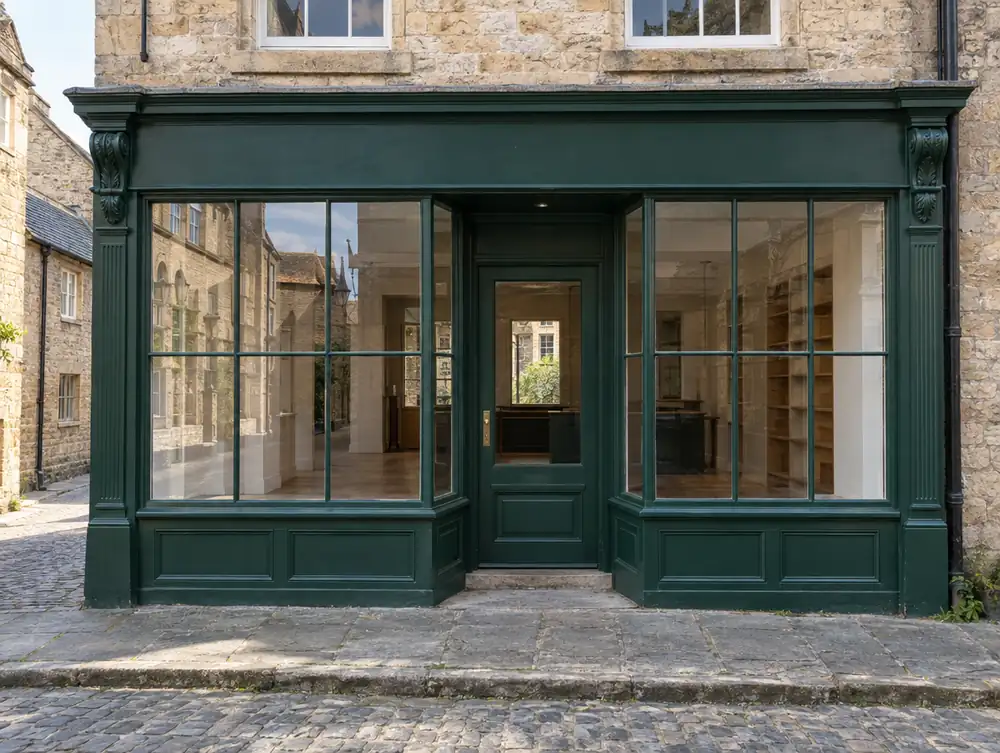
What makes timber shopfronts work well on Whiston premises?
A south or west-facing Whiston frontage is hard on paint. We'd steer you toward a lighter colour or a more stable timber, and if the brand needs a dark finish, we'd plan a shorter repaint interval from the outset.
A corner plot gives a timber front two faces and one chance to get the turn right. For Whiston premises on a corner, we'd use a pilaster or a canted bay at the angle, so the cornice wraps round without a clumsy mitre.
If the pavement falls across your frontage, let the stallriser take up the slope and keep the glass line dead level. The eye reads the long horizontal, so Whiston premises on a slope look settled once that line is true.
Could timber shopfronts in Whiston need planning permission?
Security grilles and shutters are named in England's rules: installing or replacing one on a shopfront sits outside the shop permitted development rights. The frontage itself is treated the same way, so for timber shopfronts at premises in the Whiston area, building work that materially affects the appearance needs planning permission. Confirm the position with the council before anything is ordered.
For Whiston, the usual route for planning and advert applications is through Knowsley Metropolitan Borough Council, and we confirm that when we visit.
How much should you set aside for timber shopfronts in Whiston?
A sensible starting budget is £3,995 to £13,995 plus VAT for a typical frontage. What shifts the figure is whatever can't be seen yet, such as the condition behind the old frontage or the services running through it.
| Town | Whiston |
|---|---|
| Area | Merseyside |
| Postcode districts | L34, L35, L36, WA10 |
| Planning authority | Knowsley Metropolitan Borough Council |
| Building approval | Building Regulations (Approved Documents) |
| Distance from Great Barr | About 70 miles |
| Survey | Free for new work |
Does Knowsley Metropolitan Borough Council publish shopfront guidance?
Yes, Shopfront and Signage Design Supplementary Planning Document (2023). It tells applicants what the council expects from new and altered shopfronts. A few of the things it asks for:
- The stallriser should generally be no more than 20% of the shopfront's overall height.
- The fascia should be no more than 20% of the shopfront's height and generally no deeper than 400mm.
- Solid external roller shutters are unacceptable, and internal grilles or shutters are preferred.
Questions about timber shopfronts in Whiston
How much disruption will a timber front cause in my Whiston shop?
Expect more time on site than an aluminium front, typically 3 to 7 days with the painting. Closed-day or out-of-hours fitting can be arranged, and the opening stays boarded and secure between stages.
Can a timber front take a modern sign in Whiston?
Yes. Hand-painted letters suit a timber fascia well, and raised letters or a concealed trough light work too. We draw the sign and the joinery together, so the fixings don't cut through a moulding.
Can you fit a timber front around existing tiles in Whiston?
Often, yes, and it's usually worth trying. If your stallriser or entrance has good original tile, we'd measure it carefully and scribe the new joinery to it.
Does the Equality Act apply to a shop entrance in the Whiston area?
Yes. The Equality Act 2010 applies in England, as across Great Britain, and it requires reasonable steps to remove, alter or avoid physical features that disadvantage disabled people. The duty is anticipatory, so it looks at disabled people generally, and a new Services Code replaced the 2011 Code on 5 August 2026.
Do I need planning permission to change a shopfront in the Whiston area?
Usually yes, if the work materially affects the building's external appearance. England's shop permitted development rights exclude creating, altering or replacing a shopfront, so there is no shortcut. A true like-for-like replacement usually needs no application, and the council confirms the position.