A jeweller needs glass that holds together under attack, a controlled way in and a window that still feels calm and expensive. The protection should sit in the glass, frame and fixings, where a customer never has to look at it.
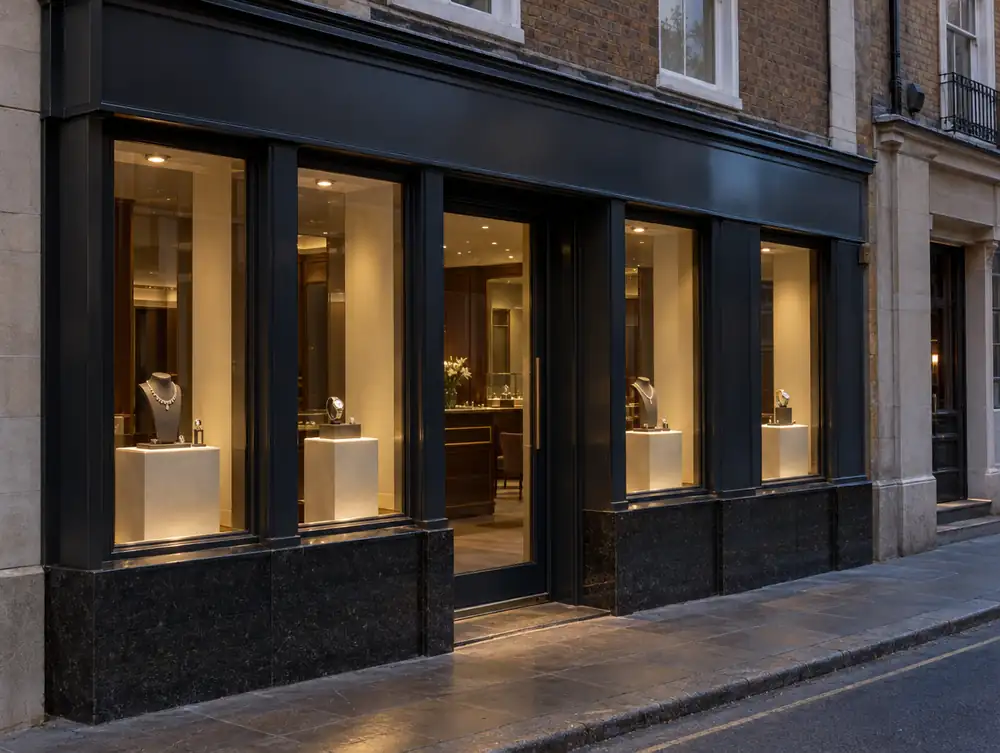
What glass do jewellers use in the window?
Thick multi-layer laminated glass is the usual choice, because the interlayers keep the pane in the frame after it has been struck. BS EN 356 classifies security glazing by its resistance to manual attack, using classes such as P6B.
Policies differ, so ask your broker what, if anything, the insurer wants before the glass is specified. We then price that build-up, and the test certificate comes with the glass where one applies.
Allow for weight as well. A thick laminate is far heavier than a standard pane, so lifting, handling and the cill below it all need checking at survey.
Why does the frame matter as much as the glass?
An attacker goes for the weakest edge, and that is rarely the middle of the pane. Heavy glass in a light frame simply moves the problem to the beads and fixings.
- Glazing beads on the inside, where they can't be levered off from the street
- Deep edge cover, so a cracked pane stays gripped
- Frame fixings into sound masonry or steel, checked at survey
- A stallriser with real mass behind the cladding
How should customers get into a jeweller's?
A door released by staff, often with a camera and call button, lets the shop see who is arriving without making them feel screened. Mount that button where a wheelchair user can reach it.
Keeping people out must not mean locking them in. Across all four UK nations, doors on an escape route can't be locked against immediate use, so the inside release needs thought from day one. That duty sits with the responsible person in England and Wales, and with dutyholders in Scotland and Northern Ireland.
How do small pieces read from the pavement?
Raise them: a stallriser around 800mm brings rings and dials close to eye level, the opposite of a clothing window.
Tighter windows work harder here than wide ones. A narrow, dark-lined case with small beams of light lets one watch hold attention, and the dark backing cuts reflections from the street. Keep the sightlines fine, because a thick frame makes a small object look smaller still.
What should the window show after closing?
Something considered, because many jewellers clear the window at night and an empty, dark case looks abandoned. Lit brand panels or display pieces of no real value keep the front alive.
If you add a shutter, a perforated one inside the glass keeps that view. LPS 1175 grades such as B3 combine a tool category and delay minutes, should you be asked for a tested level. Fitting one on the outer face is a planning matter: England and Wales place shutters expressly outside permitted development, and in Scotland and Northern Ireland the council looks at the change in appearance.
Common questions
Is laminated glass enough on its own?
Rarely. Glass, frame, fixings, door and alarm work as one set, and an attacker will test the weakest of them.
Will my insurer accept this glass?
Only your insurer can say, because terms vary by policy and stock value. Ask before ordering, and we'll supply the specification for your broker.
Can security glass go into a listed shopfront?
Sometimes, with care. In England, Historic England warns that heavier glass can affect a shop front's structure, so the frame needs checking and consent should be expected.
Can a watch window use frameless glass?
It can look right, but exposed edges give an attacker more to work on. A slim metal frame is usually the sounder choice.