From Galashiels to the furthest corner of the Scottish Borders, the sequence for accessible entrances stays the same: survey, drawings, written price, then work on site. We travel from Great Barr in Birmingham and use vetted teams working under S&K Glazing.
What sits behind the existing fascia often decides the job. Old beams, abandoned cable runs and earlier frames are common finds, which is why our visit to the Scottish Borders premises looks past the surface before anything is drawn or priced for accessible entrances.
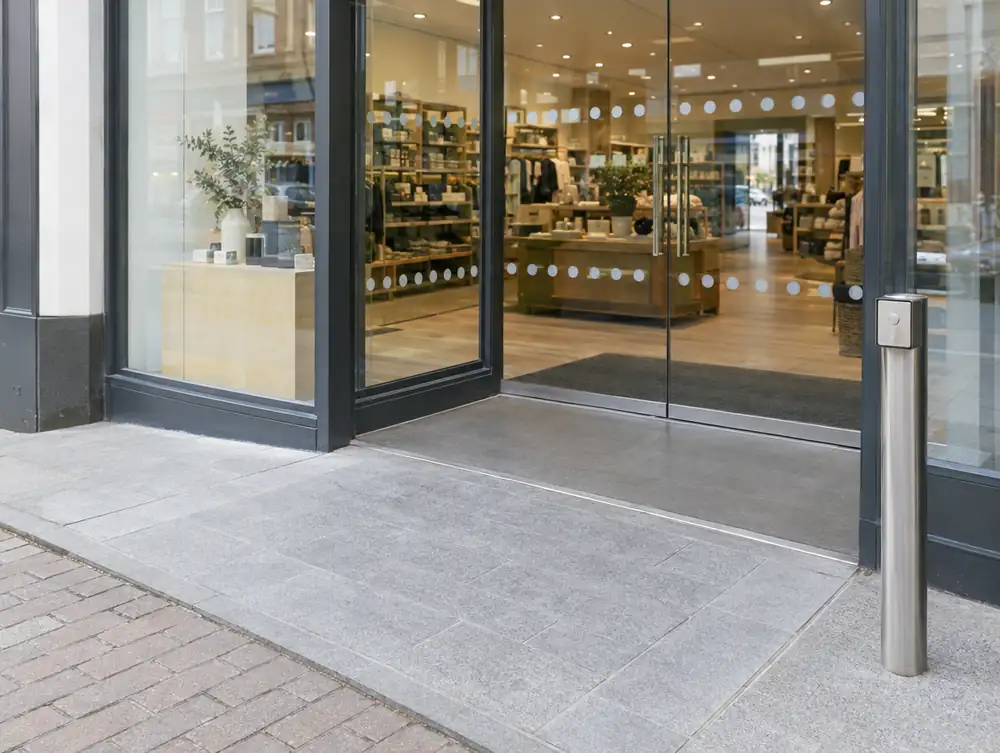
How should you approach accessible entrances in the Scottish Borders?
Busy doors need a different answer from quiet ones. A shop in Galashiels with constant footfall may suit a sliding door, while a small shop elsewhere in the Scottish Borders may do well with a power-assisted swing door and a well-placed push pad.
A better entrance helps everyone who uses it, including staff wheeling stock and parents with pushchairs. For premises in the Scottish Borders, we look at deliveries and daily use as well, so the new door works for the whole business.
What consents apply to accessible entrances in the Scottish Borders?
Scottish guidance says like-for-like windows need no permission, and a true like-for-like frontage replacement usually follows the same logic. Class 7A covers altering or replacing an existing window, but it doesn't mention shopfronts, so ask before relying on it for a display window. For accessible entrances at premises in the Scottish Borders area, a material effect on the external appearance means planning permission, and the council confirms the position.
How much do accessible entrances cost in the Scottish Borders?
A sensible starting budget is £995 to £6,995 plus VAT depending on the work. What shifts the figure is whatever can't be seen yet, such as the condition behind the old frontage or the services running through it.
| Area | Scottish Borders |
|---|---|
| Nation | Scotland |
| Towns covered | 2 |
| Main town | Galashiels |
| Planning regime | Scotland: 1997 Planning Act and the 1984 Advertisement Regulations |
| Building approval | Building warrant (Technical Handbook) |
| Survey | Free for new work, from our Great Barr base |
Does Scottish Borders Council publish shopfront guidance?
Yes, Supplementary Planning Guidance on Shop Fronts and Shop Signs (2011). It tells applicants what the council expects from new and altered shopfronts. A few of the things it asks for:
- Roller shutters are opposed on listed buildings and sensitive conservation area frontages, and elsewhere should be recessed and preferably open grille.
- Signs in conservation areas should not be internally illuminated, and reasonable external lighting is often acceptable.
- Each enterprise may have one projecting sign, with its bottom edge at least 2.25m above ground and 0.5m in from the kerb.
Questions about accessible entrances in the Scottish Borders
My shop in Galashiels has a step. What are the options?
It depends on the height and the space inside. Common answers are a shallow ramp in a recess, a lowered floor behind the door, or moving the entrance along a sloping pavement.
Can you help customers with mobility scooters at premises in Galashiels?
We can look at the door width, the turning space inside and the threshold together, as scooters need more room than most wheelchairs.
Will a powered door suit a small shop in the Scottish Borders?
Often, yes. A low-energy swing operator suits small entrances and quieter footfall, and the door can still be used by hand.
Do I need listed building consent for a shopfront in the Scottish Borders area?
Almost certainly, if the building is listed and windows or doors are changing, according to Historic Environment Scotland. The planning authority decides, and Historic Environment Scotland is consulted on some applications. Scottish Ministers are notified if it objects.
Does the Equality Act cover a shop entrance in the Scottish Borders area?
Yes. The Equality Act 2010 applies in Scotland as part of Great Britain, and its anticipatory duty expects reasonable steps to remove, alter or avoid physical features that disadvantage disabled people generally. BS 8300-2:2018 is the current British Standard for accessible buildings.