A bi-fold for Canterbury premises is one job under one contract, covering the panels, threshold and any new steel. Your named contact handles it, and we travel from Great Barr.
Nothing gets ordered off the back of a survey in Canterbury, because its job is to give us the numbers to draw and price from.
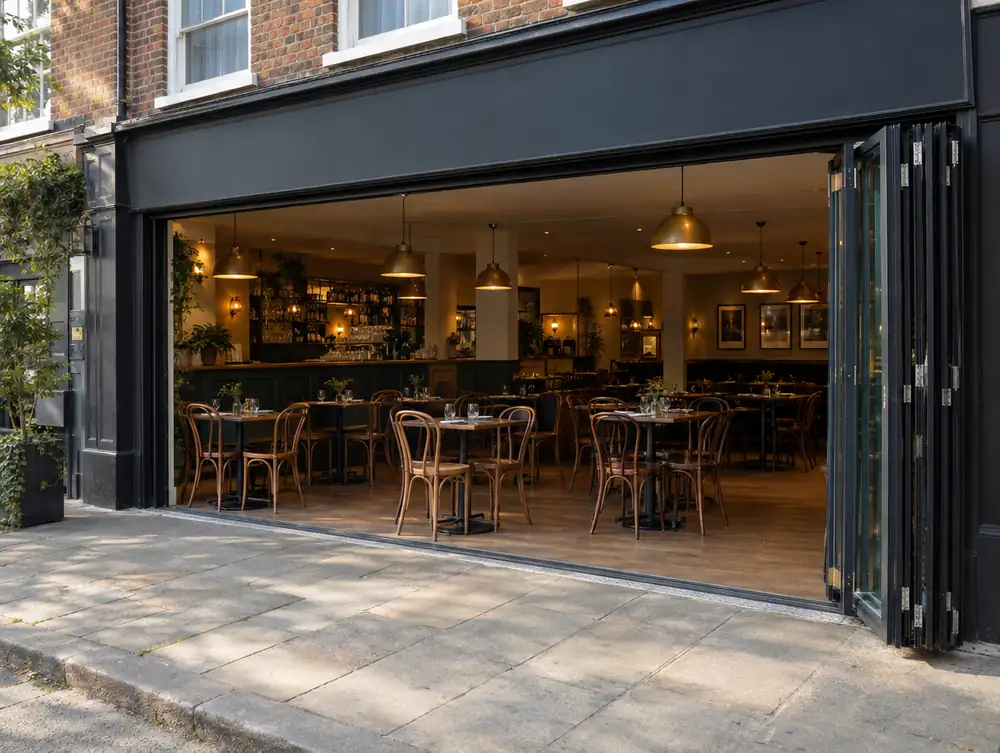
What makes bi-folding shopfronts work well on Canterbury premises?
In a parade in Canterbury, a bi-fold has to sit politely when closed. We'd match the fascia line and keep a short fixed return at one end, so the set reads as part of the row instead of a gap in it.
On a narrow Canterbury unit, the stack can swallow the opening. We'd limit the set to three panels, or look at a single sliding leaf, so the opening you gain outweighs the width lost to parked frames.
A corner unit has two fronts to think about, and the return elevation often does as much selling as the main one. If that is your layout in Canterbury, carry the fascia and glass line round the corner and treat both faces as one composition.
Could bi-folding shopfronts in Canterbury need planning permission?
Security grilles and shutters are named in England's rules: installing or replacing one on a shopfront sits outside the shop permitted development rights. The frontage itself is treated the same way, so for bi-folding shopfronts at premises in the Canterbury area, building work that materially affects the appearance needs planning permission. Confirm the position with the council before anything is ordered.
At survey we check how things stand for your building, although applications for planning permission or advertisement consent here normally go to Canterbury City Council.
How much should you set aside for bi-folding shopfronts in Canterbury?
The guide for bi-folding shopfronts is £5,195 to £13,995 plus VAT for a typical opening. Expect the lower end for simple work with clear access, and the upper end where detail, finish or awkward conditions add hours.
| Town | Canterbury |
|---|---|
| Area | Kent |
| Postcode districts | CT1, CT2, CT5, CT6 |
| Planning authority | Canterbury City Council |
| Building approval | Building Regulations (Approved Documents) |
| Distance from Great Barr | About 155 miles |
| Survey | Free for new work |
Does Canterbury City Council publish shopfront guidance?
Yes, Shopfront design Supplementary Planning Document (2020). It tells applicants what the council expects from new and altered shopfronts. A few of the things it asks for:
- Fascia depth must not exceed the depth of the console, or one-fifth of the distance from console to pavement.
- External solid roller shutters are not normally supported in conservation areas or main shopping streets and are unacceptable on listed buildings.
- Internally lit box signs, illuminated letters and window neon are unsuitable in conservation areas, with external lighting only for premises open at night.
Questions about bi-folding shopfronts in Canterbury
Which way should the panels fold at my Canterbury premises?
Inward is the usual answer, since panels folded into the room stay clear of people on the pavement. We'd draw the options where the room allows, and you choose against your seating plan.
How secure is a folding front in Canterbury overnight?
Very, if it is specified for the job. Each leaf locks top and bottom with concealed bolts, and laminated glass adds a second line of defence.
Can the threshold be level at my Canterbury premises?
It can be close to level, depending on the floor and drainage. We'd check the levels at survey, because a track sitting flush with the pavement still needs somewhere for water to go.
Does a new shopfront in the Canterbury area need Building Regulations approval?
Assume yes until building control says otherwise. England has no like-for-like exemption, though registered installers can self-certify replacement windows and doors in non-dwellings. That route doesn't cover structural glass, curtain walling or revolving doors.
Do I need planning permission to change a shopfront in the Canterbury area?
Usually yes, if the work materially affects the building's external appearance. England's shop permitted development rights exclude creating, altering or replacing a shopfront, so there is no shortcut. A true like-for-like replacement usually needs no application, and the council confirms the position.