Security after hours is rarely a simple choice between a heavy shutter and nothing. We look at your stock, your glass and your Canterbury premises together, then specify what the risk calls for.
Nothing gets ordered off the back of a survey in Canterbury, because its job is to give us the numbers to draw and price from.
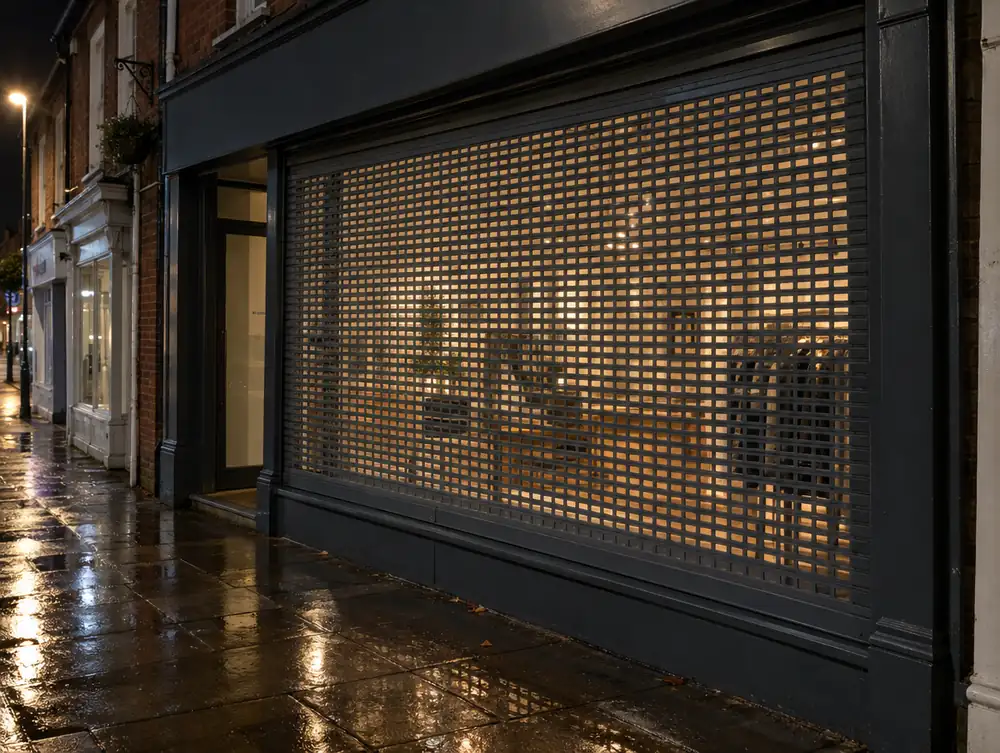
What goes into getting perforated roller shutters right in Canterbury?
If the display goes dark overnight, the shutter will read as plain metal from the street. A low-level timer on the window lighting costs very little and keeps your Canterbury frontage looking open.
If the shutter has to run past a door or a side window, we check how the curtain lands on the threshold. A neat bottom rail and floor lock keep the entrance flush when the shutter is up.
Where units share one long run of fascia, breaking the height makes you stand out for the wrong reason. If that describes your Canterbury parade, keep the line and win attention with lettering, lighting and what's in the window.
Which applications might perforated roller shutters in Canterbury involve?
A true like-for-like replacement usually needs no planning permission in England, because the external appearance isn't materially affected. New materials, a different glass line or altered proportions usually do count as material, so for perforated roller shutters at premises in the Canterbury area, an application is then likely. The council confirms which side of that line a job falls on.
Canterbury applications for planning permission or advertisement consent are normally handled by Canterbury City Council. Our survey includes a check of the position for your address.
How much could perforated roller shutters in Canterbury cost you?
Until the survey is done, plan on £1,695 to £4,495 plus VAT per shutter. Unusual sizes, fine detail and phased working push the figure up, while a simple brief and clear access keep it toward the lower end.
| Town | Canterbury |
|---|---|
| Area | Kent |
| Postcode districts | CT1, CT2, CT5, CT6 |
| Planning authority | Canterbury City Council |
| Building approval | Building Regulations (Approved Documents) |
| Distance from Great Barr | About 155 miles |
| Survey | Free for new work |
Does Canterbury City Council publish shopfront guidance?
Yes, Shopfront design Supplementary Planning Document (2020). It tells applicants what the council expects from new and altered shopfronts. A few of the things it asks for:
- Fascia depth must not exceed the depth of the console, or one-fifth of the distance from console to pavement.
- External solid roller shutters are not normally supported in conservation areas or main shopping streets and are unacceptable on listed buildings.
- Internally lit box signs, illuminated letters and window neon are unsuitable in conservation areas, with external lighting only for premises open at night.
Questions about perforated roller shutters in Canterbury
What happens if the shutter jams at closing time in Canterbury?
Do not force it, because that can damage the curtain and motor. Use the manual override if it is safe, then call us. Repairs are charged call-outs, and the fixed price is shown on our site.
Can a perforated shutter match my other sites in Kent?
Yes. Send us the colour reference and curtain type from an existing site, and we match them on the new one. The box and guides may differ, because each frontage has its own structure.
Can one person open the shutter at my Canterbury shop?
Yes. Powered shutters run at the turn of a key or a button press, and a manual override is available if the power fails. We show your staff both at handover.
Does a shop sign in the Canterbury area need advertisement consent?
Not always. In England, an unlit sign within Class 5 of the 2007 Advertisement Regulations generally needs no application, and neither does a lit sign within Class 4B. Anything outside those classes needs consent, and Class 4B isn't available in conservation areas, so check before ordering.
Do I need listed building consent for a shopfront in the Canterbury area?
Usually yes, if the building is listed. In England the local planning authority decides, and Historic England is notified of Grade I and II* works and specified Grade II works. Like-for-like repair may not need consent, so ask the council before work starts.