Landlords, shopfitters and architects working in Canterbury can use the service as a full package or for one difficult detail. Either way the drawings start from a measured survey.
Your survey is where the price gets real, because widths, heights, levels and access are all taken on site in Canterbury.
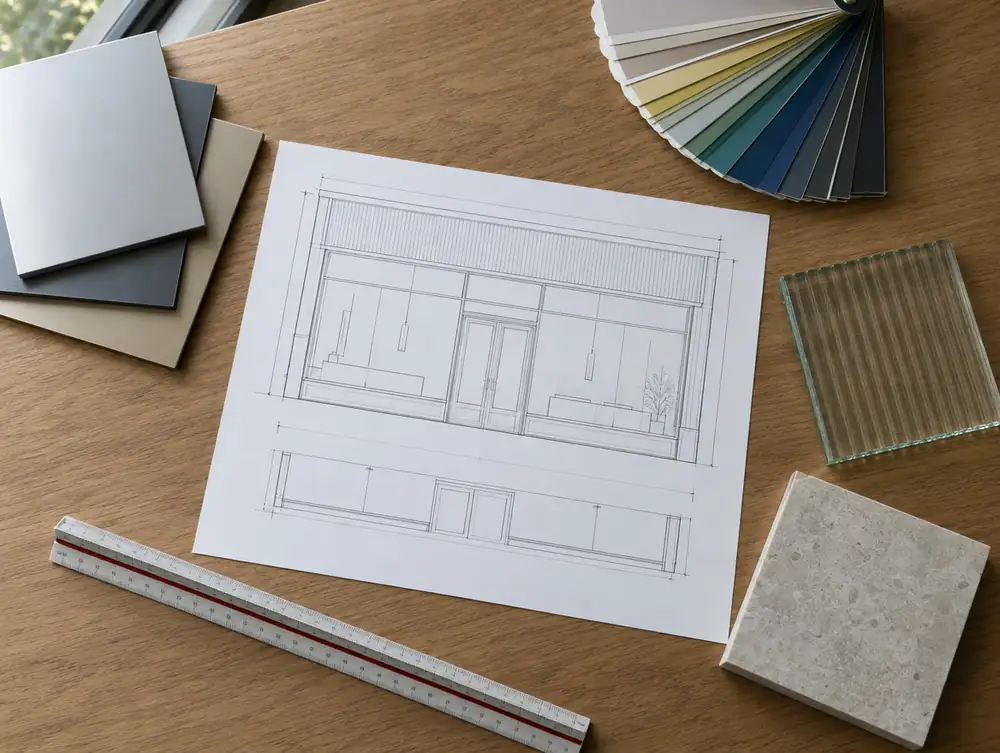
How do you design around the building when planning shopfront design in Canterbury?
Where an existing shopfront has good bones, the design may keep the frame and change only the glass, fascia and colour. We would show that option next to a new frontage, with the cost of each.
Where the building above has strong vertical lines, we carry them down through pilasters and mullions. If it is plain, the shopfront can take a calmer, wider treatment.
Where units share one long run of fascia, breaking the height makes you stand out for the wrong reason. If that describes your Canterbury parade, keep the line and win attention with lettering, lighting and what's in the window.
What permissions should you check for shopfront design in Canterbury?
England has no permitted development route for changing a shopfront. Part 7 Class A of the General Permitted Development Order 2015 excludes creating, altering or replacing one, and it allows no alterations at all on article 2(3) land. That leaves two outcomes for shopfront work at premises in the Canterbury area: a planning application, or work that doesn't materially affect the external appearance.
We confirm the position at survey, because a boundary or a special designation can change who handles the file, but applications from Canterbury premises normally go to Canterbury City Council.
What might shopfront design cost in Canterbury?
Our guide band is £495 to £2,495 plus VAT per frontage. Scope is the biggest lever, so a tighter brief for shopfront design brings the figure down faster than any change of detail.
| Town | Canterbury |
|---|---|
| Area | Kent |
| Postcode districts | CT1, CT2, CT5, CT6 |
| Planning authority | Canterbury City Council |
| Building approval | Building Regulations (Approved Documents) |
| Distance from Great Barr | About 155 miles |
| Survey | Free for new work |
Does Canterbury City Council publish shopfront guidance?
Yes, Shopfront design Supplementary Planning Document (2020). It tells applicants what the council expects from new and altered shopfronts. A few of the things it asks for:
- Fascia depth must not exceed the depth of the console, or one-fifth of the distance from console to pavement.
- External solid roller shutters are not normally supported in conservation areas or main shopping streets and are unacceptable on listed buildings.
- Internally lit box signs, illuminated letters and window neon are unsuitable in conservation areas, with external lighting only for premises open at night.
Questions about shopfront design in Canterbury
Do I need a design service for a simple Canterbury shopfront?
Not always. Every job gets a measured survey and scale drawings anyway. The design service adds options, visuals and a full specification, which pay off when the look matters most.
What do you need from me before designing for my Canterbury premises?
The address, brand files and a few frontages you admire are a good start. Tell us your rough budget too, because it helps us focus on what can be built.
Can you design a frontage for Canterbury premises I have not taken on yet?
Yes. A survey and concept drawing can show what the unit could become and what it might cost. That can be useful before you sign anything.
Does a shop sign in the Canterbury area need advertisement consent?
Not always. In England, an unlit sign within Class 5 of the 2007 Advertisement Regulations generally needs no application, and neither does a lit sign within Class 4B. Anything outside those classes needs consent, and Class 4B isn't available in conservation areas, so check before ordering.
Does the Equality Act apply to a shop entrance in the Canterbury area?
Yes. The Equality Act 2010 applies in England, as across Great Britain, and it requires reasonable steps to remove, alter or avoid physical features that disadvantage disabled people. The duty is anticipatory, so it looks at disabled people generally, and a new Services Code replaced the 2011 Code on 5 August 2026.