What should your premises say from across the road? We open every conversation about bronze and metal shopfronts in Gwent with that question, then treat sightlines and proportion as seriously as the budget.
Your frontage is read alongside its neighbours, so we note the fascia line, stallriser height and pilasters on either side before drawing bronze and metal shopfronts for Gwent premises. Matching those lines or breaking them on purpose can both work, whereas doing it by accident never does.
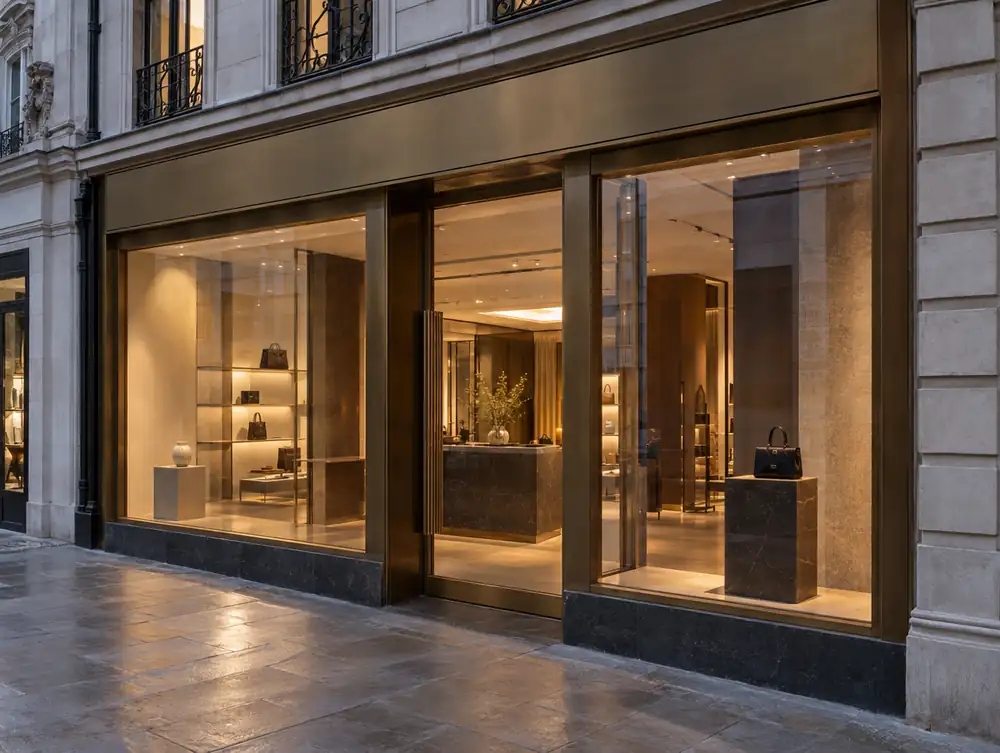
How should you approach bronze and metal shopfronts in Gwent?
Two metals can share one front if the plan is clear. For premises in Gwent we'd often pair a dark bronze frame with brass handles or lettering, keeping each metal to its own job so the eye reads one idea.
Salt air changes the specification. If your premises in Gwent sit near the coast, we'd look at grade 316 stainless fixings, tighter isolation between metals and a shorter care cycle for any live finish.
What consents apply to bronze and metal shopfronts in Gwent?
Going by Part 42 of the 1995 Order as inserted in 2014, Wales has no permitted development route for changing a shopfront. The right covers A1 and A2 premises, but it excludes creating, altering or replacing a shopfront, or fitting or replacing a security grill or shutter on one, and it doesn't apply on Article 1(5) land. For bronze and metal shopfronts at premises in the Gwent area, that leaves a planning application, or work that leaves the appearance materially unchanged.
How much do bronze and metal shopfronts cost in Gwent?
As a working budget, use £7,995 to £24,995 plus VAT for a typical frontage. Your place inside that range for bronze and metal shopfronts depends mostly on how much of the existing frontage can stay and how much has to be put right first.
| Area | Gwent |
|---|---|
| Nation | Wales |
| Towns covered | 17 |
| Main town | Newport |
| Planning regime | Wales: TCPA 1990 and the 1992 Advertisement Regulations |
| Building approval | Building Regulations (Approved Documents for Wales) |
| Survey | Free for new work, from our Great Barr base |
Does Blaenau Gwent County Borough Council publish shopfront guidance?
Yes, Shopfronts and Advertisements Supplementary Planning Guidance (2015). It tells applicants what the council expects from new and altered shopfronts. A few of the things it asks for:
- Solid metal shutters are not acceptable, while lattice or brick-bond grilles with housing hidden behind the fascia are more likely to be accepted.
- Shutter housing must be at least 2.1m above ground, and locks and guides must not encroach on the highway.
- Reinstating a stallriser is desirable where one has previously been removed.
Questions about bronze and metal shopfronts in Gwent
How long does a metal front take for sites in Gwent?
Making typically takes 8 to 14 weeks from approval, and fitting 3 to 7 days. Finish approval tends to be the stage that sets the pace.
Who cleans a bronze shopfront in Gwent?
Your window cleaner can look after the glass, while the metal needs someone briefed on the finish. A short care note and a yearly check keep the two from getting mixed up.
Can you fit a metal front around trading in Gwent?
Yes, closed-day or out-of-hours fitting can be arranged. Metal skins go on last, so the dusty work is finished before any visible finish arrives.
Can a shop fire exit in the Gwent area use a sliding door?
No, a dedicated fire exit can't be a sliding or revolving door. In Wales, article 14(2) of the Regulatory Reform (Fire Safety) Order 2005 also says fire exit doors must open in the direction of escape and can't be locked against immediate use. The responsible person holds that duty, normally the employer or whoever controls the premises for a business, otherwise the owner.
Does a replacement shopfront in the Gwent area need Building Regulations approval?
Assume yes until building control says otherwise, because Wales has no like-for-like exemption. Glazing is judged against Approved Document N, as Wales keeps Part N. A registered installer can self-certify replacement windows and doors in non-dwellings, but not structural glass, curtain walling or revolving doors.