Shade over a window display protects stock as well as customers. For frontages in Carnoustie that catch the afternoon sun, a folding arm awning or shop blind can slow fading and make the interior easier to see.
Measuring the opening is the easy part of a survey in Carnoustie. We also look at the beam above, the pavement fall and any meters or drains nearby.
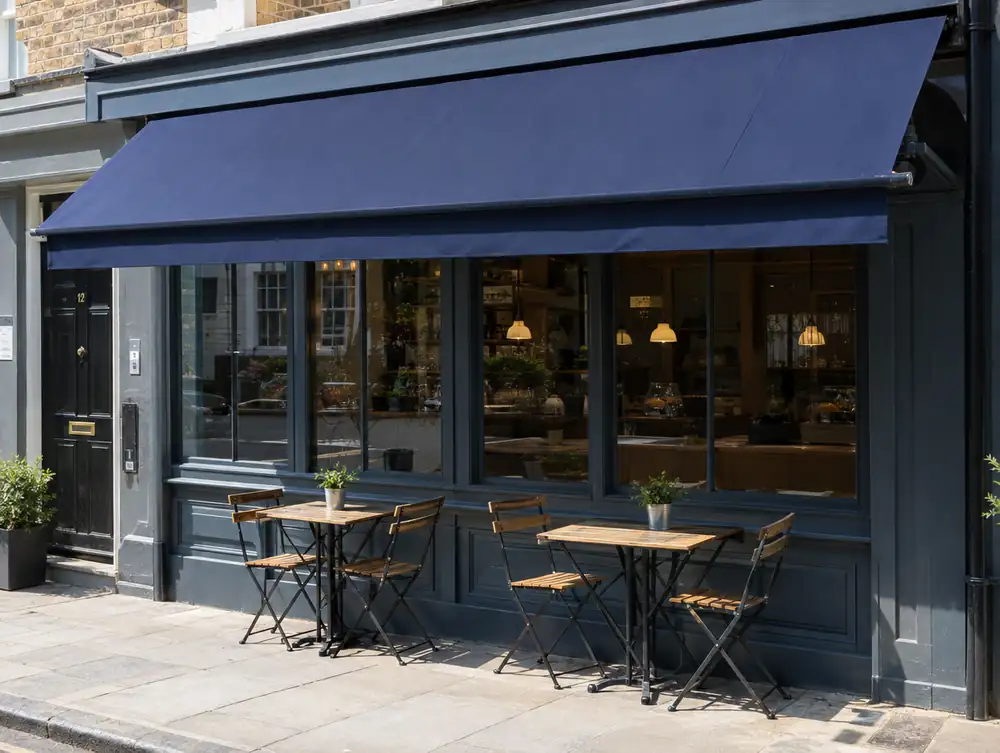
What goes into getting canopies and awnings right in Carnoustie?
Should your frontage still have an old blind box, we open it up at survey. A sound box can take a new roller and cover, and it keeps a detail worth having.
If your Carnoustie frontage faces south or west, we size the projection for the afternoon sun. A north-facing unit rarely needs shade, so a fixed canopy for shelter may be a wiser use of the budget.
If you trade after dark in Carnoustie, the view in matters more than the sign. A warm, evenly lit interior with light on the back wall will usually do more than a brighter fascia, because it gives the eye somewhere to go.
Which applications might canopies and awnings in Carnoustie involve?
Scottish guidance says like-for-like windows need no permission, and a true like-for-like frontage replacement usually follows the same logic. Class 7A covers altering or replacing an existing window, but it doesn't mention shopfronts, so ask before relying on it for a display window. For canopies and awnings at premises in the Carnoustie area, a material effect on the external appearance means planning permission, and the council confirms the position.
Class VI isn't available in Scottish conservation areas, so a lit sign there normally needs advertisement consent. Special control areas are tighter again: no Class VI, and Class IV limited to a 3.6m top height, 0.3m letters and one-twelfth of the building face. The council can say which designations cover premises in the Carnoustie area.
We confirm the position at survey, because a boundary or a special designation can change who handles the file, but applications from Carnoustie premises normally go to Angus Council.
How much could canopies and awnings in Carnoustie cost you?
Until the survey is done, plan on £1,495 to £9,995 plus VAT per canopy or awning. Unusual sizes, fine detail and phased working push the figure up, while a simple brief and clear access keep it toward the lower end.
| Town | Carnoustie |
|---|---|
| Area | Angus and Dundee |
| Postcode districts | DD7 |
| Planning authority | Angus Council |
| Building approval | Building warrant (Technical Handbook) |
| Distance from Great Barr | About 275 miles |
| Survey | Free for new work |
Questions about canopies and awnings in Carnoustie
Can the awning match other premises I run in Angus and Dundee?
Yes. Send a photograph and any fabric reference, and we match the cloth, valance and lettering as closely as current ranges allow. Fabric lines change over time, so we show you a sample first.
How long will an awning last on Carnoustie premises?
A good frame typically lasts 15 years or more, and acrylic canvas typically lasts 7 to 10 years. Regular cleaning and retracting in high wind make the biggest difference.
Will an awning hide the sign on my Carnoustie premises?
It should not, if it is designed properly. We place the box and valance so the name reads with the cover out, or we add lettering to the valance.
Does a shop sign in the Carnoustie area need advertisement consent?
Not always. Scotland's 1984 Regulations let an unlit sign within Class IV(1) go up without an application, and Class VI does the same for a lit sign with each character lit from within. Class VI isn't available in conservation areas, and one council says lit signs always need express consent, so ask first.
Do roller shutters need planning permission in the Carnoustie area?
Usually yes, if they materially affect the external appearance. Class 9A doesn't name shutters, so in Scotland treat them as falling to the appearance test rather than assuming a permitted development route. Ask the council before ordering, as this is a reading of the rules and not an official statement.