A well-chosen awning gives Arbroath premises shade, shelter and a stronger presence, then folds away when the weather turns. Projection, headroom and fixings are settled before anyone chooses a fabric.
Bring whatever you have to the survey in Arbroath: brand guidelines, lease plans, old drawings or a photo of a frontage you admire.
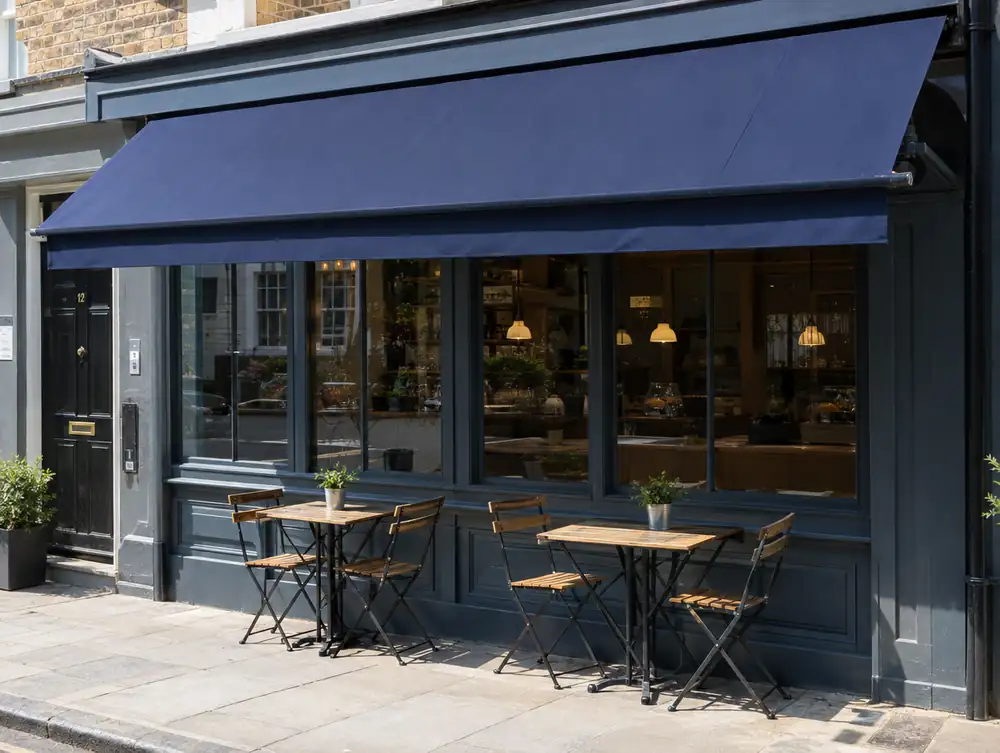
Where should you begin with canopies and awnings in Arbroath?
Where your sign sits on the fascia, the awning box goes above or below it without covering the name. If that cannot be done, we letter the valance so people can still read who you are.
If your Arbroath frontage faces south or west, we size the projection for the afternoon sun. A north-facing unit rarely needs shade, so a fixed canopy for shelter may be a wiser use of the budget.
On a north-facing frontage the glass stays free of glare, but the interior can look dim from the street, so lighting needs to sit closer to the window. If your Arbroath premises face south, the problem flips to reflections by day and fading stock.
What price should you expect for canopies and awnings in Arbroath?
Guide price: £1,495 to £9,995 plus VAT per canopy or awning. Materials, finish and the amount of drawing and coordination involved all move it, and your itemised quotation shows where the money goes on canopies and awnings.
What sign-off might you need for canopies and awnings in Arbroath?
Class 9A, Scotland's shop permitted development right, gives no route for a shopfront change. It covers Class 1A premises, but not work that alters or extends beyond the existing front, and it doesn't apply in conservation areas, National Parks or World Heritage Sites. For canopies and awnings at premises in the Arbroath area, that generally means a planning application unless the external appearance isn't materially affected.
Class VI is the class for lit signs in Scotland, and it is tightly drawn: each character lit from within, the sign at least 2.5m up, no more than 0.25m of projection, and static lighting. One Scottish council says illuminated signs always need express consent, which doesn't match Class VI, so ask the council for the Arbroath area before ordering.
Arbroath applications for planning permission or advertisement consent are normally handled by Angus Council. Our survey includes a check of the position for your address.
| Town | Arbroath |
|---|---|
| Area | Angus and Dundee |
| Postcode districts | DD11 |
| Planning authority | Angus Council |
| Building approval | Building warrant (Technical Handbook) |
| Distance from Great Barr | About 279 miles |
| Survey | Free for new work |
Questions about canopies and awnings in Arbroath
Will an awning hide the sign on my Arbroath premises?
It should not, if it is designed properly. We place the box and valance so the name reads with the cover out, or we add lettering to the valance.
Can the awning match other premises I run in Angus and Dundee?
Yes. Send a photograph and any fabric reference, and we match the cloth, valance and lettering as closely as current ranges allow. Fabric lines change over time, so we show you a sample first.
Can an awning in Arbroath be motorised?
Yes, most can. A tubular motor sits inside the roller, with a remote or wall switch, and a wind sensor can be added. You will need a power supply near the box, which we check at survey.
Do I need planning permission to alter a shopfront in the Arbroath area?
Usually yes, if the work materially affects the external appearance. Class 9A, Scotland's shop permitted development right, doesn't cover work that alters or extends beyond the existing front. A true like-for-like replacement usually needs no permission, and the council confirms the position.
Which way must a fire exit door open on a shop in the Arbroath area?
In the direction of escape. Regulation 13(2) of the Fire Safety (Scotland) Regulations 2006 also rules out sliding and revolving doors on a dedicated fire exit and says fire exit doors can't be locked against immediate use. Duties sit with dutyholders under Part 3 of the Fire (Scotland) Act 2005, meaning the employer and any person with control of the premises.