Fixed canopies give Cupar entrances year-round shelter, in steel, fabric or glass. We design the frame around the structure behind it, so it looks part of the frontage.
It helps if you can be there when we visit Cupar, since five minutes walking the frontage together answers more than a long email.
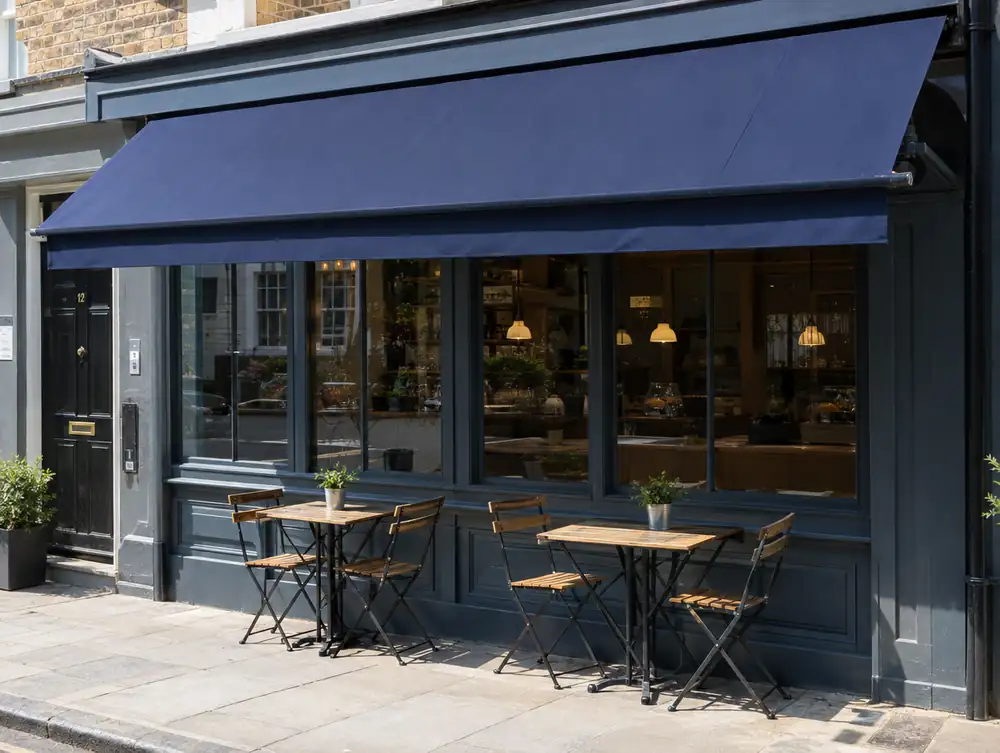
What makes canopies and awnings work well on Cupar premises?
If your Cupar premises sell food from the front, we would avoid a strong fabric colour that tints the display. Neutral or striped canvas keeps produce looking natural.
Should your frontage still have an old blind box, we open it up at survey. A sound box can take a new roller and cover, and it keeps a detail worth having.
Where the footway outside your Cupar premises is narrow, a recessed entrance earns its keep. It gives people a dry place to pause out of the walkway, and it adds a longer run of display glass either side of the door.
How much should you set aside for canopies and awnings in Cupar?
We would budget £1,495 to £9,995 plus VAT per canopy or awning. Scope sets most of the figure, so a clear brief at the start does more for the budget than any later change of detail.
Could canopies and awnings in Cupar need planning permission?
Shutters aren't named in Class 9A, so in Scotland they usually fall to the appearance test. The same goes for canopies and awnings at premises in the Cupar area: building work that materially affects the external appearance needs planning permission, and a true like-for-like usually doesn't. Ask the council to confirm the position for your site.
Signs in Scotland come under the 1984 Advertisement Regulations, which have their own class numbers. At premises in the Cupar area, an unlit fascia sign generally needs no application under Class IV(1) of Schedule 4 if it sits on a wall containing a shop window, tops out at 4.6m or first-floor level, and keeps letters to 0.75m high. Anything beyond that needs advertisement consent, and displaying a sign without consent is a criminal offence.
Planning and advert applications for Cupar premises normally go to Fife Council. We check the position for your address at survey.
| Town | Cupar |
|---|---|
| Area | Fife |
| Postcode districts | KY15 |
| Planning authority | Fife Council |
| Building approval | Building warrant (Technical Handbook) |
| Distance from Great Barr | About 264 miles |
| Survey | Free for new work |
Does Fife Council publish shopfront guidance?
Yes, Shop Front Design Guidelines (2016). It tells applicants what the council expects from new and altered shopfronts. A few of the things it asks for:
- Solid security shutters are discouraged, and shutter boxes may not project in front of the shop front.
- Internal lattice shutters and reinforced laminated glass are encouraged in town centres, with demountable mesh grilles preferred on traditional shop fronts.
- Each shop normally gets one fascia sign and one projecting sign, and only one of them may be lit.
Questions about canopies and awnings in Cupar
Will an awning or canopy be measured before I get a price in Cupar?
Yes. Every price comes from a measure-up, because wall construction and pavement width affect the design. You then receive an itemised quotation, valid for 90 days.
Will an awning hide the sign on my Cupar premises?
It should not, if it is designed properly. We place the box and valance so the name reads with the cover out, or we add lettering to the valance.
How long will an awning last on Cupar premises?
A good frame typically lasts 15 years or more, and acrylic canvas typically lasts 7 to 10 years. Regular cleaning and retracting in high wind make the biggest difference.
Do I need listed building consent for a shopfront in the Cupar area?
Almost certainly, if the building is listed and windows or doors are changing, according to Historic Environment Scotland. The planning authority decides, and Historic Environment Scotland is consulted on some applications. Scottish Ministers are notified if it objects.
Do roller shutters need planning permission in the Cupar area?
Usually yes, if they materially affect the external appearance. Class 9A doesn't name shutters, so in Scotland treat them as falling to the appearance test rather than assuming a permitted development route. Ask the council before ordering, as this is a reading of the rules and not an official statement.